
Moraceae
Fig/Mulberry family
The mulberry and fig family, including the ecologically crucial figs (Ficus) that feed hundreds of frugivore species. Characterised by milky latex and inconspicuous flowers concealed inside a fleshy receptacle (syconium in figs). Also includes breadfruit (Artocarpus) and mulberry (Morus).
Browse all 52 species ↓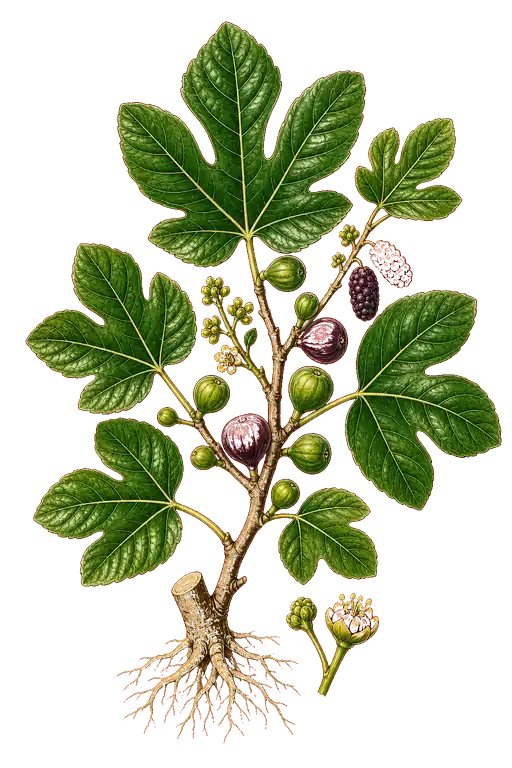
Alternate leaves and milky latex sap, with tiny flowers crowded onto a fleshy receptacle that swells into a fig- or mulberry-like compound fruit.
Includes the banyan and peepal figs, where the true flowers are hidden entirely inside the swollen receptacle rather than displayed openly.
Which Moraceae species is this?
Answer what you can see and narrow it down to a single Moraceae species.
How to recognise the Moraceae family
- 01
Milky latex throughout plant
- 02
Flowers often in dense heads or enclosed fig
- 03
Syncarp or drupe fruit; important keystone trees
To check whether a plant belongs to Moraceae, compare the leaf arrangement, leaf type, flower symmetry, fruit type, and one distinctive marker together. A single feature can mislead; the family pattern is the combination.
Learn the full family-identification methodTypical leaf characters



Characters typical of the family — individual species can vary.
Typical flower & fruit
- Flower symmetryActinomorphic (radially symmetrical)
- InflorescenceCatkin
- FruitDrupe
Typical of the family — flowering plants only; species can vary.
Notable members
Families that can look similar
Rosaceae
Compare against Rosaceae when the plant shares similar leaves, flowers, or fruit. Confirm by checking the full family pattern.
Compare RosaceaeLauraceae
Compare against Lauraceae when the plant shares similar leaves, flowers, or fruit. Confirm by checking the full family pattern.
Compare LauraceaeRhamnaceae
Compare against Rhamnaceae when the plant shares similar leaves, flowers, or fruit. Confirm by checking the full family pattern.
Compare RhamnaceaeUlmaceae
Compare against Ulmaceae when the plant shares similar leaves, flowers, or fruit. Confirm by checking the full family pattern.
Compare UlmaceaeAll 52 species in MORACEAE
- Sack Tree, Upas TreeAntiaris toxicaria
- BreadfruitArtocarpus altilis
- Jack Fruit TreeArtocarpus heterophyllus
- Wild Jack Tree, Aini, Hirsute ArtocarpusArtocarpus hirsutus
- Silver-Back ArtocarpusArtocarpus hypargyreus
- Bread-Fruit TreeArtocarpus incisus
- Monkey JackArtocarpus lacucha
- Paper Mulberry, Tapacloth TreeBroussonetia papyrifera
- Indian SnakewortDorstenia indica
- Mountain FigFicus altissima
- Yellow-Barked FigFicus amplissima
- Indian Rock FigFicus arnottiana
- Elephant Ear Fig Tree, Giant Indian FigFicus auriculata
- South-Indian FigFicus beddomei
- Banyan TreeFicus benghalensis
- Banyan TreeFicus benghalensis var. krishnae
- Benjamin Tree, Java Fig, Golden Fig, Weeping Fig, Benjamin FigFicus benjamina
- Calloused FigFicus callosa
- Common Edible Fig, Edible Fig, Fig TreeFicus carica
- Floating FigFicus cyathistipula
- Mysore FigFicus drupacea var. pubescens
- Indian Rubber Tree, Assam RubberFicus elastica
- Sand Paper TreeFicus exasperata
- Creeping FigFicus heterophylla
- Crow Fig, Mad Fig, Brahma's FigFicus hispida
- Krishna FigFicus krishnae
- Fiddle-Leafed FigFicus lyrata
- Laurel Fig, Chinese Banyan, Indian LaurelFicus microcarpa
- Soft FigFicus mollis
- Mistletoe Fig, Triangle Fig, Sweetheart Tree And Natal TreeFicus natalensis subsp. leprieurii
- Veined-Leaf FigFicus nervosa
- Punjab FigFicus palmata
- Climbing Fig, Creeping FigFicus pumila
- Cluster Fig, Country Fig, Gular FigFicus racemosa
- Peepal Tree, Sacred Fig, Pipul, Sacred Bo TreeFicus religiosa
- Mock Bodh TreeFicus rumphii
- Talbot FigFicus talbotii
- Dye FigFicus tinctoria
- Dye FigFicus tinctoria subsp. gibbosa
- Karal FigFicus tsjakela
- Spotted White FigFicus virens
- White Mulberry, MulberryMorus alba
- MulberryMorus indica
- Siamese RoughbushStreblus asper
- Artocarpus gomezianus subsp. zeylanicus
- Broussonetia luzonica
- Ficus cuspidata
- Ficus dalhousiae
- Ficus laevis var. macrocarpa
- Ficus travancorica
- Plecospermum spinosum
- Streblus taxoides
Identify any Moraceae plant in seconds
Point your camera and SASYA names the species on-device — offline and private.
Download SASYA — Free