
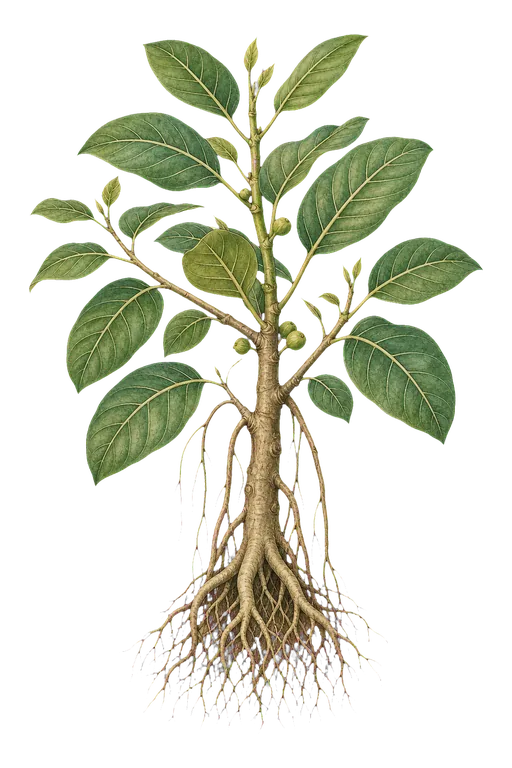
Bargad / Banyan Tree
Ficus benghalensis
- Habit
- Tree
- Found in India
- Maharashtra, Rajasthan, Telangana & more
- Flowering
- Throughout the year
How to identify Bargad
Identify Bargad by combining habit, leaf characters, flower or fruit details, location, and its family pattern. Do not rely on one feature alone.
- Look for a tree habit.
- Check the distinctive field mark: Classic banyan tree with vast canopy of prop roots.
- Confirm leaf shape: Cordate (heart-shaped).
- Confirm leaf surface: Glabrous (smooth, hairless).
- Use the leaf pattern: alternate leaf arrangement, simple leaves, entire leaf margins, pinnate venation.
- In season, compare flowering and fruiting time: Throughout the year.
- In India, compare location records such as Maharashtra, Rajasthan, Telangana, Tamil Nadu and nearby regions.
Plant Details
- Scientific name
- Ficus benghalensis
- Genus
- Ficus
- Family
- Moraceae
- Habit
- Tree
- Habitat
- Dry deciduous forests, also in the plains
- Habitat type
- Forest
- Distribution
- India, Sub Himalayan tracks, Sri Lanka, Pakistan
- Found in India
- Maharashtra, Rajasthan, Telangana, Tamil Nadu, Gujarat, Karnataka, Andhra Pradesh, West Bengal, Bihar, Uttar Pradesh, Madhya Pradesh, Delhi, Kerala, Odisha, Chhattisgarh, Uttarakhand, Goa, Himachal Pradesh, Puducherry, Assam, Chandigarh, Daman & Diu, Haryana, Jharkhand, Punjab, Jammu & Kashmir, Tripura
- Flowering & fruiting
- Throughout the year
- Conservation status
- Not Evaluated (NE)
Leaf characters
- Leaf shape
- Cordate (heart-shaped)recorded
- Leaf surface
- Glabrous (smooth, hairless)recorded
Typical of the family
- Arrangement
- Alternate



Characters marked “recorded” are for Bargad itself; the rest are typical of the Moraceae family.
Flower & fruit characters
- Flower symmetry
- Actinomorphic (radially symmetrical)
- Inflorescence
- Catkin
- Fruit
- Drupe
Typical of the Moraceae family — flowering plants only; individual species can differ.
Local Names
- Hindi
- बरगद Bargad, वट Vat, bot,बरगद baragad
- Nepali
- बर Bar, बर
- Bengali
- বট গাছ Bot-Gacha
- Tamil
- ஆல் Aal, அன்னபம் Annapam, அவரோகி Avaroki, ஆலமரம்
- Telugu
- బహుపాదము Bahu-Padamu, భాండీరము Bhandiramu, మర్రి Marri, మర్రి చెట్టు
- Kannada
- ಆಲದಮರ Aaladamara, ಗೋಳಿದಮರ Golidamara, ವಟ Vata
- Malayalam
- പേരാൽ Peraal
- Marathi
- वड Vad, वट Vat, वड
- Sanskrit
- वटवृक्षः
- Gujarati
- વડ
- Punjabi
- ਬੋਹੜ
- Assamese
- বট
- Sinhala
- නුග
Bargad in India
The banyan is India's national tree and the great shade tree of village life — बरगद Bargad (Hindi), ஆல் Aal (Tamil), బహుపాదము Bahu-Padamu (Telugu), ಆಲದಮರ Aaladamara (Kannada), പേരാൽ Peraal (Malayalam), वड Vad (Marathi). Ficus benghalensis is recorded across Maharashtra, Rajasthan, Telangana, Tamil Nadu, Gujarat, Andhra Pradesh, often as huge, centuries-old trees at crossroads, temples and chaupals.
Uses
Banyans anchor village social life, shading meeting places, markets and temples, and are venerated in several traditions. Bark and aerial roots appear in attributed folk remedies. Ecologically the figs feed birds, bats and monkeys through much of the year.
How to Identify Bargad
Unmistakable once mature: woody aerial roots drop from the branches and thicken into pillar-like trunks, letting one tree spread over a huge area. The leaves are large, leathery and oval, and the small round figs sit close to the stem, ripening red.
Frequently Asked Questions
- What is Banyan Tree called in different Indian languages?
- बरगद Bargad (Hindi); ஆல் Aal (Tamil); బహుపాదము Bahu-Padamu (Telugu); ಆಲದಮರ Aaladamara (Kannada); പേരാൽ Peraal (Malayalam); वड Vad (Marathi); বট গাছ Bot-Gacha (Bengali); વડ (Gujarati); ਬੋਹੜ (Punjabi); वटवृक्षः (Sanskrit).
- Why does a banyan tree have so many trunks?
- Its hanging aerial roots reach the ground and thicken into new prop trunks, so a single banyan can spread outward for decades and look like a small grove.
- What is the difference between banyan and peepal?
- Banyan (Ficus benghalensis) has thick oval leaves and prop roots; peepal (Ficus religiosa) has heart-shaped leaves with a long drip-tip and no curtain of aerial roots.
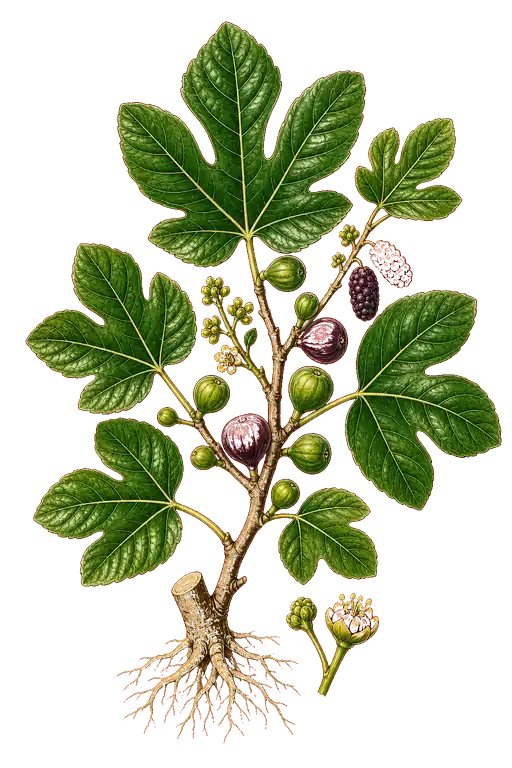
Moraceae
Fig/Mulberry family
Bargad belongs to the Moraceae family.
The illustration represents the family — not necessarily this exact species.
Explore the Moraceae familySnap it. Know it.
Point your camera at Bargad or any plant and SASYA identifies it instantly — on-device, offline, and private.
Common plant problems
If you are starting from symptoms instead of a diagnosis, use the plant disease symptom checker to narrow the cause before treating.
All plant problem & care guidesMore in Moraceae
View all MoraceaeSources: GBIF — Ficus benghalensis (India distribution & vernacular names) (CC BY 4.0) · iNaturalist — Ficus benghalensis (regional names, India observations) (CC BY 4.0) · Wikipedia — Ficus benghalensis (background/comprehension only) (CC BY-SA 4.0)