
Anjeer / Common Edible Fig
Ficus carica
Also known as Edible Fig, Fig Tree
- Habit
- Tree
- Found in India
- Maharashtra, Rajasthan, Jammu & Kashmir & more
- Flowering
- Throughout the year
How to identify Anjeer
Identify Anjeer by combining habit, leaf characters, flower or fruit details, location, and its family pattern. Do not rely on one feature alone.
- Look for a tree habit.
- Check the distinctive field mark: Sweet edible fig fruit, deeply palmate leaves.
- Confirm leaf shape: Deeply lobed (like a hand).
- Confirm leaf margin: Lobed.
- In season, compare flowering and fruiting time: Throughout the year.
- In India, compare location records such as Maharashtra, Rajasthan, Jammu & Kashmir, Himachal Pradesh and nearby regions.
- Confirm it sits within the Moraceae family pattern, then compare close relatives before deciding it is Anjeer.
Plant Details
- Scientific name
- Ficus carica
- Genus
- Ficus
- Family
- Moraceae
- Habit
- Tree
- Native to
- Mediterranean region
- Distribution
- Asia, Australia, East Medetterranean, North Africa, South Europe and USA
- Found in India
- Maharashtra, Rajasthan, Jammu & Kashmir, Himachal Pradesh, Telangana, Gujarat, Andhra Pradesh, Uttar Pradesh, Bihar, Karnataka, Uttarakhand, West Bengal
- Flowering & fruiting
- Throughout the year
Leaf characters
- Leaf shape
- Deeply lobed (like a hand)recorded
- Leaf margin
- LobedrecordedThe edge is divided into rounded or pointed sections that don't reach the midrib.“Its fragrant leaves are some 20 cm (8 in) long and 14 cm (5+1⁄2 in) wide, rough, and deeply lobed (three or five lobes).” — Wikipedia, CC BY-SA 4.0
- Leaf surface
- HirsuterecordedCovered in coarse, stiff, bristly hairs.“Its fragrant leaves are some 20 cm (8 in) long and 14 cm (5+1⁄2 in) wide, rough, and deeply lobed (three or five lobes).” — Wikipedia, CC BY-SA 4.0

Typical of the family
- Arrangement
- Alternate


Characters marked “recorded” are for Anjeer itself; the rest are typical of the Moraceae family.
Flower & fruit characters
- Flower symmetry
- Actinomorphic (radially symmetrical)
- Inflorescence
- Catkin
- Fruit
- Drupe
Typical of the Moraceae family — flowering plants only; individual species can differ.
Local Names
- Hindi
- अंजीर Anjeer, anjir,अंजीर anjir
- Bengali
- আঞ্জির
- Tamil
- Simaiyatti, அத்தி, அத்திப்பழம்
- Telugu
- అంజూరం, అంజూరము, మంచి మేడి
- Kannada
- ಅಂಜೂರ Anjura ಸೀಮೆಅತ್ತಿ Seeme atthi, ಅಂಜೂರ
- Malayalam
- അത്തി, Common fig, Ficus carica
- Marathi
- अंजीर Anjeer, अंजीर, फायकस कॅरिका
- Sinhala
- අත්තික්කා, දිඹුල්
About Anjeer
Common Edible Fig (Ficus carica) belongs to the Moraceae family, where it grows as a tree. In India it has been recorded in Maharashtra, Rajasthan, Jammu & Kashmir and 9 other states. It flowers and fruits through much of the year.
Uses
Locally it is grown for parts that are eaten, cut for timber and furniture and planted as an ornamental. Parts of this plant are reported as poisonous — treat it as unsafe to eat and wash your hands after handling.
In culture
It is used as an official or regional emblem and carries a body of folklore around it.
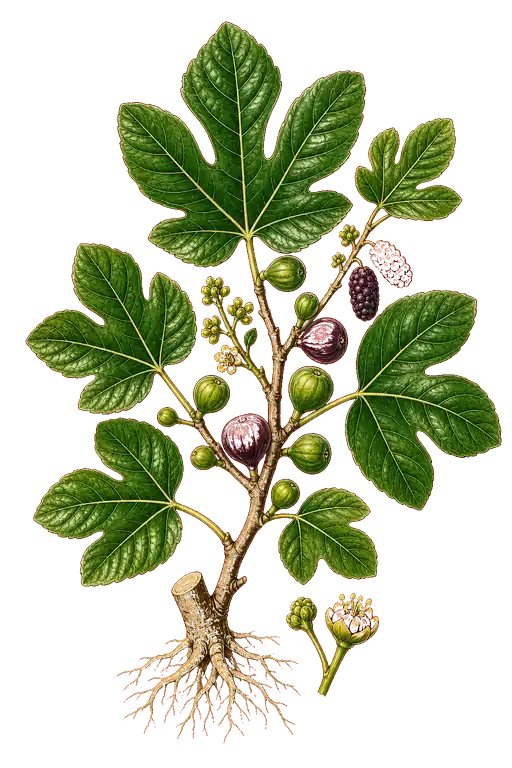
Moraceae
Fig/Mulberry family
Anjeer belongs to the Moraceae family.
The illustration represents the family — not necessarily this exact species.
Explore the Moraceae familySnap it. Know it.
Point your camera at Anjeer or any plant and SASYA identifies it instantly — on-device, offline, and private.
Common plant problems
If you are starting from symptoms instead of a diagnosis, use the plant disease symptom checker to narrow the cause before treating.
All plant problem & care guides