
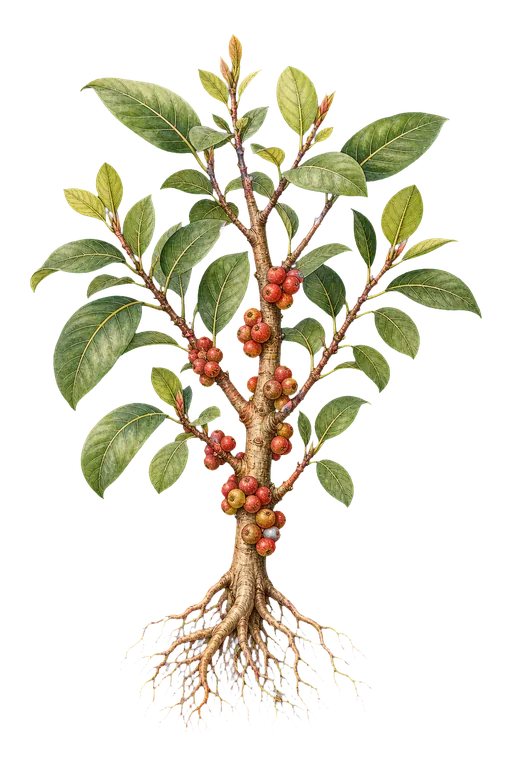
Goolar / Cluster Fig
Ficus racemosa
Also known as Country Fig, Gular Fig
- Habit
- Tree
- Found in India
- Maharashtra, Karnataka, Telangana & more
- Flowering
- Throughout the year
How to identify Goolar
Identify Goolar by combining habit, leaf characters, flower or fruit details, location, and its family pattern. Do not rely on one feature alone.
- Look for a tree habit.
- Check the distinctive field mark: Reddish figs in thick clusters directly on trunk (cluster fig).
- Confirm leaf arrangement: Alternate.
- Confirm leaf type: Simple.
- Confirm fruit type: Achene.
- Use the leaf pattern: alternate leaf arrangement, simple leaves, entire leaf margins, pinnate venation.
- In season, compare flowering and fruiting time: Throughout the year.
Plant Details
- Scientific name
- Ficus racemosa
- Genus
- Ficus
- Family
- Moraceae
- Habit
- Tree
- Habitat
- Semi-evergreen and deciduous forests, also in the plains
- Habitat type
- Forest
- Distribution
- India, Sri Lanka, Pakistan, China to New Guinea, Australia
- Found in India
- Maharashtra, Karnataka, Telangana, Tamil Nadu, Rajasthan, Kerala, Gujarat, Andhra Pradesh, Madhya Pradesh, Chhattisgarh, Uttar Pradesh, Delhi, Uttarakhand, Bihar, Goa, West Bengal, Assam, Odisha, Punjab, Puducherry, Haryana, Himachal Pradesh, Sikkim, Arunachal Pradesh, Jammu & Kashmir, Jharkhand, Manipur, Meghalaya, Mizoram, Nagaland, Tripura
- Flowering & fruiting
- Throughout the year
- Conservation status
- Not Evaluated (NE)
Leaf characters
- Leaf arrangement
- AlternaterecordedOne leaf per node, arranged in a spiral or zigzag up the stem.“The leaves of the cluster fig are simple and alternate, with lanceolate stipules measuring 1–2 centimetres (0.39–0.79 in) in length that are pubescent and often persistent on young” — Wikipedia, CC BY-SA 4.0
- Leaf type
- SimplerecordedA single, undivided leaf blade.“The leaves of the cluster fig are simple and alternate, with lanceolate stipules measuring 1–2 centimetres (0.39–0.79 in) in length that are pubescent and often persistent on young” — Wikipedia, CC BY-SA 4.0
- Leaf shape
- LanceolaterecordedLong and narrow, tapering to a point, like a lance head.“The leaves of the cluster fig are simple and alternate, with lanceolate stipules measuring 1–2 centimetres (0.39–0.79 in) in length that are pubescent and often persistent on young” — Wikipedia, CC BY-SA 4.0
- Leaf surface
- PubescentrecordedCovered in short, soft hairs.“The leaves of the cluster fig are simple and alternate, with lanceolate stipules measuring 1–2 centimetres (0.39–0.79 in) in length that are pubescent and often persistent on young” — Wikipedia, CC BY-SA 4.0

Typical of the family


Characters marked “recorded” are for Goolar itself; the rest are typical of the Moraceae family.
Flower & fruit characters
- Fruit type
- AchenerecordedA small, dry, single-seeded fruit that does not split open.“The mature syconium measures about 3 centimetres (1.2 in) in diameter and turns orange or dark crimson when ripe, containing granulate achenes.” — Wikipedia, CC BY-SA 4.0
Typical of the family
- Flower symmetry
- Actinomorphic (radially symmetrical)
- Inflorescence
- Catkin
- Fruit
- Drupe
Characters marked “recorded” are for Goolar itself; the rest are typical of the Moraceae family — flowering plants only.
Local Names
- Hindi
- गूलर Goolar,गूलर gular,उडुंबर udumbar
- Nepali
- गुलर Gular, डुम्री Dumri, डुम्री
- Bengali
- জগডুমুর
- Tamil
- அத்தி Atti, அத்தி
- Telugu
- Paidi, మేడి, అత్తి
- Kannada
- ಅತ್ತಿ Atti, ರುಮಡಿ Rumadi, ಅತ್ತಿಮರ
- Malayalam
- Atti, അത്തി
- Marathi
- Umber, उंबर, औदुंबर वृक्ष
- Sanskrit
- Udumbara
- Gujarati
- ઉંબરો
Goolar in India
The cluster fig, or gular, is a familiar riverbank and village tree across India — गूलर Goolar (Hindi), அத்தி Atti (Tamil), Paidi (Telugu), ಅತ್ತಿ Atti (Kannada), Atti (Malayalam), Umber (Marathi). Ficus racemosa is recorded throughout Maharashtra, Karnataka, Telangana, Tamil Nadu, Rajasthan, Kerala, often near water, and is the sacred udumbara of Indian tradition.
Uses
Unusually, its figs grow in dense clusters straight from the trunk and branches. The ripe figs are eaten and fed to livestock, and the bark and fruit have long-standing attributed uses in Ayurveda. The tree is revered in Hindu and Buddhist tradition.
How to Identify Goolar
A medium to large fig with a spreading crown and smooth greenish-grey bark. Its hallmark is cauliflory — rounded figs borne in bunches directly on the trunk and older branches rather than among the leaves, ripening orange-red. Like all figs it bleeds milky latex when cut.
Frequently Asked Questions
- What is Cluster Fig called in different Indian languages?
- गूलर Goolar (Hindi); அத்தி Atti (Tamil); Paidi (Telugu); ಅತ್ತಿ Atti (Kannada); Atti (Malayalam); Umber (Marathi); জগডুমুর (Bengali); ઉંબરો (Gujarati); Udumbara (Sanskrit).
- Where do cluster figs grow on the tree?
- Uniquely, the figs sprout in clusters directly from the trunk and main branches (cauliflory), not among the leaves — which is how the tree gets its name.
- Is gular fruit edible?
- Yes, the ripe figs are eaten and widely used as fodder, and the tree has attributed uses in Ayurveda — described for information, not medical advice.
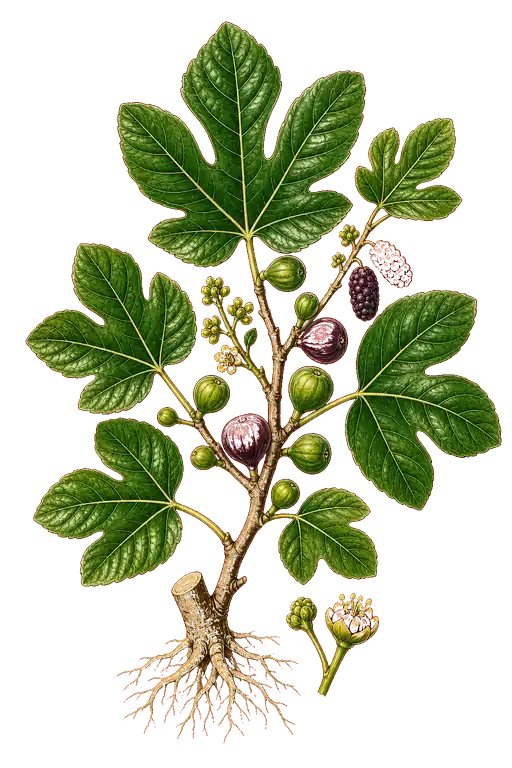
Moraceae
Fig/Mulberry family
Goolar belongs to the Moraceae family.
The illustration represents the family — not necessarily this exact species.
Explore the Moraceae familySnap it. Know it.
Point your camera at Goolar or any plant and SASYA identifies it instantly — on-device, offline, and private.
Common plant problems
If you are starting from symptoms instead of a diagnosis, use the plant disease symptom checker to narrow the cause before treating.
All plant problem & care guidesMore in Moraceae
View all MoraceaeSources: GBIF — Ficus racemosa (India distribution & vernacular names) (CC BY 4.0) · iNaturalist — Ficus racemosa (regional names, India observations) (CC BY 4.0) · Wikipedia — Ficus racemosa (background/comprehension only) (CC BY-SA 4.0)