
Phagoora / Elephant Ear Fig Tree
Ficus auriculata
Also known as Giant Indian Fig
- Habit
- Tree
- Found in India
- Kerala, Karnataka, Tamil Nadu & more
- Flowering
- October-May
How to identify Phagoora
Identify Phagoora by combining habit, leaf characters, flower or fruit details, location, and its family pattern. Do not rely on one feature alone.
- Look for a tree habit.
- Check the distinctive field mark: Huge rounded leaves (elephant ear fig).
- Confirm leaf arrangement: Alternate.
- Confirm leaf shape: Cordate.
- In season, compare flowering and fruiting time: October-May.
- In India, compare location records such as Kerala, Karnataka, Tamil Nadu, West Bengal and nearby regions.
- Confirm it sits within the Moraceae family pattern, then compare close relatives before deciding it is Phagoora.
Plant Details
- Scientific name
- Ficus auriculata
- Genus
- Ficus
- Family
- Moraceae
- Habit
- Tree
- Habitat
- Near streams, also cultivated
- Habitat type
- Wetland, Cultivated
- Distribution
- India, Himalayas, Bhutan, Myanmar, Bangladesh, China, Japan, Malesia
- Found in India
- Kerala, Karnataka, Tamil Nadu, West Bengal, Arunachal Pradesh, Sikkim, Maharashtra, Meghalaya, Uttarakhand, Assam, Punjab, Himachal Pradesh, Mizoram, Odisha, Delhi, Telangana, Chandigarh, Goa, Haryana, Jammu & Kashmir, Madhya Pradesh, Tripura
- Flowering & fruiting
- October-May
- Conservation status
- Not Evaluated (NE)
Leaf characters
- Leaf arrangement
- AlternaterecordedOne leaf per node, arranged in a spiral or zigzag up the stem.“The leaves are alternate, big and round, and are up to 44 cm (17 in) long and 45 cm (18 in) wide, with cordate or rounded base, acute apex, and 5–7 main veins from the leaf base.” — Wikipedia, CC BY-SA 4.0
- Leaf shape
- CordaterecordedHeart-shaped, with a notch at the base.“The leaves are alternate, big and round, and are up to 44 cm (17 in) long and 45 cm (18 in) wide, with cordate or rounded base, acute apex, and 5–7 main veins from the leaf base.” — Wikipedia, CC BY-SA 4.0
- Leaf surface
- Hirsute (coarsely hairy)recorded
Typical of the family



Characters marked “recorded” are for Phagoora itself; the rest are typical of the Moraceae family.
Flower & fruit characters
- Flower symmetry
- Actinomorphic (radially symmetrical)
- Inflorescence
- Catkin
- Fruit
- Drupe
Typical of the Moraceae family — flowering plants only; individual species can differ.
Local Names
- Hindi
- फागूड़ा Phagoora, तिमला Timla, tirmal, tunla
- Nepali
- तिमिला Timilaa निमारो Nimaaro, अँजीर Anjeer
- Bengali
- ডুমুর Doomoor
- Tamil
- யானை காது அத்தி Yanai Katu Atti
- Telugu
- రాచ బొడ్ Racha Bodda
- Kannada
- ಅಂಜೂರ Anjoora, ಸೀಮೆ ಅತ್ತಿ Seeme Atthi
- Malayalam
- ആന ചെവിയൻ അത്തി Aanachcheviyan Aththi, തൊണ്ടിപ്പഴം Thontippazham, വലിയ അത്തി Valiya Aththi, വലിയ അത്തി
- Marathi
- देशी अंजीर Deshi Anjir
About Phagoora
Elephant Ear Fig Tree (Ficus auriculata) is a tree in the Moraceae family. In India it has been recorded in Kerala, Karnataka, Tamil Nadu and 19 other states. It grows in near streams, also cultivated. Flowering and fruiting run from October to May.
Uses
In practice it is grown for parts that are eaten and harvested for fodder.
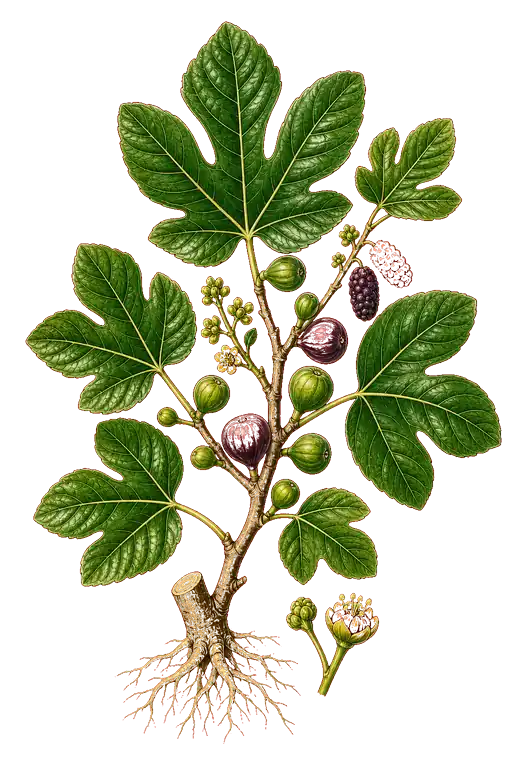
Moraceae
Fig/Mulberry family
Phagoora belongs to the Moraceae family.
The illustration represents the family — not necessarily this exact species.
Explore the Moraceae familySnap it. Know it.
Point your camera at Phagoora or any plant and SASYA identifies it instantly — on-device, offline, and private.
Common plant problems
If you are starting from symptoms instead of a diagnosis, use the plant disease symptom checker to narrow the cause before treating.
All plant problem & care guides