

Pipal / Peepal Tree
Ficus religiosa
Also known as Sacred Fig, Pipul, Sacred Bo Tree
- Habit
- Tree
- Found in India
- Telangana, Maharashtra, Tamil Nadu & more
- Flowering
- Throughout the year
How to identify Pipal
Identify Pipal by combining habit, leaf characters, flower or fruit details, location, and its family pattern. Do not rely on one feature alone.
- Look for a tree habit.
- Check the distinctive field mark: Long tapering drip-tip on heart-shaped leaf (peepal).
- Confirm leaf shape: Cordate.
- Confirm leaf surface: Glabrous (smooth, hairless).
- Use the leaf pattern: alternate leaf arrangement, simple leaves, entire leaf margins, pinnate venation.
- In season, compare flowering and fruiting time: Throughout the year.
- In India, compare location records such as Telangana, Maharashtra, Tamil Nadu, Kerala and nearby regions.
Plant Details
- Scientific name
- Ficus religiosa
- Genus
- Ficus
- Family
- Moraceae
- Habit
- Tree
- Distribution
- Himalayas, India, Pakistan, China, Yunan, Thailand, Myanmar, Malaysia
- Found in India
- Telangana, Maharashtra, Tamil Nadu, Kerala, Andhra Pradesh, Gujarat, Rajasthan, West Bengal, Karnataka, Uttar Pradesh, Delhi, Bihar, Odisha, Uttarakhand, Assam, Chhattisgarh, Madhya Pradesh, Punjab, Haryana, Puducherry, Chandigarh, Jharkhand, Goa, Sikkim, Himachal Pradesh, Tripura, Manipur, Meghalaya, Mizoram, Arunachal Pradesh, Jammu & Kashmir
- Flowering & fruiting
- Throughout the year
- Conservation status
- Not Evaluated (NE)
Leaf characters
- Leaf shape
- CordaterecordedHeart-shaped, with a notch at the base.“The leaves are cordate in shape with a distinctive extended drip tip;” — Wikipedia, CC BY-SA 4.0
- Leaf surface
- Glabrous (smooth, hairless)recorded
Typical of the family
- Arrangement
- Alternate



Characters marked “recorded” are for Pipal itself; the rest are typical of the Moraceae family.
Flower & fruit characters
- Flower symmetry
- Actinomorphic (radially symmetrical)
- Inflorescence
- Catkin
- Fruit
- Drupe
Typical of the Moraceae family — flowering plants only; individual species can differ.
Local Names
- Hindi
- अस्वत्थ Aswattha, पीपल Pipal, pipal, pipul
- Nepali
- पिपल Pipal, पिपल
- Bengali
- অশ্বত্থ Asbattha, অশ্বত্থ, পিপল
- Tamil
- அரசமரம் Araca-Maram, பிப்பலம் Pippalam, அரச மரம்
- Telugu
- పిప్పలము Pippalamu, రావీచెట్టు Ravichettu, రావి చెట్టు
- Kannada
- ಅರಳಿಮರ Aralimara, ಅಶ್ವತ್ಥಮರ Asvatthamara, ಅಶ್ವತ್ಥಮರ
- Malayalam
- അരയാൽ Arayal, പിപ്പലം Pippalam, അരയാൽ
- Marathi
- अश्वत्थ Ashwattha, पिंपळ Pimpala, पिंपळ
- Sanskrit
- Pippala
Pipal in India
The peepal or sacred fig is among the most revered trees in India — अस्वत्थ Aswattha (Hindi), அரசமரம் Araca-Maram (Tamil), పిప్పలము Pippalamu (Telugu), ಅರಳಿಮರ Aralimara (Kannada), അരയാൽ Arayal (Malayalam), अश्वत्थ Ashwattha (Marathi). Ficus religiosa is recorded across Telangana, Maharashtra, Tamil Nadu, Andhra Pradesh, Gujarat, Kerala and grows readily on its own, even sprouting from old walls and rooftops.
Uses
It is sacred in Hinduism, Buddhism and Jainism — the Bodhi tree under which the Buddha is said to have attained enlightenment is a peepal — and is commonly planted by temples and tied with sacred threads. Various parts have attributed uses in traditional medicine.
How to Identify Pipal
Best known for its leaf: glossy, heart-shaped and drawn out into a long, slender 'drip tip', so the foliage trembles in the lightest breeze. It is a large, spreading tree with small figs that ripen purple, and unlike the banyan it lacks a curtain of prop roots.
Frequently Asked Questions
- What is Peepal Tree called in different Indian languages?
- अस्वत्थ Aswattha (Hindi); அரசமரம் Araca-Maram (Tamil); పిప్పలము Pippalamu (Telugu); ಅರಳಿಮರ Aralimara (Kannada); അരയാൽ Arayal (Malayalam); अश्वत्थ Ashwattha (Marathi); অশ্বত্থ Asbattha (Bengali); Pippala (Sanskrit).
- How do I tell a peepal from a banyan?
- Peepal leaves are heart-shaped with a long tail-like tip and the tree has no prop roots; banyan leaves are thick and oval and the tree drops aerial roots that become extra trunks.
- Why does the peepal leaf always flutter?
- Its long, thin leaf-tip and flattened leaf-stalk let the leaves move in even a slight breeze, giving the tree its characteristic shimmering look.
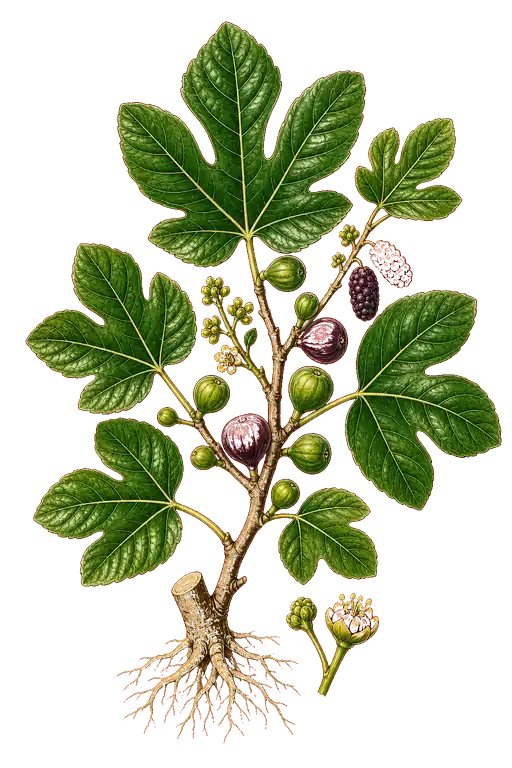
Moraceae
Fig/Mulberry family
Pipal belongs to the Moraceae family.
The illustration represents the family — not necessarily this exact species.
Explore the Moraceae familySnap it. Know it.
Point your camera at Pipal or any plant and SASYA identifies it instantly — on-device, offline, and private.
Common plant problems
If you are starting from symptoms instead of a diagnosis, use the plant disease symptom checker to narrow the cause before treating.
All plant problem & care guidesMore in Moraceae
View all MoraceaeSources: GBIF — Ficus religiosa (India distribution & vernacular names) (CC BY 4.0) · iNaturalist — Ficus religiosa (regional names, India observations) (CC BY 4.0) · Wikipedia — Ficus religiosa (background/comprehension only) (CC BY-SA 4.0)