
Rubiaceae
Coffee/Madder family
A cosmopolitan family best known for coffee (Coffea) and quinine (Cinchona). Predominantly tropical trees, shrubs, and herbs with characteristic opposite leaves and interpetiolar stipules. The family includes important medicines and dyes.
Browse all 143 species ↓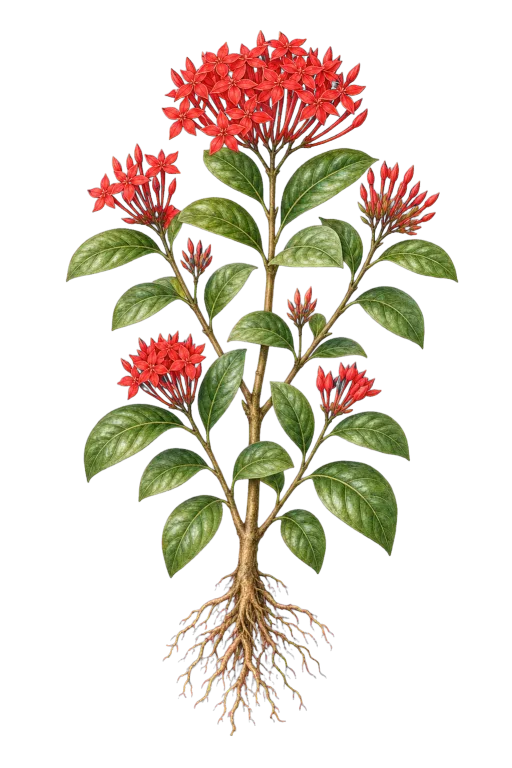
Opposite or whorled leaves with a small stipule between each pair, and 4- or 5-parted tubular flowers above an inferior ovary.
Includes coffee — the stimulant alkaloids in Coffea are typical of the family's broader tendency to accumulate bitter, alkaloid-rich compounds.
Which Rubiaceae species is this?
Answer what you can see and narrow it down to a single Rubiaceae species.
How to recognise the Rubiaceae family
- 01
Opposite leaves with interpetiolar stipules
- 02
4–5-merous tubular flowers
- 03
Includes Coffee, Gardenia, Ixora
To check whether a plant belongs to Rubiaceae, compare the leaf arrangement, leaf type, flower symmetry, fruit type, and one distinctive marker together. A single feature can mislead; the family pattern is the combination.
Learn the full family-identification methodTypical leaf characters
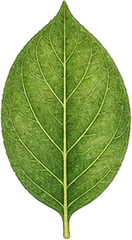
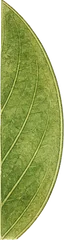
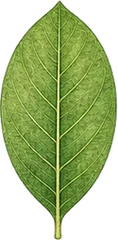
Characters typical of the family — individual species can vary.
Typical flower & fruit
- Flower symmetryActinomorphic (radially symmetrical)
- InflorescenceCyme
- FruitBerry
Typical of the family — flowering plants only; species can vary.
Notable members
Families that can look similar
Asclepiadaceae
Compare against Asclepiadaceae when the plant shares similar leaves, flowers, or fruit. Confirm by checking the full family pattern.
Compare AsclepiadaceaeApocynaceae
Compare against Apocynaceae when the plant shares similar leaves, flowers, or fruit. Confirm by checking the full family pattern.
Compare ApocynaceaeGentianaceae
Compare against Gentianaceae when the plant shares similar leaves, flowers, or fruit. Confirm by checking the full family pattern.
Compare GentianaceaeMyrtaceae
Compare against Myrtaceae when the plant shares similar leaves, flowers, or fruit. Confirm by checking the full family pattern.
Compare MyrtaceaeAll 143 species in RUBIACEAE
- HalduAdina cordifolia
- KadamAnthocephalus chinensis
- Panama RoseArachnothryx leucophylla
- South-Indian Corn-CockleArgostemma courtallense
- Basil-Like Button WeedBorreria ocymoides
- Narrow Leaved CanthiumCanthium angustifolium
- Carray Cheddle, Coromandel Canthium, Honey-Thorn, Wild JessamineCanthium parviflorum
- Emetic Nut, Common Emetic Nut, Mountain PomegranateCatunaregam spinosa
- Chassalia Curviflora Var. OphioxyloidesChassalia curviflora var. ophioxyloides
- QuinineCinchona calisaya
- Red CinchonaCinchona succirubra
- Arabian Coffee, CoffeeCoffea arabica
- Bengal CoffeeCoffea benghalensis
- Robusta CoffeeCoffea canephora
- Liberian CoffeeCoffea liberica
- Robusta CoffeeCoffea robusta
- Creeping DentellaDentella repens
- Cumbi-Gum Tree, Dekamella-Gum Gardenia, Gummy Cape JasmineGardenia gummifera
- Cape Jasmine, Bush Gardenia, Bunga CineGardenia jasminoides
- Indian BoxwoodGardenia latifolia
- Brilliant Gardenia, Gummy Gardenia, White Emetic NutGardenia resinifera
- Spinous Cape JasmineGardenia turgida
- Snake PennywortGeophila repens
- Beach GardeniaGuettarda speciosa
- HalduHaldina cordifolia
- Hummingbird Bush, Scarlet Bush, Fire BushHamelia patens
- Jointed HedyotisHedyotis articularis subsp. santapaui
- Small-Flowered KohautiaHedyotis aspera
- Blue HedyotisHedyotis cyanantha
- Purple HedyotisHedyotis purpurascens
- Kadwa SiridHymenodictyon obovatum
- Bridal Couch Tree, KuthanHymenodictyon orixense
- Small-Flowered Ixora, Torch TreeIxora arborea
- GorbaleIxora brachiata
- Red Ixora, Jungle 'Geranium', Flame Of The Woods, Sacred Ixora, Jungle Flame Ixora, Needle Flower, Sacred IxoraIxora coccinea
- Rosy IxoraIxora elongata
- White Jungle FlameIxora finlaysoniana
- Black IxoraIxora nigricans
- Large-Flower IxoraIxora notoniana
- Torch TreeIxora pavetta
- Many-Flowered IxoraIxora polyantha
- Sumatra KnoxiaKnoxia sumatrensis
- Tapering-Leaf Wool-FlowerLasianthus acuminatus
- Jack's Wool-FlowerLasianthus jackianus
- MuynaMeyna laxiflora
- Tropical Girdle PodMitracarpus villosus
- True Kadamb, Kaim, Corn Snapdragon TreeMitragyna parvifolia
- Narrow-Leaf MorindaMorinda angustifolia
- Noni Tree, Great Morinda, Indian MulberryMorinda citrifolia
- Indian MulberryMorinda coreia
- Morinda TreeMorinda pubescens
- Morinda TreeMorinda pubescens var. stenophylla
- Mapoon Bush, Yellow-DyeMorinda reticulata
- Morinda tinctoria
- Common Indian MulberryMorinda umbellata
- Red-Leaved MussaendaMussaenda erythrophylla
- SchizomussaendaMussaenda frondosa
- White FlagMussaenda glabrata
- Lanceleaf StarvioletNeanotis lancifolia
- Delta-Petal StarvioletNeanotis montholonii
- Racemose StarvioletNeanotis rheedei
- Tubeflower StarvioletNeanotis tubulosa
- Kadamb TreeNeolamarckia cadamba
- Purple Neo-CheesewoodNeonauclea purpurea
- Kerala NeurocalyxNeurocalyx calycinus
- Blue Diamond FlowerOldenlandia affinis
- Flattop Nille GrassOldenlandia corymbosa
- Cluster Flower Mille Grains, Wild CorianderOldenlandia herbacea
- PankiOldenlandia pumila
- Dye Root, Chay RootOldenlandia umbellata
- Indian Snake Root, Mongoose PlantOphiorrhiza mungos
- Wrinkled-Leaf Snake RootOphiorrhiza rugosa
- Hill Pavetta, Indian SorrelPavetta indica
- Tubeflower PavettaPavetta siphonantha
- Egyptian Starcluster, Pentas, Star Flower, Star ClusterPentas lanceolata
- Yellow MussaendaPseudomussaenda flava
- Dalzell's PsychotriaPsychotria dalzellii
- South Indian Wild CoffeePsychotria flavida
- Malabar PsychotriaPsychotria truncata
- Ceylon BoxwoodPsydrax dicoccos var. dicoccos
- Umbelled CanthiumPsydrax umbellata
- TamilnadiaRandia uliginosa
- False Ipecac, Undulated IpecacRichardia scabra
- Sweet-Smelling RondeletiaRondeletia odorata
- Indian MadderRubia cordifolia
- Indian SaprosmaSaprosma glomeratum
- Jointed ButtonweedSpermacoce articularis
- Shaggy ButtonweedSpermacoce hispida
- Oval-Leaf False-ButtonweedSpermacoce latifolia
- Pacific False ButtonweedSpermacoce mauritiana
- Shrubby False ButtonweedSpermacoce verticillata
- Forest ChampaSpermadictyon suaveolens
- Asiatic TarennaTarenna asiatica
- Mountain WendlandiaWendlandia thyrsoidea
- Benkara malabarica
- Borreria pusilla
- Canthium glabrum
- Canthium rheedei
- Canthium travancoricum
- Catunaregam rugulosa
- Diplospora singularis
- Hedyotis eualata var. agastyamalayana
- Hedyotis hirsutissima
- Hedyotis neesiana
- Hedyotis rajasekaranii
- Hedyotis shettyi
- Ixora johnsonii
- Ixora lanceolaria
- Ixora lawsonii
- Ixora monticola
- Ixora saulierei
- Ixora sivarajiana
- Knoxia wightiana
- Lasianthus capitulatus
- Lasianthus dichotomus
- Mussaenda tomentosa
- Mycetia acuminata
- Neanotis monosperma var. tirunelvelica
- Ochreinauclea missionis
- Octotropis travancorica
- Oldenlandia stocksii
- Ophiorrhiza brunonis
- Ophiorrhiza grandiflora
- Ophiorrhiza nairii
- Ophiorrhiza radicans
- Pavetta brunonis
- Pavetta crassicaulis
- Pavetta hispidula
- Pavetta zeylanica
- Psychotria adenophylla
- Psychotria anamallayana
- Psychotria elongata
- Psychotria nigra
- Psychotria nilgiriensis
- Psychotria octosulcata
- Psydrax ficiformis
- Randia brandisii
- Randia candolleana
- Randia rugulosa
- Saprosma ceylanicum
- Tarenna nilagirica
- Uncaria sessilifructus
- Wendlandia tinctoria subsp. tinctoria
Identify any Rubiaceae plant in seconds
Point your camera and SASYA names the species on-device — offline and private.
Download SASYA — Free