
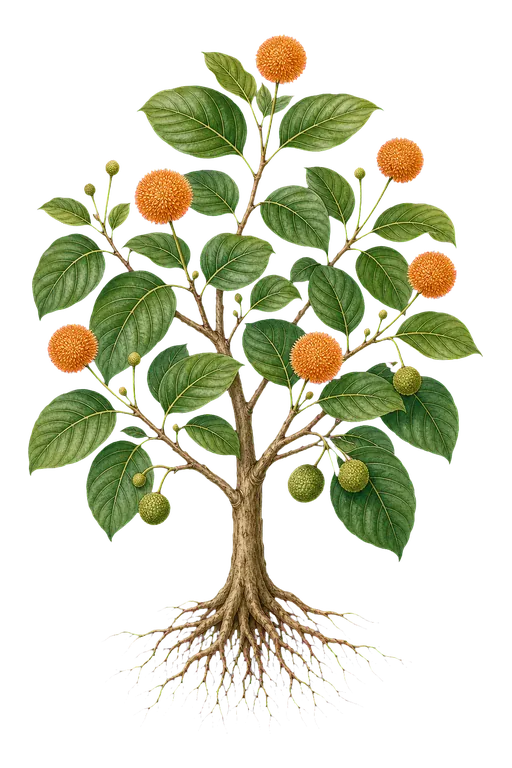
Kadamb / Kadamb Tree
Neolamarckia cadamba
- Habit
- Tree
- Found in India
- Maharashtra, Gujarat, Karnataka & more
- Flowering
- April-September
How to identify Kadamb
Identify Kadamb by combining habit, leaf characters, flower or fruit details, location, and its family pattern. Do not rely on one feature alone.
- Look for a tree habit.
- Check the distinctive field mark: Round orange-yellow ball-shaped flower heads (kadamba).
- Confirm leaf surface: Glabrous (smooth, hairless).
- Confirm flower colour: Yellow.
- Confirm fruit type: Capsule.
- Use the leaf pattern: opposite leaf arrangement, simple leaves, entire leaf margins, pinnate venation.
- In season, compare flowering and fruiting time: April-September.
Plant Details
- Scientific name
- Neolamarckia cadamba
- Genus
- Neolamarckia
- Family
- Rubiaceae
- Habit
- Tree
- Habitat
- Along banks of rivers and streams in Evergreen forests, also in the plains
- Native to
- India
- Distribution
- Asia, Pacific, Ausralia
- Found in India
- Maharashtra, Gujarat, Karnataka, Rajasthan, West Bengal, Uttar Pradesh, Telangana, Odisha, Andhra Pradesh, Bihar, Assam, Tamil Nadu, Madhya Pradesh, Kerala, Uttarakhand, Chhattisgarh, Delhi, Andaman & Nicobar Islands, Nagaland, Haryana, Punjab, Tripura, Sikkim, Jharkhand, Manipur, Puducherry
- Flowering & fruiting
- April-September
- Conservation status
- Not Evaluated (NE)
Leaf characters
- Leaf surface
- Glabrous (smooth, hairless)recorded
Typical of the family
- Arrangement
- Opposite
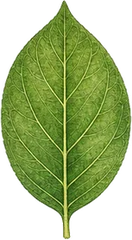


Characters marked “recorded” are for Kadamb itself; the rest are typical of the Rubiaceae family.
Flower & fruit characters
- Flower colour
- Yellowrecorded
- Fruit type
- CapsulerecordedA dry fruit from a fused ovary that splits open at maturity to release seeds.“cadamba occur in small, fleshy capsules packed closely together to form a fleshy yellow-orange infructescence containing approximately 8000 seeds.” — Wikipedia, CC BY-SA 4.0
Typical of the family
- Flower symmetry
- Actinomorphic (radially symmetrical)
- Inflorescence
- Cyme
- Fruit
- Berry
Characters marked “recorded” are for Kadamb itself; the rest are typical of the Rubiaceae family — flowering plants only.
Local Names
- Hindi
- कदम्ब Kadamb, kadam,कदम kadam,कदम्ब kadamb
- Bengali
- কদম, নীপ, সিন্ধুপুষ্প
- Tamil
- வெள்ளை கதம்பு Vellaikkatampu, கடம்பு, கடம்பு மரம்
- Telugu
- కదంబము, కదంబ, కదంబం
- Kannada
- ಕದಂಬ Kadamba, ಕಡಬೆ Kadabe, ಕಡವ Kadava, ಕದಂಬ
- Malayalam
- Katampu, കടമ്പു, ആറ്റുതേക്ക്
- Marathi
- कदंब Kadamb, कदंब, कळंब
Kadamb in India
The kadam is steeped in Indian myth, associated with Krishna and the monsoon — कदम्ब Kadamb (Hindi), வெள்ளை கதம்பு Vellaikkatampu (Tamil), కదంబము (Telugu), ಕದಂಬ Kadamba (Kannada), Katampu (Malayalam), कदंब Kadamb (Marathi). Neolamarckia cadamba is recorded across Maharashtra, Gujarat, West Bengal, Rajasthan, Karnataka, Uttar Pradesh, a fast-growing tree of moist regions.
Uses
It is grown for shade, for its fast-growing pale timber used in plywood and pulp, and as a culturally sacred tree planted near temples. The fragrant flowers are used in perfumery and worship, and parts have attributed traditional medicinal uses.
How to Identify Kadamb
A tall tree with a straight trunk and tiered, horizontal branches bearing large glossy leaves. Its signature is the flower head: a perfectly round, golden-orange ball of tiny fragrant flowers bristling with white styles, like a small pom-pom.
Frequently Asked Questions
- What is Kadamb Tree called in different Indian languages?
- कदम्ब Kadamb (Hindi); வெள்ளை கதம்பு Vellaikkatampu (Tamil); కదంబము (Telugu); ಕದಂಬ Kadamba (Kannada); Katampu (Malayalam); कदंब Kadamb (Marathi); কদম (Bengali).
- What do kadam flowers look like?
- They form a striking round, orange-yellow ball of densely packed tiny flowers with protruding styles, resembling a fragrant pom-pom.
- Why is the kadam tree important in India?
- It is culturally sacred — closely associated with Krishna and the monsoon — and is also valued for fast-growing timber and shade.
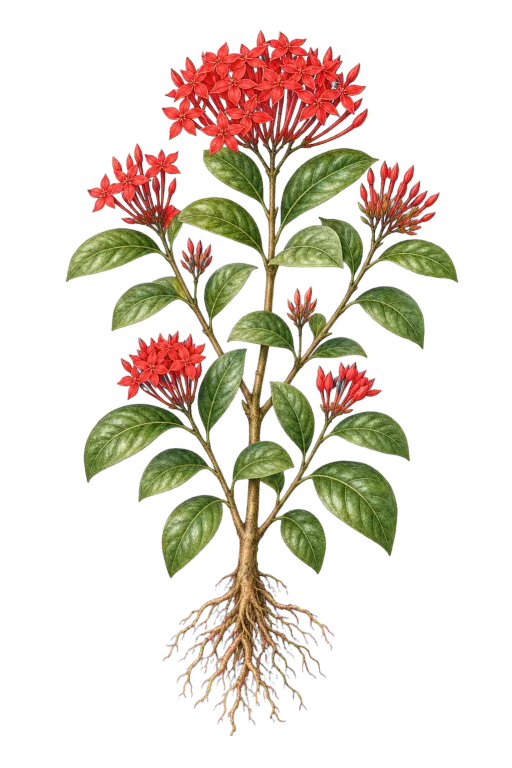
Rubiaceae
Coffee/Madder family
Kadamb belongs to the Rubiaceae family.
The illustration represents the family — not necessarily this exact species.
Explore the Rubiaceae familySnap it. Know it.
Point your camera at Kadamb or any plant and SASYA identifies it instantly — on-device, offline, and private.
Common plant problems
If you are starting from symptoms instead of a diagnosis, use the plant disease symptom checker to narrow the cause before treating.
All plant problem & care guidesMore in Rubiaceae
View all RubiaceaeSources: GBIF — Neolamarckia cadamba (India distribution & vernacular names) (CC BY 4.0) · iNaturalist — Neolamarckia cadamba (regional names, India observations) (CC BY 4.0) · Wikipedia — Neolamarckia cadamba (background/comprehension only) (CC BY-SA 4.0)