
Capparaceae
Caper Family
The caper family of trees, shrubs, and climbers characteristic of dry, arid, and rocky habitats. Capers (Capparis spinosa) are the pickled flower buds widely used in Mediterranean cuisine. Most members have 4 petals, long protruding stamens, and a gynophore (stalk below the ovary).
Browse all 31 species ↓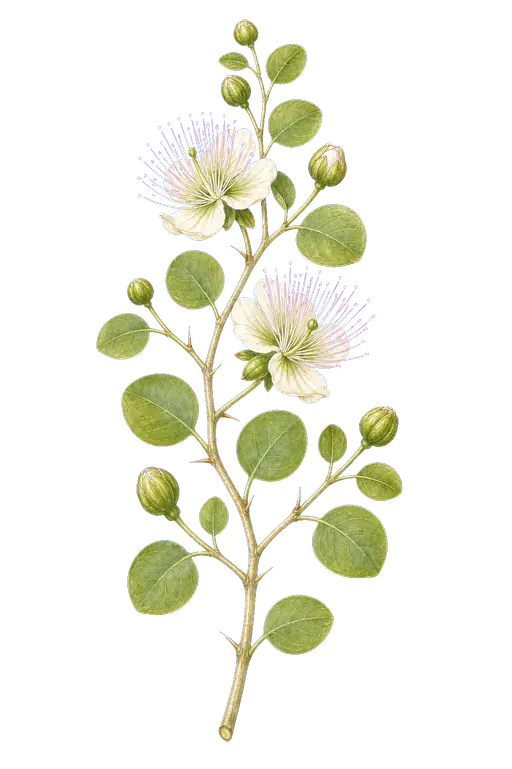
Alternate simple leaves on shrubs and trees adapted to dry, rocky habitats; flowers show four clawed petals and a ring of many long stamens that project well past the petals on a stalked ovary (gynophore), giving the flower a spidery, exploded look.
Pickled flower buds and immature fruit (capers) come from the same acrid, mustard-oil-bearing tissues found throughout the family — a chemical defence shared with its mustard-family relatives.
Which Capparaceae species is this?
Answer what you can see and narrow it down to a single Capparaceae species.
How to recognise the Capparaceae family
- 01
Long exserted stamens, conspicuous gynophore
- 02
4 petals, often with long claws
- 03
Adapted to dry, rocky, or saline habitats
To check whether a plant belongs to Capparaceae, compare the leaf arrangement, leaf type, flower symmetry, fruit type, and one distinctive marker together. A single feature can mislead; the family pattern is the combination.
Learn the full family-identification methodTypical leaf characters
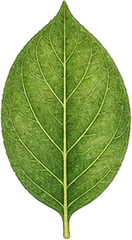


Characters typical of the family — individual species can vary.
Typical flower & fruit
- Flower symmetryActinomorphic (radially symmetrical)
- InflorescenceRaceme
- FruitCapsule
Typical of the family — flowering plants only; species can vary.
Notable members
Families that can look similar
Brassicaceae
Compare against Brassicaceae when the plant shares similar leaves, flowers, or fruit. Confirm by checking the full family pattern.
Compare BrassicaceaeMoringaceae
Compare against Moringaceae when the plant shares similar leaves, flowers, or fruit. Confirm by checking the full family pattern.
Compare MoringaceaeEuphorbiaceae
Compare against Euphorbiaceae when the plant shares similar leaves, flowers, or fruit. Confirm by checking the full family pattern.
Compare EuphorbiaceaePhyllanthaceae
Compare against Phyllanthaceae when the plant shares similar leaves, flowers, or fruit. Confirm by checking the full family pattern.
Compare PhyllanthaceaeAll 31 species in CAPPARACEAE
- Indian CadabaCadaba fruticosa
- Three-Leaf CadabaCadaba trifoliata
- Indian CaperCapparis brevispina
- Caper PlantCapparis decidua
- Spreading CaperCapparis divaricata
- Large-Petal CaperCapparis grandiflora
- Tree CaperCapparis grandis
- Large CaperCapparis moonii
- Malabar CaperCapparis rheedei
- Round Leaf CaperCapparis rotundifolia
- Wild Caper BushCapparis sepiaria
- Caperbush, Caper, CaperberryCapparis spinosa
- Ceylon CaperCapparis zeylanica
- Rough Spider FlowerCleome aspera
- Cat Spider FlowerCleome felina
- Spider FlowerCleome gynandra
- Spider FlowerCleome hassleriana
- Spindle PodCleome monophylla
- Purple CleomeCleome rutidosperma
- Simple Leaved ClammyweedCleome simplicifolia
- Whiskered Spider FlowerCleome speciosa
- Wild-Dog Mustard, Sticky CleomeCleome viscosa
- Crateva Adansonii Subsp. OdoraCrateva adansonii subsp. odora
- Three-Leaved Caper, Garlic Pear TreeCrateva magna
- Sacred Barna, Galric PearCrateva nurvala
- Petal-Less CaperMaerua apetala
- Necklace-Berried CaperMaerua oblongifolia
- Capparis cleghornii
- Capparis shevaroyensis
- Capparis tenera
- Cleome chelidonii
Identify any Capparaceae plant in seconds
Point your camera and SASYA names the species on-device — offline and private.
Download SASYA — Free