Moringaceae family
Moringa Family
2 catalogue species · Order Brassicales
The Moringaceae family (Moringa Family) is a botanical family placed in the order Brassicales. In the SASYA catalogue it spans 2 species. Its members are predominantly trees. Several members are valued in traditional medicine. Familiar examples include bitter drumstick tree and Drumstick Tree.
Explore the species roster ↓Field identification keys
Compare several features together. These are typical family patterns; individual species can vary. Observe without tasting or handling unfamiliar plants.
- Stem cross-section
- Round
- Leaf arrangement
- Alternate
- Leaf type
- Compound
- Flower symmetry
- Zygomorphic
- Fruit
- Capsule
- Distinctive marker
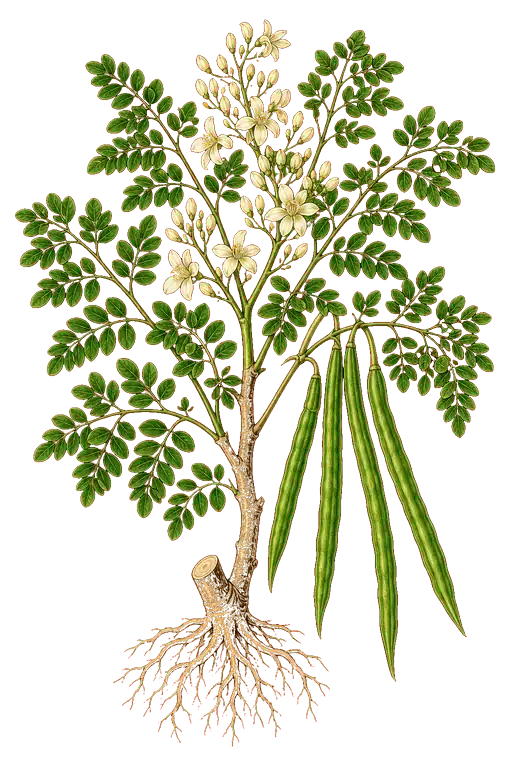
- Fruit a long, ridged, drumstick-shaped pod splitting along three seams; trunk base often swollen and water-storing.
Familiar members: Sahjan · Jangli Sargua
Species in Moringaceae
2 of 2 species
Native status is regional. Range tags distinguish Kew WCVP dataset matches from individual reviews. Pet-filter records report no known toxicity to cats and dogs; some sources cover a genus or cultivar. Review the source context. Missing values are excluded, and no rating establishes suitability to eat or freedom from other hazards.
| Botanical name | Common & regional names | Origin & reviewed pet status |
|---|---|---|
| Moringa oleifera | Sahjan Moringa / Drumstick Tree / Horse Raddish Tree / Ben Oil Tree / Coatli / Oil of ben tree
+12 languages
| Native: India ↗︎ Kew datasetKew WCVP dataset; accepted-name match. Dataset matching is separate from an individual regional review. Recorded worldwide native range: NE. Pakistan to NW. India. |
| Moringa concanensis | Jangli Sargua bitter drumstick tree
+1 languages
| Native: India ↗︎ Kew datasetKew WCVP dataset; accepted-name match. Dataset matching is separate from an individual regional review. Recorded worldwide native range: Pakistan to W. India. |
Pinnately or bipinnately compound, feathery leaves on trees with a swollen, water-storing trunk base; irregular, cream to yellow, five-petalled flowers ripen into a long, ridged, drumstick-shaped pod that splits along three seams.
Nearly every part of the plant — leaves, pods, seeds, flowers, and roots — is edible or medicinally used, giving moringa a reputation as one of the most nutritionally dense trees known.
Which Moringaceae species is this?
Answer what you can see and narrow it down to a single Moringaceae species.
To check whether a plant belongs to Moringaceae, compare the leaf arrangement, leaf type, flower symmetry, fruit type, and one distinctive marker together. A single feature can mislead; the family pattern is the combination.
Learn the full family-identification methodTypical leaf characters

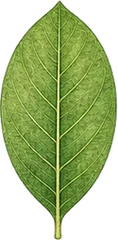
Characters typical of the family — individual species can vary.
Typical flower & fruit
- Flower symmetryZygomorphic (bilaterally symmetrical)
- InflorescencePanicle
- FruitCapsule
Typical of the family — flowering plants only; species can vary.
Families that can look similar
Capparaceae
Compare against Capparaceae when the plant shares similar leaves, flowers, or fruit. Confirm by checking the full family pattern.
Compare CapparaceaeBrassicaceae
Compare against Brassicaceae when the plant shares similar leaves, flowers, or fruit. Confirm by checking the full family pattern.
Compare BrassicaceaeBalsaminaceae
Compare against Balsaminaceae when the plant shares similar leaves, flowers, or fruit. Confirm by checking the full family pattern.
Compare BalsaminaceaeBignoniaceae
Compare against Bignoniaceae when the plant shares similar leaves, flowers, or fruit. Confirm by checking the full family pattern.
Compare BignoniaceaeMeet Moringaceae in the field
Point your camera, explore possible matches and compare the field marks. Identification runs on your phone, offline and private.
Download SASYA — Free