
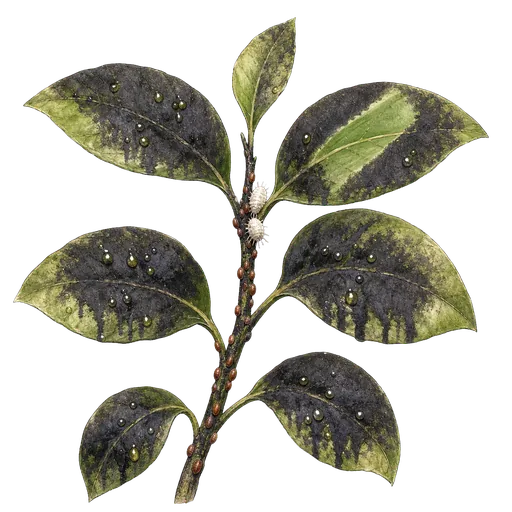
How to identify it
- A dark grey to black coating on upper leaf surfaces, stems, and anything below the plant
- The coating rubs off, leaving healthy green tissue underneath — nothing is sunken, spotted, or rotted
- Leaves feel sticky before the mould appears, and often still are underneath it
- Worst directly beneath heavily infested growth; the film follows where honeydew has dripped
- Look above the mould and you will usually find scale, mealybugs, aphids, whiteflies, or psyllids
If left untreated
- The film thickens and blocks light, so the leaf photosynthesises poorly
- Growth slows and the plant looks permanently dull and dirty
- Leaves may yellow and drop early under a heavy coating
- Fruit and ornamental foliage become unsaleable or unusable
- The underlying pest infestation, which is the real damage, keeps spreading
What it could be confused with
Pest Damage — sooty mould is not an alternative to pest damage, it is the visible consequence of it. Finding sooty mould means you should be looking for the insects producing the honeydew.
Powdery Mildew — mildew is a white to grey powder that grows into the leaf surface; sooty mould is black and sits on top of it. Both rub, but mildew leaves a mottled or discoloured patch behind and sooty mould leaves clean green.
Fungal Leaf Spot — leaf spot makes defined spots with rings and cannot be rubbed off.
Air pollution or dust — road dust is grey-brown, evenly deposited, and washes off with plain water; sooty mould is black, patchy, follows the honeydew drip pattern, and needs soapy water to shift.
What causes it
- Fungi in genera such as Capnodium and Cladosporium, feeding on honeydew rather than on plant tissue
- Honeydew produced by sap-sucking insects: scale, mealybugs, aphids, whiteflies, psyllids
- Anything above the plant that drips honeydew — a mould-covered plant is often sitting under an infested tree
- Still, humid conditions that let the film build up
- Ant activity, which farms and protects honeydew-producing insects and so keeps the cycle going
Plants commonly affected
- Citrus, mango, guava, and other fruit trees
- Ficus, hibiscus, gardenia, camellia, crotons
- Indoor plants with scale or mealybug — especially older, unrepotted specimens
- Any plant parked beneath an infested tree or shrub
How to treat it
Do this first
- Find and treat the insects. Cleaning the mould without removing the honeydew source only means it returns. Check stems, leaf undersides, and new growth for scale bumps, white fuzz, or clustered aphids
- Isolate potted plants so the pests do not spread
- Deal with ants trailing up the stem, or they will re-establish the colony
Cultural fixes
- Wipe leaves with a soft cloth and a weak solution of mild liquid soap in lukewarm water, then rinse
- For sturdy plants, wash the foliage down with a gentle spray outdoors
- Prune out badly coated and heavily infested growth
- Improve airflow and light around the plant
- Move plants out from under infested overhanging trees
Organic treatments
- Insecticidal soap or neem oil against the sap-suckers, covering leaf undersides, repeated weekly for two to three cycles
- Horticultural oil smothers scale and mealybug and loosens the mould film at the same time
- Dab individual mealybugs and scale with a cotton bud dipped in diluted isopropyl alcohol
- No fungicide is needed — remove the honeydew supply and the mould starves and weathers off
In India
- Very common on citrus, mango and guava wherever scale and psyllid populations are high
- Trees along dusty roadsides accumulate a mixed film of dust and sooty mould; wash the foliage before judging how much is mould
- Ant control at the trunk base is particularly effective locally, since ants actively move and protect the insects producing the honeydew
How to prevent it
- Inspect new plants for scale and mealybug before bringing them home
- Check leaf undersides monthly on plants that have had pests before
- Keep ants off trunks and stems
- Do not park clean plants beneath a plant with a known infestation
- Avoid heavy nitrogen feeding, which drives the soft sappy growth sap-suckers prefer
Will the plant recover?
Yes, almost always. Sooty mould does no direct damage to plant tissue — the harm is shading, and the pests underneath. Once the insects are controlled, no fresh honeydew is deposited, and the existing film dries, flakes, and weathers away over a few weeks, faster if you wash it off. Leaves that yellowed under a thick coating may still drop, but new growth comes in clean.
Frequently asked questions
Will a fungicide get rid of sooty mould?
No, and it is not the right tool. The fungus feeds on honeydew, not on the plant, so it is not something a fungicide has to cure. Remove the sap-sucking insects producing the honeydew and the mould has nothing to live on.
Is sooty mould harmful to my plant?
Not directly. It does not penetrate or infect leaf tissue. The damage is indirect — a thick black film blocks light and slows growth — and the real problem is the insect infestation that produced the honeydew in the first place.
How do I clean the black film off the leaves?
Wipe with a soft cloth dipped in lukewarm water with a little mild liquid soap, then rinse. Sturdy plants can simply be hosed down outdoors. Treat the insects at the same time, or the film returns within weeks.
Why does sooty mould keep coming back?
Because the honeydew source is still there. Look above and around the plant — an untreated scale infestation, or an infested tree overhead dripping onto it. Ants trailing up the stem are a strong sign that a honeydew-producing colony is still being farmed.
Sources
- Royal Horticultural Society (RHS) — Sooty moulds
- University of California IPM — Sooty mold
- Queensland Department of Agriculture — Sooty mould
General guidance for home growers — always follow product labels and local regulations before using any treatment.
Not sure what your plant is?
Identify any plant on-device with SASYA — offline, private, and free.