
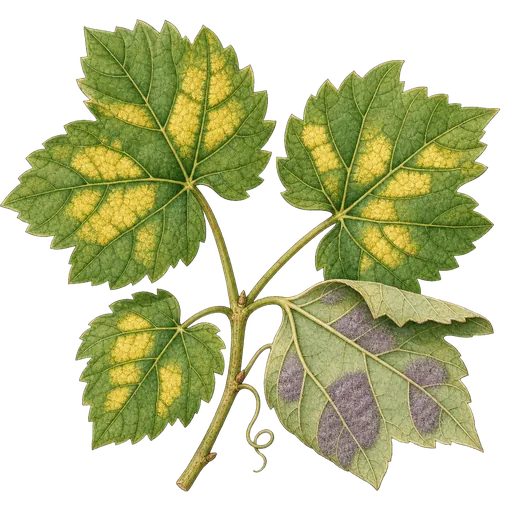
How to identify it
- Pale green, yellow, or brown patches on the upper leaf surface
- The patches are angular, boxed in by the leaf veins, giving a blocky rather than round outline
- Turn the leaf over: a fine grey, violet, or off-white downy layer sits exactly under each patch
- Worst on the oldest, lowest, shadiest leaves first, then spreads upward
- Affected patches dry to brown and the leaf dies from those areas outward
If left untreated
- Patches merge, whole leaves brown and drop
- Rapid defoliation from the base upward in humid weather
- Seedlings can collapse within days
- Yield and flowering fall sharply on food and ornamental crops
What it could be confused with
Powdery Mildew — the two are unrelated despite the name. Powdery mildew is a white dusty film on the top of the leaf that you can wipe off, and it thrives in warm dry air. Downy mildew growth is on the underside, cannot be wiped away cleanly, and needs wet conditions. If in doubt, check which side the growth is on.
Fungal Leaf Spot — leaf spot makes round, defined spots with rings or halos. Downy mildew makes angular patches bounded by veins, with fuzz underneath.
Nutrient Deficiency — deficiency yellows tissue between veins across the whole plant with nothing growing on the underside.
Leaf Sunburn & Scorch — scorch hits the most exposed leaves; downy mildew starts on the shaded lower ones.
What causes it
- Oomycete water moulds — Peronospora, Plasmopara, Pseudoperonospora and relatives, each fairly specific to its host group
- Cool damp conditions, roughly 15-23 °C, with long periods of leaf wetness
- Overhead watering, heavy dew, fog, and monsoon rain
- Crowded plantings and poor airflow keeping foliage damp
- Spores carried on wind and splashing water; resting spores survive in soil and crop debris
Plants commonly affected
- Cucurbits — cucumber, melon, gourds, pumpkin
- Grape vine, and basil (a serious and fast-moving problem on tulsi and sweet basil)
- Brassicas, onion, spinach, lettuce, peas
- Ornamentals — impatiens, coleus, rose, snapdragon
How to treat it
Do this first
- Remove and bin affected leaves as soon as you see the fuzz — do not compost
- Stop overhead watering immediately; water the soil only
- Increase spacing and airflow around the plants
- Isolate potted plants from healthy ones — spores travel easily
Cultural fixes
- Water in the morning so foliage dries before nightfall
- Thin dense growth and stake sprawling plants off the ground
- Clear crop debris at the end of the season; resting spores overwinter in it
- Rotate away from the affected crop family for two to three seasons
- Grow resistant varieties, which exist for cucumber, basil, grape and impatiens
Organic treatments
- Copper-based fungicide (copper oxychloride, Bordeaux mixture) applied preventively, before and during humid spells
- Potassium bicarbonate sprays give some suppression on light infections
- Bacillus subtilis biofungicides as a protectant
- Nothing organic cures colonised tissue — treatment protects healthy leaves only, so remove infected ones first
Chemical treatment (last resort)
- Oomycete-specific products (metalaxyl, mandipropamid, fosetyl-aluminium) are used commercially; ordinary fungicides aimed at true fungi work poorly, because this is not a true fungus
- Rotate active ingredients — resistance develops quickly
- Observe the pre-harvest interval on the label for any edible crop
In India
- The monsoon is the main risk window; expect downy mildew on cucurbits and grapes from the first sustained wet spell
- Downy mildew on tulsi and basil moves extremely fast in humid coastal conditions — harvest heavily at the first sign rather than trying to save the planting
- Grape-growing regions time protective sprays to forecast rain rather than to a fixed calendar
How to prevent it
- Choose resistant varieties wherever they are offered
- Space and prune for airflow from the start
- Never water overhead, and never in the evening
- Inspect the undersides of lower leaves weekly during humid weather
- Buy clean stock; the disease often arrives on nursery plants
Will the plant recover?
Leaves already showing angular patches will not recover — that tissue is colonised and will brown and drop. A vigorous, well-established plant can outgrow a light infection if you strip the affected leaves, dry the canopy out, and protect the new growth. Fast-moving hosts such as basil and impatiens are usually not worth saving once several leaves are affected; pull them, clear the debris, and replant with a resistant variety.
Frequently asked questions
What is the difference between downy mildew and powdery mildew?
Check which side of the leaf the growth is on. Powdery mildew is a white dusty coating on the upper surface that wipes off, and it likes warm dry air. Downy mildew is grey-violet fuzz on the underside, paired with angular yellow patches above, and it needs cool wet conditions. They are different organisms and need different treatments.
Why are the yellow patches square-ish rather than round?
The mould spreads inside the leaf and is stopped by the veins, so the patch fills the space between them and takes on an angular, blocky outline. Round spots with a defined edge usually mean ordinary fungal leaf spot instead.
Can I still eat basil or spinach with downy mildew?
Unaffected leaves are safe to eat after washing. Discard leaves showing patches or fuzz — they taste poor and the planting is usually not worth keeping once the disease is established.
Does downy mildew come back every year?
It can. Resting spores survive in soil and crop debris, and fresh spores blow in on the wind. Clearing debris, rotating crops, and growing resistant varieties are what break the cycle.
Sources
- Royal Horticultural Society (RHS) — Downy mildews
- Cornell University — Cucurbit downy mildew
- University of California IPM — Downy mildew
- Indian Council of Agricultural Research (ICAR) — Grape downy mildew management
General guidance for home growers — always follow product labels and local regulations before using any treatment.
Not sure what your plant is?
Identify any plant on-device with SASYA — offline, private, and free.