
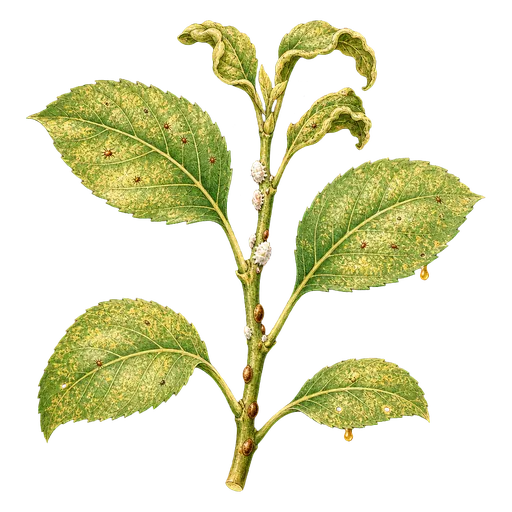
How to identify it
- Fine yellow speckling or stippling on leaves (sap-suckers)
- Sticky residue (honeydew) on leaves or surfaces below the plant
- Fine webbing between leaves and stems (spider mites)
- Visible insects — clusters on new growth, white fuzz, or brown bumps along stems
If left untreated
- Leaves yellow, curl, distort, or drop
- Black sooty mould grows on the sticky honeydew
- New growth is stunted; heavy infestations can kill the plant
What it could be confused with
Powdery Mildew — Mildew is a dry white powdery film on the leaf surface; pest webbing is fine silk strands and comes with moving specks (mites) and stippling.
Nutrient Deficiency — Deficiency yellows leaves evenly in a pattern with no insects, webbing, or sticky residue.
Fungal Leaf Spot — Leaf spot is defined spots with rings; pest damage is speckling, distortion, and the presence of insects or their residue.
What causes it
- Common houseplant pests — spider mites, mealybugs, aphids, scale, thrips, whiteflies, fungus gnats
- Often introduced on new plants or in contaminated potting mix
Plants commonly affected
- Most houseplants are susceptible
- Calathea, ivy, palms (spider mites)
- Succulents and cacti (mealybugs)
- Citrus and ferns (scale)
How to treat it
Do this first
- Isolate the plant away from others right away
- Rinse the plant under a gentle shower to knock pests off
- Wipe visible bugs (mealybugs, scale) with a cotton bud dipped in diluted isopropyl alcohol
Cultural fixes
- Raise humidity to discourage spider mites
- Remove badly infested leaves
- Let soil dry between waterings to control fungus gnats
Organic treatments
- Insecticidal soap or neem oil sprayed over all surfaces including undersides, repeated weekly
- Yellow sticky traps for whiteflies and fungus gnats
- Repeat treatments every 5-7 days for 2-3 cycles to catch newly hatched pests
Chemical treatment (last resort)
- Last resort: a labelled systemic insecticide for stubborn scale or mealybug. Follow the label exactly; ventilate; keep away from children and pets.
In India
- Neem oil (and neem-based sprays) are cheap and very effective; widely available at Indian nurseries
How to prevent it
- Quarantine every new plant for 2 weeks and inspect undersides of leaves
- Wipe leaves and inspect regularly so you catch pests early
- Avoid over-fertilising, which produces soft pest-prone growth
- Use clean pots and fresh sterile potting mix
Will the plant recover?
Most infestations are beatable with persistence — the key is repeat treatments to break the life cycle. Severe, long-running infestations may be easier to solve by taking healthy cuttings.
Frequently asked questions
What are the tiny bugs on my houseplant?
Common culprits are spider mites (webbing, stippling), mealybugs (white fuzz), aphids (clusters on new growth), scale (brown bumps), and whiteflies. Isolate the plant and treat with neem or insecticidal soap, repeating weekly.
Why are my plant's leaves sticky?
Sticky residue is honeydew excreted by sap-sucking pests like aphids, mealybugs, scale, or whiteflies. Check the undersides of leaves and treat the infestation.
How do I get rid of spider mites?
Rinse the plant, raise humidity (mites love dry air), and spray all surfaces with neem or insecticidal soap every 5-7 days for a few cycles until the webbing and stippling stop.
Do I need to repeat pest treatments?
Yes. Most sprays don't kill eggs, so repeat every 5-7 days for 2-3 cycles to catch newly hatched pests, or the infestation rebounds.
Are fungus gnats harmful to my plant?
The flying adults are mostly a nuisance, but their larvae feed on roots in constantly wet soil. Let the topsoil dry between waterings and use yellow sticky traps.
Sources
- Royal Horticultural Society (RHS) — Houseplant pests
- University of Minnesota Extension — Insects on houseplants
- Clemson Cooperative Extension — Common houseplant insects & related pests
General guidance for home growers — always follow product labels and local regulations before using any treatment.
Check your plant with SASYA
Identify any plant, check a leaf for common problems and set watering reminders — on-device, private and free. Health checks and reminders are on Android now, coming to iPhone next.