How to identify it
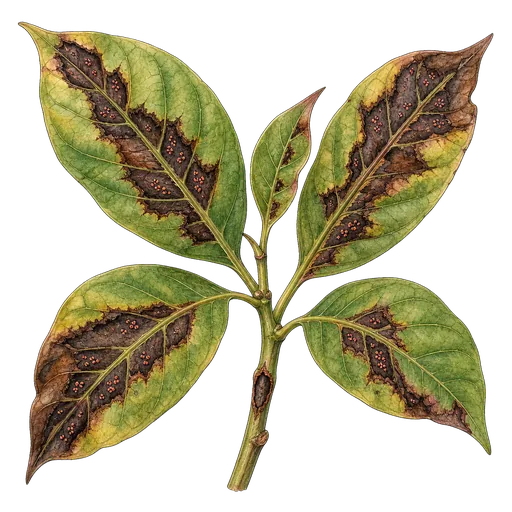
- Dark brown to black spots that are sunken — run a finger over one and you can feel the dip
- Lesions often follow the leaf veins, or start at the leaf tip and margin, and merge into large dead patches
- On fruit: circular sunken craters that soften and rot, common on ripening mango, chilli, banana and papaya
- In humid weather, tiny salmon-pink or orange spore masses ooze from the centre of older lesions — this is the clearest single sign
- Twig dieback from the tip downward, with dark sunken cankers where a lesion has girdled the stem
If left untreated
- Leaves yellow around the lesions and drop early, thinning the canopy
- Flowers and young fruit blacken and fall, cutting yield sharply
- Fruit that looks clean at harvest rots in storage — the infection sits latent until ripening
- Cankers girdle twigs and small branches, killing them back
What it could be confused with
Fungal Leaf Spot — ordinary leaf spot is flat or slightly raised with a defined ring or halo. Anthracnose lesions are sunken, tend to run along veins, and produce pink spore masses when wet.
Bacterial Leaf Spot — bacterial spots look water-soaked and greasy with a yellow halo, and are usually angular because they stop at the leaf veins. Anthracnose is dry and sunken.
Leaf Sunburn & Scorch — scorch is confined to the most exposed leaves and produces no spots, rings, or spore masses.
What causes it
- Colletotrichum and related fungi, overwintering in fallen leaves, mummified fruit, and infected twigs
- Spores spread by splashing water — rain, monsoon, and overhead watering
- Long leaf wetness: infection needs many hours of moisture on the surface
- Warm humid conditions, roughly 20-30 °C, are ideal
- Dense unpruned canopies that stay wet and still after rain
- Latent infection: fruit is infected while green, shows nothing, then rots as it ripens
Plants commonly affected
- Mango, chilli and capsicum, banana, papaya, guava, avocado
- Beans, cucurbits, tomato
- Ornamentals — anthurium, dieffenbachia, ficus, croton
- Shade and street trees, especially in a wet spring
How to treat it
Do this first
- Remove and bin every affected leaf, twig, and fruit — do not compost them, the spores survive
- Stop overhead watering; water the soil, not the foliage
- Move potted plants apart and out of the rain while they recover
Cultural fixes
- Prune to open the canopy so leaves dry quickly after rain
- Clear all fallen leaves and mummified fruit from under the plant — this is the main source of next season's infection
- Sterilise pruning tools between cuts with alcohol so you do not carry spores along the branch
- Avoid working among wet plants; spores move on hands and tools
Organic treatments
- Copper-based fungicide (copper oxychloride, Bordeaux mixture) applied at the first sign and repeated as directed, especially before forecast rain
- Neem oil sprays help suppress light infections and act preventively
- Trichoderma or Bacillus subtilis biocontrol preparations, applied to soil and foliage
- Treatment is protective, not curative — it stops new infection, but existing sunken lesions will not heal
Chemical treatment (last resort)
- Systemic fungicides (azoxystrobin, carbendazim, mancozeb) are used commercially on fruit crops
- Rotate active ingredients between sprays — Colletotrichum develops resistance quickly
- Observe the pre-harvest interval printed on the label before eating any treated fruit
In India
- Anthracnose is the single most damaging pre- and post-harvest disease of mango, and losses run high through the monsoon
- Time preventive sprays to the flowering and fruit-set window, and again before the monsoon breaks
- Post-harvest hot water treatment of mango (around 50-55 °C for a few minutes) is a standard measure against latent infection
- In chilli, the same fungus causes die-back and fruit rot; rotate away from solanaceous crops for two to three seasons in affected beds
How to prevent it
- Plant resistant or tolerant varieties where available
- Space plants for airflow, and prune annually to keep canopies open
- Keep the ground beneath fruit trees clear of fallen debris
- Water at the base, early in the day
- Do not save seed or cuttings from infected plants
Will the plant recover?
Established plants usually survive — anthracnose disfigures and defoliates but rarely kills a mature tree or shrub. The affected leaves and fruit are lost for good, and existing lesions never heal. What recovers is the new flush, provided you clear the fallen debris that reinfects it. Annual crops such as chilli and beans are often better pulled and replaced once fruit rot is widespread.
Frequently asked questions
What do the pink spots inside the lesions mean?
Those salmon-pink or orange masses are the fungus's spores, pushed out in humid weather. They are the most reliable sign that a sunken dark lesion is anthracnose rather than ordinary leaf spot, and they mean the plant is actively shedding infectious material.
Why does my mango look fine at harvest and rot a week later?
The fruit was infected while still green and the fungus stayed dormant until ripening began. This latent infection is typical of anthracnose, which is why orchard sprays during flowering and fruit set matter more than anything done after picking.
Can I eat fruit with anthracnose spots?
Cut away the sunken rotted areas generously and the rest is usually fine to eat, though the texture and flavour suffer. Discard fruit that has softened through. If the plant was treated with a chemical fungicide, respect the pre-harvest interval on the label.
Is anthracnose the same as leaf spot?
They overlap, but anthracnose lesions are sunken, often follow veins, spread to stems and fruit, and produce pink spore masses. Ordinary fungal leaf spot stays on the leaf as flat, ringed spots.
Sources
- Indian Council of Agricultural Research (ICAR) — Mango anthracnose management
- University of California IPM — Anthracnose
- Royal Horticultural Society (RHS) — Anthracnose
- Clemson Cooperative Extension — Anthracnose diseases
General guidance for home growers — always follow product labels and local regulations before using any treatment.
Not sure what your plant is?
Identify any plant on-device with SASYA — offline, private, and free.