
Bhu Okra / Turkey Tangle Frogfruit
Phyla nodiflora
Also known as Capeweed, Carper Weed, Creeping Lip Plant, Creeping Vervain, Purple Lippia
- Habit
- Herb
- Found in India
- Kerala, West Bengal, Maharashtra & more
- Flowering
- Throughout the year
How to identify Bhu Okra
Identify Bhu Okra by combining habit, leaf characters, flower or fruit details, location, and its family pattern. Do not rely on one feature alone.
- Look for a herb habit.
- Check the distinctive field mark: Creeping lawn-weed habit.
- Confirm leaf shape: Orbicular.
- Confirm leaf surface: Glabrous (smooth, hairless).
- Confirm flower colour: White.
- Confirm flower arrangement: Head (dense tight cluster).
- In season, compare flowering and fruiting time: Throughout the year.
Plant Details
- Scientific name
- Phyla nodiflora
- Genus
- Phyla
- Family
- Verbenaceae
- Habit
- Herb
- Native to
- Old World tropics
- Distribution
- Tropics & sub-tropics
- Found in India
- Kerala, West Bengal, Maharashtra, Uttarakhand, Uttar Pradesh, Tamil Nadu, Karnataka, Telangana, Rajasthan, Gujarat, Assam, Bihar, Andhra Pradesh, Delhi, Odisha, Chhattisgarh, Haryana, Madhya Pradesh, Punjab, Himachal Pradesh, Arunachal Pradesh, Jammu & Kashmir, Puducherry
- Flowering & fruiting
- Throughout the year
- Conservation status
- Least Concern (LC)
Leaf characters
- Leaf shape
- OrbicularrecordedRounded, roughly circular.“It is similar to the related species Phyla lanceolata, but differs in having much shorter leaves that are often blunt and much more rounded.” — Wikipedia, CC BY-SA 4.0
- Leaf surface
- Glabrous (smooth, hairless)recorded
Typical of the family
- Arrangement
- Opposite
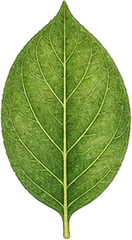

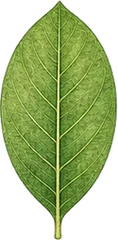
Characters marked “recorded” are for Bhu Okra itself; the rest are typical of the Verbenaceae family.
Flower & fruit characters
- Flower colour
- Whiterecorded
- Flower arrangement
- Head (dense tight cluster)recorded
Typical of the family
- Flower symmetry
- Zygomorphic (bilaterally symmetrical)
- Inflorescence
- Cyme
- Fruit
- Drupe
Characters marked “recorded” are for Bhu Okra itself; the rest are typical of the Verbenaceae family — flowering plants only.
Local Names
- Hindi
- भू ओकरा Bhu Okra, छोटा ओकरा Chota Okra, जल बूटी Jal Buti
- Nepali
- अकमर Akamar, जल पिप्ली Jal Piplee, कोकना Kokanaa
- Bengali
- বুকুনবুটি Bukunbuti, কাচড়াঘাস Kacharaghas, ভূঁই ওকরা
- Tamil
- பொடுதலை Potutalai, தோயபாணம் Toyapanam, வன்னிகா Vannika
- Telugu
- బొక్కెనాకు Bokenaku, బొక్కెన Bokkena, గజ పిప్పలి కాడ Gajapippali-Kada
- Kannada
- ಜಲಹಿಪ್ಪಲಿ Jala Hippali, ಕೆರೆಹಿಪ್ಪಲಿ Kere Hippali, ನೀರುಹಿಪ್ಪಲಿ Neeru Hippali
- Malayalam
- ജലതിപ്പലി Jalathippali, കാട്ടുതിപ്പലി Kattuthippali, നീർതിപ്പലി Neerthippali
- Marathi
- गौर मुंडी Goura Mundi, जल पिंपळी Jala Pimpali, रतवेल Ratavel
About Bhu Okra
Turkey Tangle Frogfruit (Phyla nodiflora) belongs to the Verbenaceae family, where it grows as a herb. In India it has been recorded in Kerala, West Bengal, Maharashtra and 20 other states. It flowers and fruits through much of the year.
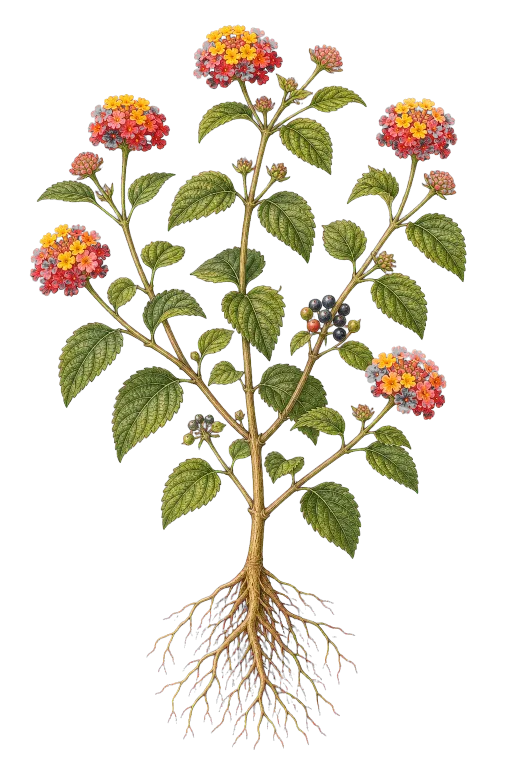
Verbenaceae
Verbena/Teak family
Bhu Okra belongs to the Verbenaceae family.
The illustration represents the family — not necessarily this exact species.
Explore the Verbenaceae familySnap it. Know it.
Point your camera at Bhu Okra or any plant and SASYA identifies it instantly — on-device, offline, and private.
Common plant problems
If you are starting from symptoms instead of a diagnosis, use the plant disease symptom checker to narrow the cause before treating.
All plant problem & care guides