
Mahua / Illipe Butter Tree
Madhuca neriifolia
- Habit
- Tree
- Found in India
- Tamil Nadu, Karnataka, Kerala
- Flowering
- November-March
Plant Details
- Scientific name
- Madhuca neriifolia
- Genus
- Madhuca
- Family
- Sapotaceae
- Habit
- Tree
- Habitat
- Banks of rivers in evergreen and semi-Evergreen forests
- Distribution
- India, Sri Lanka
- Found in India
- Tamil Nadu, Karnataka, Kerala
- Flowering & fruiting
- November-March
- Conservation status
- Endangered (EN)
Leaf characters
- Arrangement
- Alternate



Typical of the Sapotaceae family — a field-mark hint, not measured for this exact species.
Flower & fruit characters
Typical of the Sapotaceae family — flowering plants only; individual species can differ.
Local Names
- Hindi
- महुवा Mahua
- Tamil
- ஆத்து இலுப்பை Atta Illupei, Atta illupei, Vanji
- Kannada
- Hulinanele, Nanale, Neeruhippe
- Malayalam
- Attuillippa, Kattuilluppei, Attu-ilippa, Iluppa
- Marathi
- Tupa, मोहा Moha
About Mahua
Illipe Butter Tree (Madhuca neriifolia) is a tree belonging to the Sapotaceae family (Sapodilla/Chicle family). Members of this family are generally characterised by alternate simple leaves, cymose axillary flower clusters, berry fruit. It is typically found in banks of rivers in evergreen and semi-evergreen forests. It occurs across India, Sri Lanka. Flowering and fruiting are typically seen during November-March. Its conservation status has been assessed as Endangered (EN).
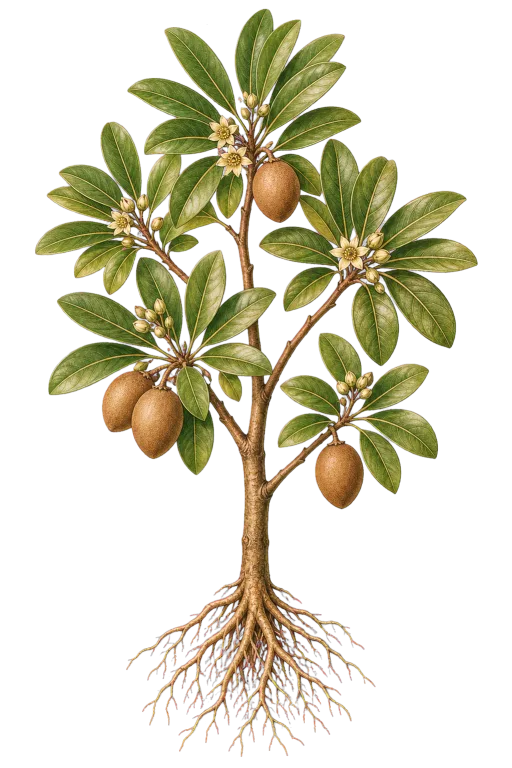
Sapotaceae
Sapodilla/Chicle family
Mahua belongs to the Sapotaceae family.
The illustration represents the family — not necessarily this exact species.
Explore the Sapotaceae family →Snap it. Know it.
Point your camera at Mahua or any plant and SASYA identifies it instantly — on-device, offline, and private.