
Sapotaceae
Sapodilla/Chicle family
Trees with milky latex and alternate leathery leaves. Includes sapodilla (chiku), star apple, and mahua. Latex of sapodilla is the original chicle.
Browse all 16 species ↓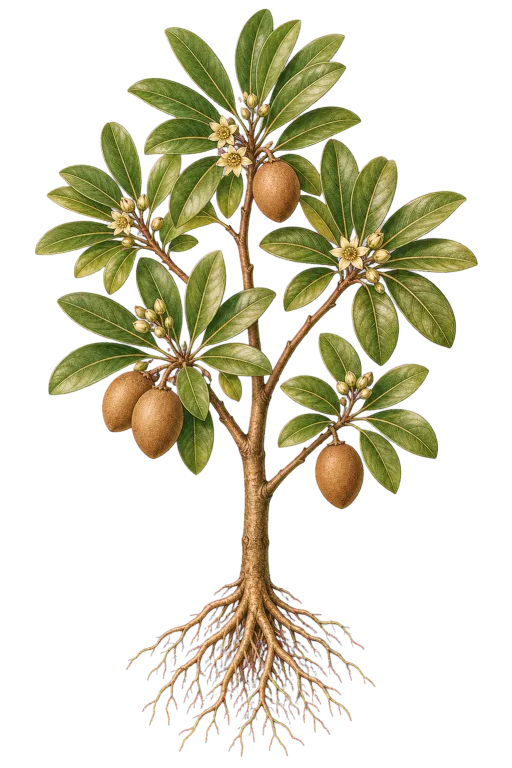
Alternate, leathery leaves on trees that ooze white milky latex from any cut; small flowers with fused, often hairy sepals ripen into a fleshy berry — the latex of one member, sapodilla, was the original source of chewing-gum base (chicle).
Milky latex runs throughout the family's bark and fruit — edible once ripe in sapodilla, but historically tapped elsewhere as a natural rubber or gum substitute.
Which Sapotaceae species is this?
Answer what you can see and narrow it down to a single Sapotaceae species.
How to recognise the Sapotaceae family
- 01
Leaf arrangement: alternate
- 02
Leaf type: simple
- 03
Growth forms: tree
- 04
Inflorescence: cymose axillary
- 05
Fruit: berry
To check whether a plant belongs to Sapotaceae, compare the leaf arrangement, leaf type, flower symmetry, fruit type, and one distinctive marker together. A single feature can mislead; the family pattern is the combination.
Learn the full family-identification methodTypical leaf characters
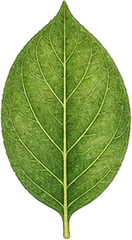


Characters typical of the family — individual species can vary.
Typical flower & fruit
- Flower symmetryActinomorphic (radially symmetrical)
- InflorescenceCyme
- FruitBerry
Typical of the family — flowering plants only; species can vary.
Notable members
Families that can look similar
Balsaminaceae
Compare against Balsaminaceae when the plant shares similar leaves, flowers, or fruit. Confirm by checking the full family pattern.
Compare BalsaminaceaeSolanaceae
Compare against Solanaceae when the plant shares similar leaves, flowers, or fruit. Confirm by checking the full family pattern.
Compare SolanaceaeAnnonaceae
Compare against Annonaceae when the plant shares similar leaves, flowers, or fruit. Confirm by checking the full family pattern.
Compare AnnonaceaeFlacourtiaceae
Compare against Flacourtiaceae when the plant shares similar leaves, flowers, or fruit. Confirm by checking the full family pattern.
Compare FlacourtiaceaeAll 16 species in SAPOTACEAE
- Cainito, Star Apple, Satin Leaf, West Indian Star AppleChrysophyllum cainito
- Wild Star AppleChrysophyllum roxburghii
- Indian Butter TreeMadhuca longifolia var. latifolia
- South-Indian Mahua, Mahua TreeMadhuca longifolia var. longifolia
- Illipe Butter TreeMadhuca neriifolia
- Obtuse-Leaved Mimusops, The Caylon Iron WoodManilkara hexandra
- Sapota, Nasebarry, SapodillaManilkara zapota
- Indian Medlar, Bullet Wood Tree, Asian Bulletwood, Bakul Tree, Spanish CherryMimusops elengi
- Indian Gutta PerchaPalaquium ellipticum
- AguaiPouteria gardneriana
- Hairy XantolisXantolis tomentosa
- Chrysophyllum lanceolatum
- Isonandra lanceolata
- Madhuca bourdillonii
- Manilkara kauki
- Manilkara roxburghiana
Identify any Sapotaceae plant in seconds
Point your camera and SASYA names the species on-device — offline and private.
Download SASYA — Free