
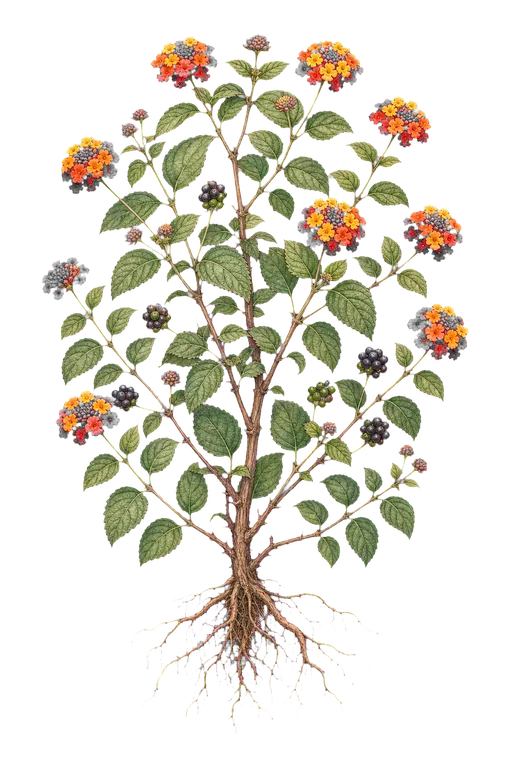
Raimuniya / Lantana
Lantana camara
Also known as Shrub Verbena, Wild Sage
- Habit
- Shrub
- Found in India
- Tamil Nadu, Kerala, Maharashtra & more
- Flowering
- Throughout the year
How to identify Raimuniya
Identify Raimuniya by combining habit, leaf characters, flower or fruit details, location, and its family pattern. Do not rely on one feature alone.
- Look for a shrub habit.
- Check the distinctive field mark: Flower clusters change color as they age.
- Confirm leaf arrangement: Opposite.
- Confirm leaf type: Simple.
- Confirm flower colour: Yellow.
- Use the leaf pattern: opposite leaf arrangement, simple leaves, toothed leaf margins, pinnate venation.
- In season, compare flowering and fruiting time: Throughout the year.
Plant Details
- Scientific name
- Lantana camara
- Genus
- Lantana
- Family
- Verbenaceae
- Habit
- Shrub
- Native to
- Central America
- Distribution
- Naturalized in Tropics
- Found in India
- Tamil Nadu, Kerala, Maharashtra, Karnataka, Andhra Pradesh, Telangana, Uttarakhand, Uttar Pradesh, West Bengal, Rajasthan, Assam, Gujarat, Chhattisgarh, Madhya Pradesh, Odisha, Delhi, Goa, Mizoram, Bihar, Haryana, Himachal Pradesh, Punjab, Arunachal Pradesh, Jharkhand, Meghalaya, Sikkim, Tripura, Chandigarh, Manipur, Puducherry, Jammu & Kashmir, Nagaland
- Flowering & fruiting
- Throughout the year
- Conservation status
- Not Evaluated (NE)
Leaf characters
- Leaf arrangement
- OppositerecordedTwo leaves arise from the stem at the same point, facing each other.“The leaves are broadly ovate, opposite, and simple and have a strong odour when crushed.” — Wikipedia, CC BY-SA 4.0
- Leaf type
- SimplerecordedA single, undivided leaf blade.“The leaves are broadly ovate, opposite, and simple and have a strong odour when crushed.” — Wikipedia, CC BY-SA 4.0
- Leaf shape
- OvaterecordedEgg-shaped, broader near the base.“The leaves are broadly ovate, opposite, and simple and have a strong odour when crushed.” — Wikipedia, CC BY-SA 4.0
- Leaf surface
- Hirsute (coarsely hairy)recorded

Typical of the family


Characters marked “recorded” are for Raimuniya itself; the rest are typical of the Verbenaceae family.
Flower & fruit characters
- Flower colour
- Yellowrecorded
Typical of the family
- Flower symmetry
- Zygomorphic (bilaterally symmetrical)
- Inflorescence
- Cyme
- Fruit
- Drupe
Characters marked “recorded” are for Raimuniya itself; the rest are typical of the Verbenaceae family — flowering plants only.
Local Names
- Hindi
- Raimuniya राईमुनिया रई
- Nepali
- मसिनो काँडा, Masino Kaandaa वन फन्दा Van Phandaa, गन्हाउने काँडा
- Bengali
- লান্টানা
- Tamil
- உன்னிச்செடி Unnichedi, உண்ணிச்செடி
- Telugu
- Pulikampa, తలంబ్రాలు చెట్టు
- Kannada
- ಲಂಟಾನ Lantaana ಕಸೂತಿಹೂ Kasooti hoo, ಕಾಡುಜೋಳ Kaadu jola, ಚದುರಂಗ Chaduranga
- Malayalam
- ലന്റാന കമാര
- Marathi
- टणटणी Tantani, घाणेरी Ghaneri, टणटणी
- Sinhala
- ගඳපාන
Raimuniya in India
Lantana is everywhere in India — and that is exactly the problem. Known as Raimuniya राईमुनिया रई (Hindi), உன்னிச்செடி Unnichedi (Tamil), Pulikampa (Telugu), ಲಂಟಾನ Lantaana ಕಸೂತಿಹೂ Kasooti hoo (Kannada), ലന്റാന കമാര (Malayalam), टणटणी Tantani (Marathi), this Central American shrub has become one of the country's most aggressive invasive weeds, recorded across Tamil Nadu, Kerala, Maharashtra, Karnataka, Andhra Pradesh, Telangana and choking forest edges, grazing land and roadsides.
Uses
Lantana is mainly significant as a weed rather than a useful plant: it crowds out native vegetation and is toxic to livestock. There are attributed folk-medicine uses and growing efforts to turn its woody stems into furniture, but it is best known as a species to control, not cultivate.
How to Identify Raimuniya
A prickly, strong-smelling shrub with rough, toothed leaves and flat-topped flower clusters in which the florets change colour as they age — often yellow and orange to pink and red in the same head. Small green berries ripen blue-black and are spread by birds.
Frequently Asked Questions
- What is Lantana called in different Indian languages?
- Raimuniya राईमुनिया रई (Hindi); உன்னிச்செடி Unnichedi (Tamil); Pulikampa (Telugu); ಲಂಟಾನ Lantaana ಕಸೂತಿಹೂ Kasooti hoo (Kannada); ലന്റാന കമാര (Malayalam); टणटणी Tantani (Marathi); লান্টানা (Bengali).
- Why is lantana considered a weed in India?
- Lantana spreads aggressively, forms dense thickets that crowd out native plants and pasture, and is toxic to grazing animals, making it a serious invasive across Indian landscapes.
- Is lantana poisonous to animals?
- Yes — its foliage and unripe berries are toxic to cattle and other livestock, which is one reason it is actively managed and removed.
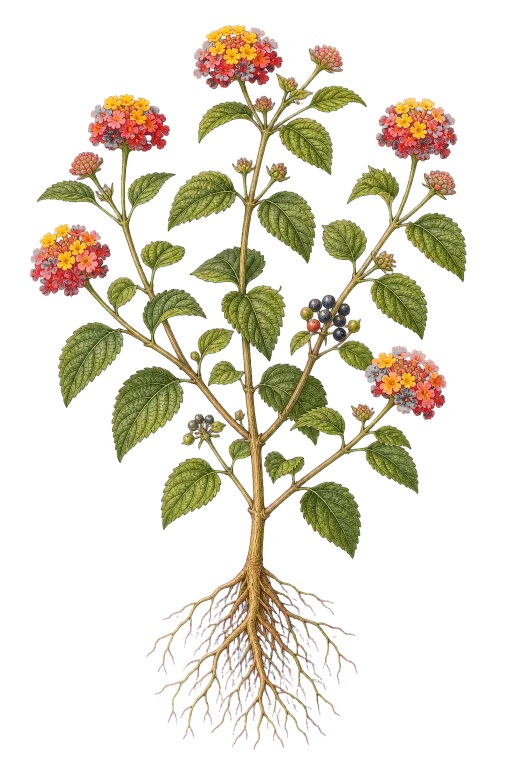
Verbenaceae
Verbena/Teak family
Raimuniya belongs to the Verbenaceae family.
The illustration represents the family — not necessarily this exact species.
Explore the Verbenaceae familySnap it. Know it.
Point your camera at Raimuniya or any plant and SASYA identifies it instantly — on-device, offline, and private.
Common plant problems
If you are starting from symptoms instead of a diagnosis, use the plant disease symptom checker to narrow the cause before treating.
All plant problem & care guidesMore in Verbenaceae
View all VerbenaceaeSources: GBIF — Lantana camara (India distribution & vernacular names) (CC BY 4.0) · iNaturalist — Lantana camara (regional names, India observations) (CC BY 4.0) · Wikipedia — Lantana camara (background/comprehension only) (CC BY-SA 4.0)