
Shalari / Celery
Apium graveolens
- Found in India
- Himachal Pradesh, Maharashtra, Uttarakhand & more
How to identify Shalari
Identify Shalari by combining habit, leaf characters, flower or fruit details, location, and its family pattern. Do not rely on one feature alone.
- Check the distinctive field mark: Thick fleshy leaf stalks.
- Confirm leaf type: Pinnately compound.
- Confirm leaf shape: Deeply lobed/toothed.
- Confirm flower colour: White.
- Confirm flower arrangement: Umbel.
- In India, compare location records such as Himachal Pradesh, Maharashtra, Uttarakhand, West Bengal.
- Confirm it sits within the Apiaceae family pattern, then compare close relatives before deciding it is Shalari.
Plant Details
- Scientific name
- Apium graveolens
- Genus
- Apium
- Family
- Apiaceae
- Found in India
- Himachal Pradesh, Maharashtra, Uttarakhand, West Bengal
- Conservation status
- Not Evaluated (NE)
Leaf characters
- Leaf type
- Pinnately compoundrecordedLeaflets are arranged in rows along a central stalk, like a feather.“The leaves are bright green to yellowish-green, 1- to 2-pinnate with leaflets that are variously shaped, often rhomboid, up to 6 cm (2+1⁄2 in) long and 4 cm (1+1⁄2 in) broad.” — Wikipedia, CC BY-SA 4.0
- Leaf shape
- Deeply lobed/toothedrecorded
Typical of the family
- Arrangement
- Alternate


Characters marked “recorded” are for Shalari itself; the rest are typical of the Apiaceae family.
Flower & fruit characters
- Flower colour
- Whiterecorded
- Flower arrangement
- UmbelrecordedFlower stalks all radiate from a single point, like umbrella ribs.“The flowers are produced in umbels, mostly with short peduncles, with four to twelve rays.” — Wikipedia, CC BY-SA 4.0
- Fruit type
- SchizocarprecordedA dry fruit that splits apart at maturity into several one-seeded segments.“The fruit is a schizocarp, broadly ovoid to globose, 1–1.5 mm (3⁄64–1⁄16 in) long and wide.” — Wikipedia, CC BY-SA 4.0
Typical of the family
- Flower symmetry
- Actinomorphic (radially symmetrical)
- Inflorescence
- Umbel
- Fruit
- Schizocarp
Characters marked “recorded” are for Shalari itself; the rest are typical of the Apiaceae family — flowering plants only.
Local Names
- Hindi
- shalari
About Shalari
Celery (Apium graveolens) belongs to the Apiaceae family. In India it has been recorded in Himachal Pradesh, Maharashtra, Uttarakhand and 1 other states.
Uses
Locally it is grown for parts that are eaten.
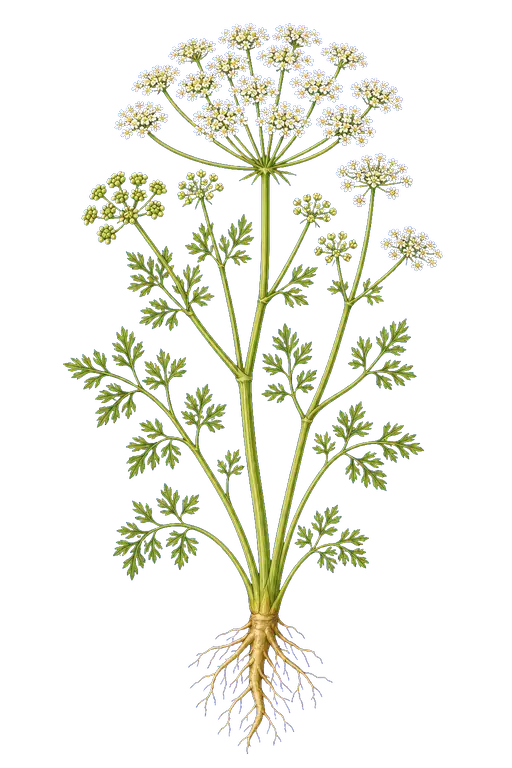
Apiaceae
Carrot family
Shalari belongs to the Apiaceae family.
The illustration represents the family — not necessarily this exact species.
Explore the Apiaceae familySnap it. Know it.
Point your camera at Shalari or any plant and SASYA identifies it instantly — on-device, offline, and private.
Common plant problems
If you are starting from symptoms instead of a diagnosis, use the plant disease symptom checker to narrow the cause before treating.
All plant problem & care guides