
Tree-Of-Heaven
Ailanthus altissima
- Habit
- Tree
- Found in India
- Jammu & Kashmir, Himachal Pradesh, Uttarakhand
How to identify Tree-Of-Heaven
Identify Tree-Of-Heaven by combining habit, leaf characters, flower or fruit details, location, and its family pattern. Do not rely on one feature alone.
- Look for a tree habit.
- Check the distinctive field mark: Fast-growing weedy tree, foul-smelling leaves (tree of heaven).
- Confirm leaf arrangement: Opposite.
- Confirm leaf type: Pinnately compound.
- Confirm flower colour: White.
- Confirm flower arrangement: Panicle.
- In India, compare location records such as Jammu & Kashmir, Himachal Pradesh, Uttarakhand.
Plant Details
- Scientific name
- Ailanthus altissima
- Genus
- Ailanthus
- Family
- Simaroubaceae
- Habit
- Tree
- Distribution
- India, China
- Found in India
- Jammu & Kashmir, Himachal Pradesh, Uttarakhand
- Conservation status
- Not Evaluated (NE)
Leaf characters
- Leaf arrangement
- OppositerecordedTwo leaves arise from the stem at the same point, facing each other.“The leaflets are ovate-lanceolate with entire margins, somewhat asymmetric and occasionally not directly opposite to each other.” — Wikipedia, CC BY-SA 4.0
- Leaf type
- Pinnately compoundrecordedLeaflets are arranged in rows along a central stalk, like a feather.“The leaves are large, odd- or even-pinnately compound on the stem.” — Wikipedia, CC BY-SA 4.0
- Leaf shape
- CordaterecordedHeart-shaped, with a notch at the base.“They have lenticels and heart-shaped leaf scars (i.e., a scar left on the twig after a leaf falls) with many bundle scars (i.e., small marks where the veins of the leaf once connec” — Wikipedia, CC BY-SA 4.0
- Leaf margin
- EntirerecordedA smooth, unbroken edge with no teeth or notches.“The leaflets are ovate-lanceolate with entire margins, somewhat asymmetric and occasionally not directly opposite to each other.” — Wikipedia, CC BY-SA 4.0
- Leaf surface
- PubescentrecordedCovered in short, soft hairs.“The buds are finely pubescent, dome-shaped, and partially hidden behind the petiole, though they are completely visible in the dormant season at the sinuses of the leaf scars.” — Wikipedia, CC BY-SA 4.0
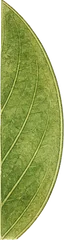
Characters marked “recorded” are for Tree-Of-Heaven itself; the rest are typical of the Simaroubaceae family.
Flower & fruit characters
- Flower colour
- Whiterecorded“The sepals are cup-shaped, lobed and united while the petals are valvate (i.e., they meet at the edges without overlapping), white and hairy towards the inside.” — Wikipedia, CC BY-SA 4.0
- Flower arrangement
- PaniclerecordedA branching cluster of clusters.“The flowers are small and appear in large panicles up to 50 cm (20 in) in length at the end of new shoots.” — Wikipedia, CC BY-SA 4.0
- Fruit type
- SamararecordedA dry, winged fruit adapted for wind dispersal.“The seeds borne on the female trees are 5 mm (0.2 in) in diameter and each is encapsulated in a samara that is 2.5 cm (1 in) long and 1 cm (0.4 in) broad, appearing July through Au” — Wikipedia, CC BY-SA 4.0
Characters marked “recorded” are for Tree-Of-Heaven itself; the rest are typical of the Simaroubaceae family — flowering plants only.
Local Names
- Bengali
- আইলান্থাস আলতিসসিমা
- Marathi
- महारुख
About Tree-Of-Heaven
A member of the Simaroubaceae family, Tree-of-heaven (Ailanthus altissima) is a tree. In India it has been recorded in Jammu & Kashmir, Himachal Pradesh and Uttarakhand.
Uses
It is grown for parts that are eaten, long used in traditional medicine and cut for timber and furniture. Those medicinal uses are traditional attributions, not medical advice. Its sap or hairs can irritate skin, so handle it with care.
In culture
It is recorded in classical literature.
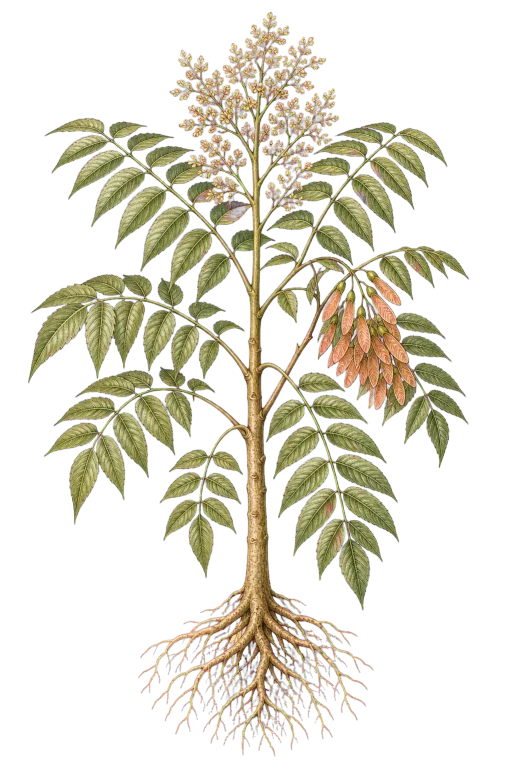
Simaroubaceae
Quassia Family
Tree-Of-Heaven belongs to the Simaroubaceae family.
The illustration represents the family — not necessarily this exact species.
Explore the Simaroubaceae familySnap it. Know it.
Point your camera at Tree-Of-Heaven or any plant and SASYA identifies it instantly — on-device, offline, and private.
Common plant problems
If you are starting from symptoms instead of a diagnosis, use the plant disease symptom checker to narrow the cause before treating.
All plant problem & care guides