Simaroubaceae family
Quassia Family
6 catalogue species · Order Sapindales
The Simaroubaceae family (Quassia Family) is a botanical family placed in the order Sapindales. In the SASYA catalogue it spans 6 species across 4 genera. Its members are predominantly trees. Well-represented genera include Ailanthus, Balanites and Quassia. Several members are valued in traditional medicine. Familiar examples include tree-of-heaven, Heaven Tree and White Palle.
Explore the species roster ↓Field identification keys
Compare several features together. These are typical family patterns; individual species can vary. Observe without tasting or handling unfamiliar plants.
- Stem cross-section
- Round
- Distinctive marker
- Bark and wood carry an intensely bitter taste (quassin), detectable at only a few parts per million — used commercially as a natural bittering agent.
Familiar members: Mahanimb · Hingot · Lakshmitaru · Guggula-Dhup · Kasturi
Species in Simaroubaceae
6 of 6 species
Native status is regional. Range tags distinguish Kew WCVP dataset matches from individual reviews. Pet-filter records report no known toxicity to cats and dogs; some sources cover a genus or cultivar. Review the source context. Missing values are excluded, and no rating establishes suitability to eat or freedom from other hazards.
| Botanical name | Common & regional names | Origin & reviewed pet status |
|---|---|---|
| Ailanthus excelsa | Mahanimb Heaven Tree
+4 languages
| Native: Andaman Is., Assam, India, West Himalaya ↗︎ Kew datasetKew WCVP dataset; accepted-name match. Dataset matching is separate from an individual regional review. Recorded worldwide native range: Indian Subcontinent, Andaman Is.. |
| Balanites roxburghii | Hingot Desert Date
+4 languages
| Native: India ↗︎ Kew datasetKew WCVP dataset; accepted-name match. Dataset matching is separate from an individual regional review. Recorded worldwide native range: India. |
| Simarouba glauca | Lakshmitaru Aceituno / Paradise tree / dysentery-bark
| Introduced: India ↗︎ Kew datasetKew WCVP dataset; accepted-name match. Dataset matching is separate from an individual regional review. Recorded worldwide native range: S. Florida to Caribbean, Mexico to C. America. |
| Ailanthus triphysa | Guggula-Dhup White Palle / Maharukh
+2 languages
| Native: Andaman Is., India ↗︎ Kew datasetKew WCVP dataset; accepted-name match. Dataset matching is separate from an individual regional review. Recorded worldwide native range: Trop. & Subtrop. Asia to NE. Queensland. |
| Quassia amara | Kasturi Amargo / Bitter Ash / Bitterwood
| Not listed native: India ↗︎ Kew datasetKew WCVP dataset; accepted-name match. Dataset matching is separate from an individual regional review. Recorded worldwide native range: C. Mexico to S. Trop. America and Guadalupe. Not listed native does not establish introduction or absence from India. |
| Ailanthus altissima | Tree-Of-Heaven
| Introduced: India ↗︎ Kew datasetKew WCVP dataset; accepted-name match. Dataset matching is separate from an individual regional review. Recorded worldwide native range: China, Taiwan. |
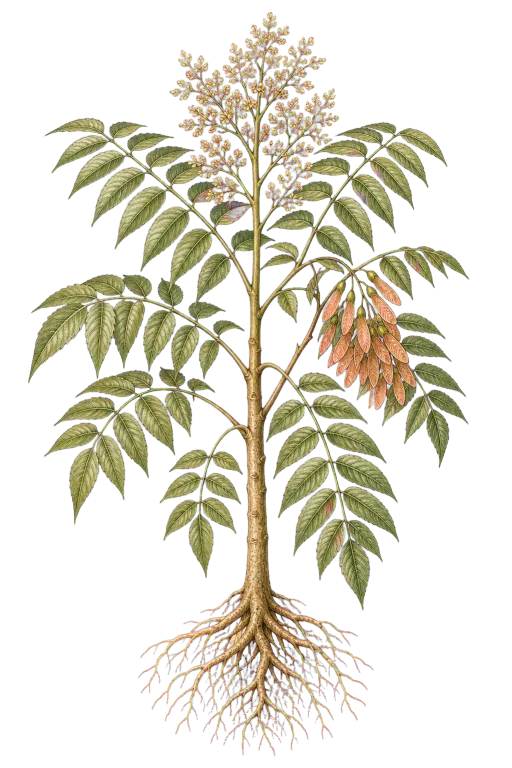
Pinnately compound, often bitter-tasting leaves on trees; small, regular flowers sit atop a fleshy disc and ripen into a cluster of small drupes, with bark and wood carrying an intensely bitter taste throughout the family.
Quassin and related bitter compounds, concentrated in bark and wood, are so intensely bitter they are used commercially as a natural insecticide and bittering agent, detectable at only a few parts per million.
Which Simaroubaceae species is this?
Answer what you can see and narrow it down to a single Simaroubaceae species.
To check whether a plant belongs to Simaroubaceae, compare the leaf arrangement, leaf type, flower symmetry, fruit type, and one distinctive marker together. A single feature can mislead; the family pattern is the combination.
Learn the full family-identification methodFamilies that can look similar
Rutaceae
Compare against Rutaceae when the plant shares similar leaves, flowers, or fruit. Confirm by checking the full family pattern.
Compare RutaceaeMeliaceae
Compare against Meliaceae when the plant shares similar leaves, flowers, or fruit. Confirm by checking the full family pattern.
Compare MeliaceaeAnacardiaceae
Compare against Anacardiaceae when the plant shares similar leaves, flowers, or fruit. Confirm by checking the full family pattern.
Compare AnacardiaceaeSapindaceae
Compare against Sapindaceae when the plant shares similar leaves, flowers, or fruit. Confirm by checking the full family pattern.
Compare SapindaceaeMeet Simaroubaceae in the field
Point your camera, explore possible matches and compare the field marks. Identification runs on your phone, offline and private.
Download SASYA — Free