
Morpankhi / Oriental Arbor-Vitae
Thuja orientalis
- Habit
- Tree
- Found in India
- West Bengal, Maharashtra
How to identify Morpankhi
Identify Morpankhi by combining habit, leaf characters, flower or fruit details, location, and its family pattern. Do not rely on one feature alone.
- Look for a tree habit.
- Check the distinctive field mark: Flattened fan-like foliage sprays, ornamental hedge conifer.
- Confirm leaf arrangement: Opposite.
- In India, compare location records such as West Bengal, Maharashtra.
- Confirm it sits within the Cupressaceae family pattern, then compare close relatives before deciding it is Morpankhi.
Plant Details
- Scientific name
- Thuja orientalis
- Genus
- Thuja
- Family
- Cupressaceae
- Habit
- Tree
- Habitat
- Planted
- Habitat type
- Cultivated
- Native to
- N. China and Korea
- Distribution
- India, China, North Korea, Russia, Tajikistan, Uzbekistan
- Found in India
- West Bengal, Maharashtra
- Conservation status
- Not Evaluated (NE)
Leaf characters
- Leaf arrangement
- OppositerecordedTwo leaves arise from the stem at the same point, facing each other.“The leaves, arranged in four rows, fleshy, opposite, decussate, truncated, imbricated as adults, somewhat curved inwards, of uniform green color and with a resiniferous gland on th” — Wikipedia, CC BY-SA 4.0
Characters marked “recorded” are for Morpankhi itself; the rest are typical of the Cupressaceae family.
Flower & fruit characters
- Fruit
- Berry
Typical of the Cupressaceae family — flowering plants only; individual species can differ.
Local Names
- Hindi
- मोरपंखी Morpankhi, मयूरपंखी mayurpankhi
- Manipuri
- ꯂꯥꯢꯔꯤꯛꯍꯩꯕꯤ Lairikheibi
- Nepali
- मयूरपंखी mayurpankhi
About Morpankhi
Oriental Arbor-vitae (Thuja orientalis) belongs to the Cupressaceae family, where it grows as a tree. In India it has been recorded in West Bengal and Maharashtra. It is planted.
Uses
Locally it is cut for timber and furniture, planted as an ornamental and distilled for an aromatic oil.
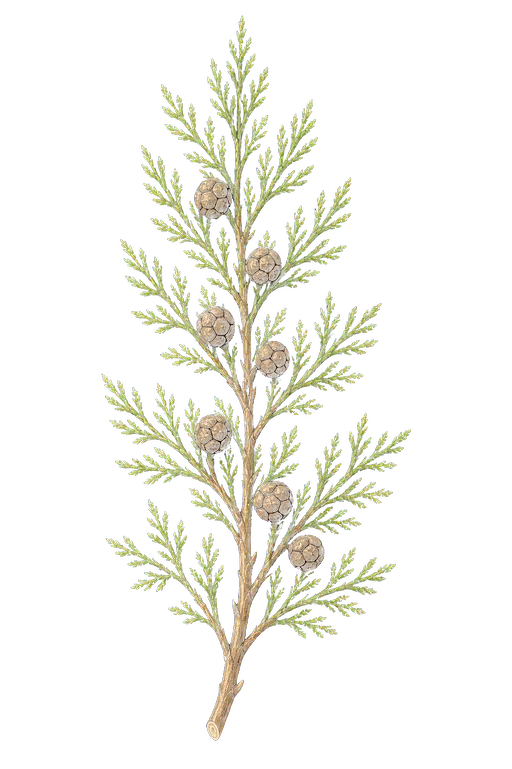
Cupressaceae
Cypress Family
Morpankhi belongs to the Cupressaceae family.
The illustration represents the family — not necessarily this exact species.
Explore the Cupressaceae familySnap it. Know it.
Point your camera at Morpankhi or any plant and SASYA identifies it instantly — on-device, offline, and private.
Common plant problems
If you are starting from symptoms instead of a diagnosis, use the plant disease symptom checker to narrow the cause before treating.
All plant problem & care guides