
Portuguese Cypress
Cupressus lusitanica
- Habit
- Tree
- Found in India
- Arunachal Pradesh, Goa, Maharashtra & more
How to identify Portuguese Cypress
Identify Portuguese Cypress by combining habit, leaf characters, flower or fruit details, location, and its family pattern. Do not rely on one feature alone.
- Look for a tree habit.
- Check the distinctive field mark: Blue-green foliage.
- Confirm leaf shape: Orbicular.
- In India, compare location records such as Arunachal Pradesh, Goa, Maharashtra, Uttarakhand.
- Confirm it sits within the Cupressaceae family pattern, then compare close relatives before deciding it is Portuguese Cypress.
Plant Details
- Scientific name
- Cupressus lusitanica
- Genus
- Cupressus
- Family
- Cupressaceae
- Habit
- Tree
- Habitat
- Planted
- Habitat type
- Cultivated
- Found in India
- Arunachal Pradesh, Goa, Maharashtra, Uttarakhand
- Conservation status
- Not Evaluated (NE)
Leaf characters
- Leaf shape
- OrbicularrecordedRounded, roughly circular.“The leaves are scale-like, 2–5 mm long, and produced on rounded (not flattened) shoots.” — Wikipedia, CC BY-SA 4.0
Characters marked “recorded” are for Portuguese Cypress itself; the rest are typical of the Cupressaceae family.
Flower & fruit characters
- Fruit
- Berry
Typical of the Cupressaceae family — flowering plants only; individual species can differ.
About Portuguese Cypress
Portuguese Cypress (Cupressus lusitanica) is a tree in the Cupressaceae family. In India it has been recorded in Arunachal Pradesh, Goa, Maharashtra and 1 other states. It is planted.
Uses
It is cut for timber and furniture, planted as an ornamental and valued as a shade and avenue tree.
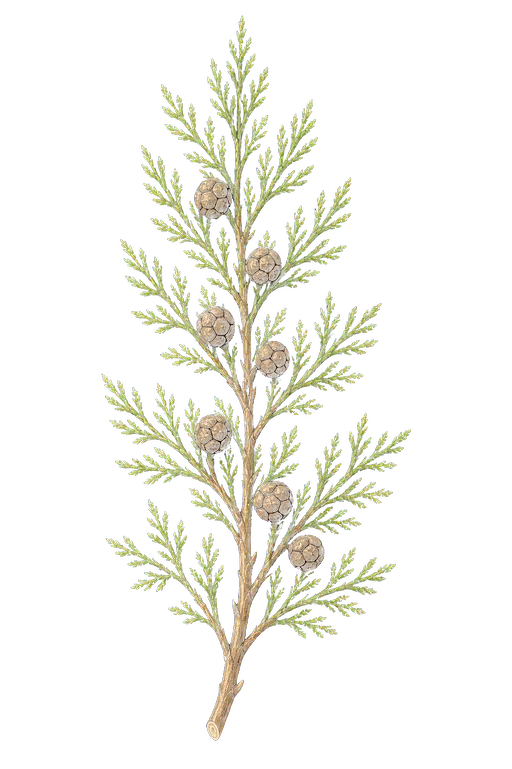
Cupressaceae
Cypress Family
Portuguese Cypress belongs to the Cupressaceae family.
The illustration represents the family — not necessarily this exact species.
Explore the Cupressaceae familySnap it. Know it.
Point your camera at Portuguese Cypress or any plant and SASYA identifies it instantly — on-device, offline, and private.
Common plant problems
If you are starting from symptoms instead of a diagnosis, use the plant disease symptom checker to narrow the cause before treating.
All plant problem & care guides