

Typical of the Combretaceae family
Terminalia paniculata
Kindal / Flowering Murdah किंजळ
Marathi name · See all regional names ↓
Also known as Flowering Murdels
- Habit
- Tree
- Found in India
- Maharashtra, Tamil Nadu, Karnataka & more
- Flowering
- August-January
Kindal in regional languages
Find the name you know, then compare it with the botanical profile. Columns list recorded aliases; they are not paired translations. A Latin spelling appears only when it is present in the source record.
| Language | Regional script | Recorded Latin spelling |
|---|---|---|
| Hindi | Not recorded | kindal |
| Tamil | பூமருது | Pumarutu, Vadamarudu, Venmaruthu |
| Telugu | చిరిమాను | Putanallamanu |
| Kannada | ಹುಲಿವೆ · ಹುಲುವೆ · ಹೊನಗಲು | Hulive, Huluve, Honagalu |
| Malayalam | Not recorded | Pullamaruthu, Pumarutu, Maruthu |
| Marathi | किंजळ | Kindal, Kinjal |
See the original recorded names
- Hindi
- kindal
- Tamil
- பூமருது Pumarutu, Vadamarudu, Venmaruthu
- Telugu
- Putanallamanu, చిరిమాను
- Kannada
- ಹುಲಿವೆ Hulive, ಹುಲುವೆ Huluve, ಹೊನಗಲು Honagalu
- Malayalam
- Pullamaruthu, Pumarutu, Maruthu
- Marathi
- Kindal, Kinjal, किंजळ
Ecology & growing context
- Native status · Kew WCVP
- WCVP native range includes India Kew dataset ↗
Kew WCVP dataset; accepted-name match. Dataset matching is separate from an individual regional review. Recorded worldwide native range: S. India.
- Recorded habitat
- Moist and dry deciduous fotests, also in the plains
- Explore nearby plants
- Maharashtra →Tamil Nadu →Karnataka →
Occurrence records show where a plant has been recorded; they do not establish that it is native there. Compare local habitat and growing conditions when choosing plants for a garden.
How to identify Kindal
Identify Kindal by combining habit, leaf characters, flower or fruit details, location, and its family pattern. Do not rely on one feature alone.
- Look for a tree habit.
- Confirm fruit type: Winged.
- In season, compare flowering and fruiting time: August-January.
- In India, compare location records such as Maharashtra, Tamil Nadu, Karnataka, Kerala and nearby regions.
- Confirm it sits within the Combretaceae family pattern, then compare close relatives before deciding it is Kindal.
Plant Details
- Scientific name
- Terminalia paniculata
- Genus
- Terminalia
- Family
- Combretaceae
- Habit
- Tree
- Habitat
- Moist and dry deciduous fotests, also in the plains
- Habitat type
- Forest
- Native to
- India
- Distribution
- India
- Found in India
- Maharashtra, Tamil Nadu, Karnataka, Kerala, Uttarakhand, Andhra Pradesh, Goa, Uttar Pradesh, Assam
- Flowering & fruiting
- August-January
- Conservation status
- Not Evaluated (NE)
Leaf characters



Typical of the Combretaceae family — a field-mark hint, not measured for this exact species.
Flower & fruit characters
- Fruit type
- Wingedrecorded
Typical of the family
- Inflorescence
- Spike



Characters marked “recorded” are for Kindal itself; the rest are typical of the Combretaceae family — flowering plants only.
About Kindal
A member of the Combretaceae family, Flowering Murdah (Terminalia paniculata) is a tree. In India it has been recorded in Maharashtra, Tamil Nadu, Karnataka and 6 other states. It grows in moist and dry deciduous fotests, also in the plains. Flowering and fruiting run from August to January.
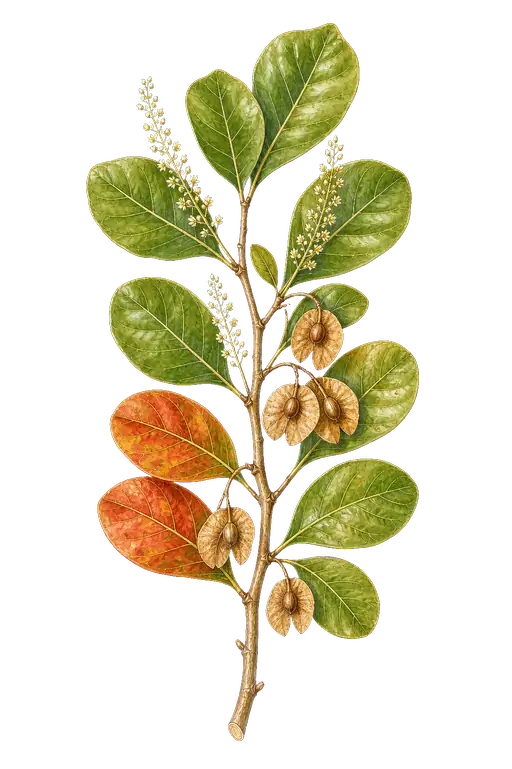
Combretaceae
Indian almond family
Kindal belongs to the Combretaceae family.
The illustration represents the family — not necessarily this exact species.
Explore the Combretaceae familySnap it. Know it.
Point your camera at Kindal or any plant and SASYA identifies it instantly — on-device, offline, and private.
Common plant problems
If you are starting from symptoms instead of a diagnosis, use the plant disease symptom checker to narrow the cause before treating.
All plant problem & care guides