
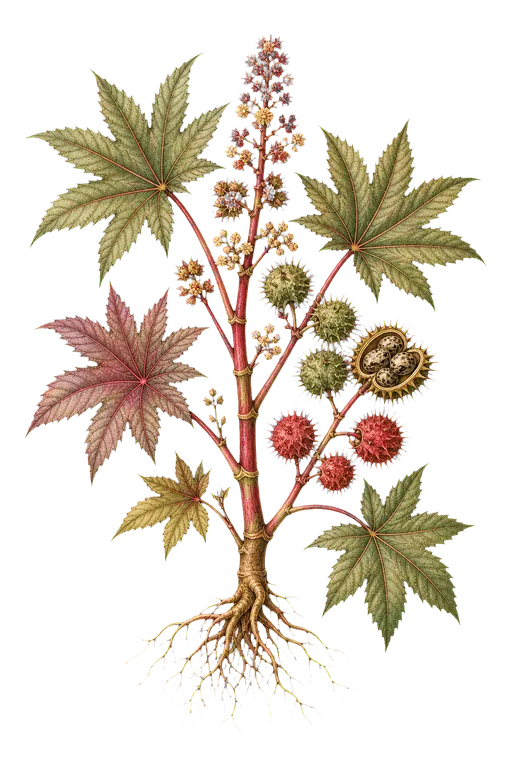
Arandi / Castor Plant
Ricinus communis
Also known as Castorbean, Krapata, Palma Christi, Ricin
- Habit
- Shrub
- Found in India
- Maharashtra, Tamil Nadu, Telangana & more
- Flowering
- Throughout the year
How to identify Arandi
Identify Arandi by combining habit, leaf characters, flower or fruit details, location, and its family pattern. Do not rely on one feature alone.
- Look for a shrub habit.
- Check the distinctive field mark: Large palmate leaves, spiny red seed capsules (castor bean).
- Confirm leaf arrangement: Alternate.
- Confirm leaf margin: Toothed.
- Confirm flower colour: Red.
- Confirm flower arrangement: Panicle.
- Use the leaf pattern: alternate leaf arrangement, simple leaves, toothed leaf margins, palmate venation.
Plant Details
- Scientific name
- Ricinus communis
- Genus
- Ricinus
- Family
- Euphorbiaceae
- Habit
- Shrub
- Native to
- Tropical Africa
- Distribution
- Cultivated Throughout tropics
- Found in India
- Maharashtra, Tamil Nadu, Telangana, Karnataka, Kerala, Andhra Pradesh, Assam, Uttarakhand, West Bengal, Uttar Pradesh, Rajasthan, Goa, Madhya Pradesh, Delhi, Odisha, Gujarat, Haryana, Punjab, Chhattisgarh, Himachal Pradesh, Bihar, Puducherry, Arunachal Pradesh, Mizoram, Jharkhand, Chandigarh, Jammu & Kashmir, Lakshadweep, Manipur, Sikkim, Tripura, Meghalaya, Nagaland
- Flowering & fruiting
- Throughout the year
- Conservation status
- Not Evaluated (NE)
Leaf characters
- Leaf arrangement
- AlternaterecordedOne leaf per node, arranged in a spiral or zigzag up the stem.“The glossy leaves are 15–45 centimetres (6–18 inches) long, long-stalked, alternate and palmate with five to twelve deep lobes with coarsely toothed segments.” — Wikipedia, CC BY-SA 4.0
- Leaf margin
- ToothedrecordedA saw-like or jagged edge (serrate or dentate).“The glossy leaves are 15–45 centimetres (6–18 inches) long, long-stalked, alternate and palmate with five to twelve deep lobes with coarsely toothed segments.” — Wikipedia, CC BY-SA 4.0
- Leaf surface
- Glabrous (smooth, hairless)recorded
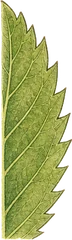
Typical of the family


Characters marked “recorded” are for Arandi itself; the rest are typical of the Euphorbiaceae family.
Flower & fruit characters
- Flower colour
- Redrecorded
- Flower arrangement
- PaniclerecordedA branching cluster of clusters.“The flowers lack petals and are unisexual (male and female) where both types are borne on the same plant (monoecious) in terminal panicle-like inflorescences of green or, in some v” — Wikipedia, CC BY-SA 4.0
- Fruit type
- CapsulerecordedA dry fruit from a fused ovary that splits open at maturity to release seeds.“The stems and the spherical, spiny seed capsules also vary in pigmentation.” — Wikipedia, CC BY-SA 4.0
Typical of the family
- Flower symmetry
- Actinomorphic (radially symmetrical)
- Inflorescence
- Cyme
- Fruit
- Capsule
Characters marked “recorded” are for Arandi itself; the rest are typical of the Euphorbiaceae family — flowering plants only.
Local Names
- Hindi
- Arandi अरंडी,अरंडी arandi,अरण्डी arandi
- Nepali
- अंडेर Ander, अँडिर
- Bengali
- Veranda, ভেন্না
- Tamil
- ஆமணக்கு மரம், ஆமணக்கு
- Telugu
- ఆముదము, ఆముదం
- Kannada
- ಹರಳು Haralu, ಔಡಲ Oudala, ಅವುಂಡಲಗೆ
- Malayalam
- Chittamankku, ആവണക്ക്, ഏരണ്ഡ
- Marathi
- एरंड
- Gujarati
- દિવેલી
Arandi in India
The castor plant is a familiar tall weed and oilseed crop across India — Arandi अरंडी (Hindi), ஆமணக்கு மரம் (Tamil), ఆముదము (Telugu), ಹರಳು Haralu (Kannada), Chittamankku (Malayalam), एरंड (Marathi). Ricinus communis is recorded across Maharashtra, Tamil Nadu, Telangana, Karnataka, Kerala, Andhra Pradesh, on waste ground and as a cultivated crop.
Uses
Its seeds yield castor oil, long used traditionally as a lamp oil, lubricant and laxative, and now in industry — attributed traditional uses. Crucially, the raw seeds contain ricin and are highly poisonous, so the seeds must never be eaten; only properly processed oil is used.
How to Identify Arandi
A fast-growing, often reddish-stemmed shrubby herb with very large, glossy, star-shaped (palmate) lobed leaves. The spiny rounded seed capsules cluster at the top and split to reveal glossy, mottled, bean-like seeds.
Frequently Asked Questions
- What is Castor Plant called in different Indian languages?
- Arandi अरंडी (Hindi); ஆமணக்கு மரம் (Tamil); ఆముదము (Telugu); ಹರಳು Haralu (Kannada); Chittamankku (Malayalam); एरंड (Marathi); Veranda (Bengali); દિવેલી (Gujarati).
- Are castor seeds poisonous?
- Yes — raw castor seeds contain ricin and are highly toxic; only correctly processed castor oil is safe, and the seeds should never be eaten.
- What is castor oil used for?
- Castor oil has long traditional use as a laxative, lamp oil and lubricant, and is widely used in industry and cosmetics today.
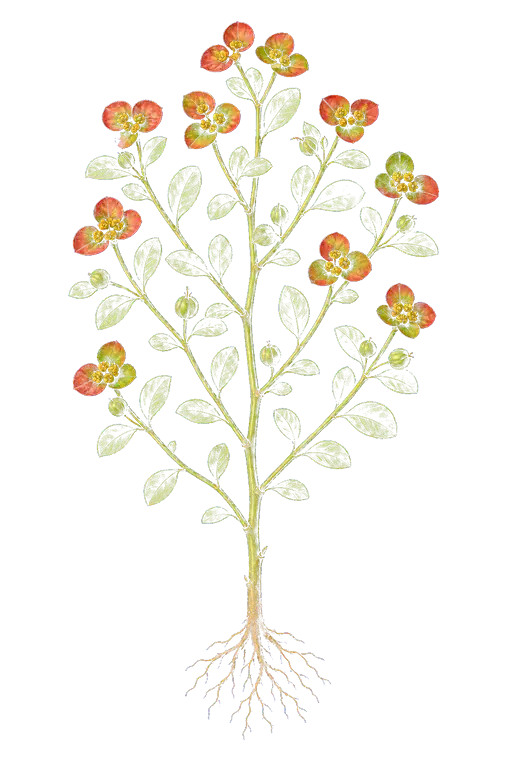
Euphorbiaceae
Spurge/Euphorbia family
Arandi belongs to the Euphorbiaceae family.
The illustration represents the family — not necessarily this exact species.
Explore the Euphorbiaceae familySnap it. Know it.
Point your camera at Arandi or any plant and SASYA identifies it instantly — on-device, offline, and private.
Common plant problems
If you are starting from symptoms instead of a diagnosis, use the plant disease symptom checker to narrow the cause before treating.
All plant problem & care guidesMore in Euphorbiaceae
View all EuphorbiaceaeSources: GBIF — Ricinus communis (India distribution & vernacular names) (CC BY 4.0) · iNaturalist — Ricinus communis (regional names, India observations) (CC BY 4.0) · Wikipedia — Ricinus communis (background/comprehension only) (CC BY-SA 4.0)