
Cat's Tail
Acalypha hispida
Also known as Chenille Plant, Red-Hot Cat's Tail, Foxtail, Red Hot Poker
- Habit
- Shrub
- Found in India
- Kerala, Maharashtra, Karnataka & more
- Flowering
- Throughout the year
How to identify Cat's Tail
Identify Cat's Tail by combining habit, leaf characters, flower or fruit details, location, and its family pattern. Do not rely on one feature alone.
- Look for a shrub habit.
- Check the distinctive field mark: Long drooping red fuzzy catkin flower spikes (red-hot cat's tail).
- Confirm leaf margin: Toothed (serrate/dentate edge).
- Confirm leaf surface: Hirsute (coarsely hairy).
- Confirm flower colour: Red.
- Confirm flower arrangement: Catkin.
- In season, compare flowering and fruiting time: Throughout the year.
Plant Details
- Scientific name
- Acalypha hispida
- Genus
- Acalypha
- Family
- Euphorbiaceae
- Habit
- Shrub
- Habitat
- Grown as ornamental plant
- Habitat type
- Cultivated
- Native to
- Papua New Guinea
- Distribution
- Cultivated in most parts of the world
- Found in India
- Kerala, Maharashtra, Karnataka, Tamil Nadu, Telangana, Assam, West Bengal, Goa, Andhra Pradesh, Puducherry, Haryana, Arunachal Pradesh, Bihar, Chhattisgarh, Gujarat, Mizoram, Uttar Pradesh
- Flowering & fruiting
- Throughout the year
- Conservation status
- Not Evaluated (NE)
Leaf characters
- Leaf margin
- Toothed (serrate/dentate edge)recorded
- Leaf surface
- Hirsute (coarsely hairy)recorded
Typical of the family
- Arrangement
- Alternate


Characters marked “recorded” are for Cat's Tail itself; the rest are typical of the Euphorbiaceae family.
Flower & fruit characters
- Flower colour
- Redrecorded
- Flower arrangement
- CatkinrecordedA slim, often dangling spike of tiny, usually wind-pollinated flowers.“The female plant bears pistillate flowers which are 0.7 millimeters long and range in color from purple to bright red, and grow in clusters along catkins that can grow up to fifty ” — Wikipedia, CC BY-SA 4.0
Typical of the family
- Flower symmetry
- Actinomorphic (radially symmetrical)
- Inflorescence
- Cyme
- Fruit
- Capsule
Characters marked “recorded” are for Cat's Tail itself; the rest are typical of the Euphorbiaceae family — flowering plants only.
Local Names
- Telugu
- అకాలిఫా
About Cat's Tail
Cat's tail (Acalypha hispida) is a shrub in the Euphorbiaceae family. In India it has been recorded in Kerala, Maharashtra, Karnataka and 14 other states. It is grown as ornamental plant. It flowers and fruits through much of the year.
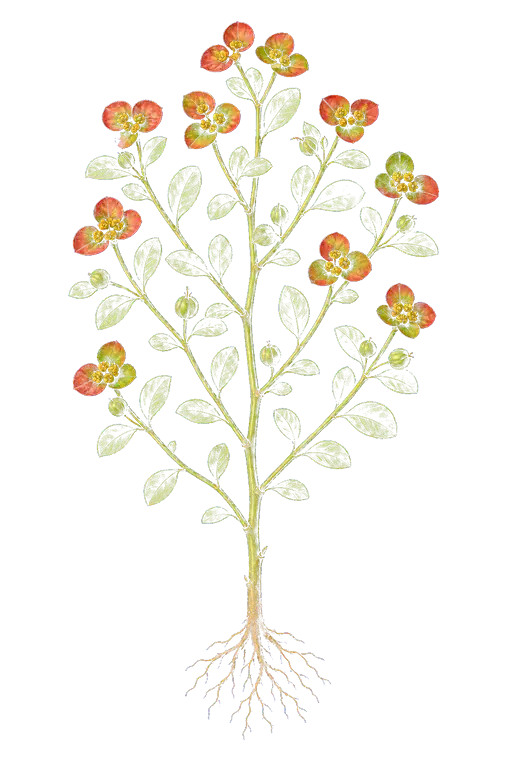
Euphorbiaceae
Spurge/Euphorbia family
Cat's Tail belongs to the Euphorbiaceae family.
The illustration represents the family — not necessarily this exact species.
Explore the Euphorbiaceae familySnap it. Know it.
Point your camera at Cat's Tail or any plant and SASYA identifies it instantly — on-device, offline, and private.
Common plant problems
If you are starting from symptoms instead of a diagnosis, use the plant disease symptom checker to narrow the cause before treating.
All plant problem & care guides