
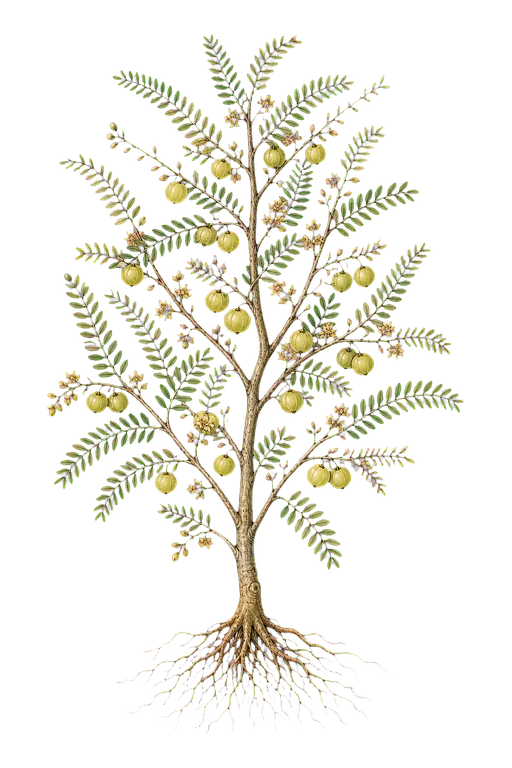
Anvala / Indian Gooseberry
Phyllanthus emblica
Also known as Emblic Myrobalan
- Habit
- Tree
- Found in India
- Maharashtra, Telangana, Karnataka & more
- Flowering
- July-May
How to identify Anvala
Identify Anvala by combining habit, leaf characters, flower or fruit details, location, and its family pattern. Do not rely on one feature alone.
- Look for a tree habit.
- Check the distinctive field mark: Sour edible fruit rich in vitamin C (Indian gooseberry/amla).
- Confirm leaf type: Pinnately compound.
- Confirm leaf margin: Entire (smooth edge).
- Confirm flower colour: Green.
- Use the leaf pattern: alternate leaf arrangement, simple leaves, entire leaf margins, pinnate venation.
- In season, compare flowering and fruiting time: July-May.
Plant Details
- Scientific name
- Phyllanthus emblica
- Genus
- Phyllanthus
- Family
- Euphorbiaceae
- Habit
- Tree
- Distribution
- India, Himalayas, Myanmar, China, Malaysia, Nepal
- Found in India
- Maharashtra, Telangana, Karnataka, Tamil Nadu, Rajasthan, Kerala, Madhya Pradesh, Gujarat, Uttarakhand, Assam, Mizoram, Andhra Pradesh, West Bengal, Uttar Pradesh, Delhi, Himachal Pradesh, Odisha, Chhattisgarh, Bihar, Manipur, Puducherry, Punjab, Chandigarh, Haryana, Meghalaya, Nagaland, Arunachal Pradesh, Goa, Jammu & Kashmir, Sikkim, Tripura
- Flowering & fruiting
- July-May
- Conservation status
- Not Evaluated (NE)
Leaf characters
- Leaf type
- Pinnately compoundrecordedLeaflets are arranged in rows along a central stalk, like a feather.“The leaves are simple, subsessile and closely set along branchlets, light green, resembling pinnate leaves.” — Wikipedia, CC BY-SA 4.0
- Leaf margin
- Entire (smooth edge)recorded
- Leaf surface
- Glabrous (smooth, hairless)recorded
Typical of the family
- Arrangement
- Alternate

Characters marked “recorded” are for Anvala itself; the rest are typical of the Euphorbiaceae family.
Flower & fruit characters
- Flower colour
- GreenrecordedGreen or greenish
Typical of the family
- Flower symmetry
- Actinomorphic (radially symmetrical)
- Inflorescence
- Cyme
- Fruit
- Capsule
Characters marked “recorded” are for Anvala itself; the rest are typical of the Euphorbiaceae family — flowering plants only.
Local Names
- Hindi
- आँवला anvala,आंवला anvala
- Nepali
- अमला
- Bengali
- আমলকী, আমলকি
- Tamil
- நெல்லி
- Telugu
- ఉసిరి, అమ్ల, ఉసిరి కాయ
- Kannada
- ನೆಲ್ಲಿ
- Malayalam
- നെല്ലി, Indian gooseberry, അമ്ലകി
- Marathi
- आवळा
- Sanskrit
- Amla, amalaka
- Urdu
- Amla
Anvala in India
Amla, the Indian gooseberry, is one of the most important plants in Indian tradition — आँवला (Hindi), நெல்லி (Tamil), ఉసిరి (Telugu), ನೆಲ್ಲಿ (Kannada), നെല്ലി (Malayalam), आवळा (Marathi). Phyllanthus emblica grows wild and cultivated across Maharashtra, Telangana, Karnataka, Tamil Nadu, Rajasthan, Kerala, in dry forests and orchards alike.
Uses
The sour, astringent fruit is a cornerstone of Ayurveda and a key ingredient of chyawanprash and triphala — attributed traditional uses. In the kitchen it becomes murabba, pickle, candy and juice, and it is valued as a rich, natural source of vitamin C.
How to Identify Anvala
A medium tree with feathery sprays of small leaflets that look almost like a compound leaf but sit on slender twigs. The greenish-yellow fruits are round, smooth and faintly six-lined, hard and very sour when fresh. Leaves and fruit often appear together along the branchlets.
Frequently Asked Questions
- What is Indian Gooseberry called in different Indian languages?
- आँवला (Hindi); நெல்லி (Tamil); ఉసిరి (Telugu); ನೆಲ್ಲಿ (Kannada); നെല്ലി (Malayalam); आवळा (Marathi); আমলকী (Bengali); Amla (Sanskrit).
- What is amla used for in Ayurveda?
- Amla is a central rasayana ingredient and a component of triphala and chyawanprash; these are traditional Ayurvedic uses, described here for information rather than as medical advice.
- Can you eat raw amla?
- Yes, though it is intensely sour and astringent — it is often eaten with salt, made into murabba or candy, or juiced.
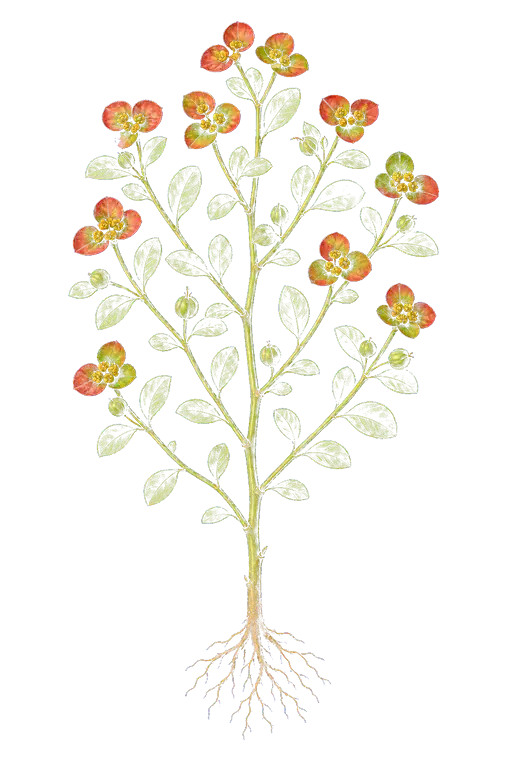
Euphorbiaceae
Spurge/Euphorbia family
Anvala belongs to the Euphorbiaceae family.
The illustration represents the family — not necessarily this exact species.
Explore the Euphorbiaceae familySnap it. Know it.
Point your camera at Anvala or any plant and SASYA identifies it instantly — on-device, offline, and private.
Common plant problems
If you are starting from symptoms instead of a diagnosis, use the plant disease symptom checker to narrow the cause before treating.
All plant problem & care guidesMore in Euphorbiaceae
View all EuphorbiaceaeSources: GBIF — Phyllanthus emblica (India distribution & vernacular names) (CC BY 4.0) · iNaturalist — Phyllanthus emblica (regional names, India observations) (CC BY 4.0) · Wikipedia — Phyllanthus emblica (background/comprehension only) (CC BY-SA 4.0)