
Bongi / Himalayan Screw Pine
Pandanus furcatus
- Habit
- Shrub
- Found in India
- Arunachal Pradesh, Maharashtra, West Bengal & more
- Flowering
- October-April
How to identify Bongi
Identify Bongi by combining habit, leaf characters, flower or fruit details, location, and its family pattern. Do not rely on one feature alone.
- Look for a shrub habit.
- Check the distinctive field mark: Found in Himalayan foothill forests.
- Confirm leaf shape: Linear.
- Confirm leaf margin: Toothed.
- Confirm flower colour: Yellow.
- Confirm fruit type: Drupe.
- In season, compare flowering and fruiting time: October-April.
Plant Details
- Scientific name
- Pandanus furcatus
- Genus
- Pandanus
- Family
- Pandanaceae
- Habit
- Shrub
- Habitat
- Along river banks
- Habitat type
- Wetland
- Distribution
- Indo-Malesia
- Found in India
- Arunachal Pradesh, Maharashtra, West Bengal, Goa, Kerala, Meghalaya, Sikkim, Uttarakhand
- Flowering & fruiting
- October-April
- Conservation status
- Not Evaluated (NE)
Leaf characters
- Leaf shape
- LinearrecordedVery long and narrow with roughly parallel sides.“The crown is made up of linear leaves 5 m long, pale-green, with finely toothed margins, rarely up to 6 m long (exceeded in the genus only by Pandanus laxespicatus).” — Wikipedia, CC BY-SA 4.0
- Leaf margin
- ToothedrecordedA saw-like or jagged edge (serrate or dentate).“The crown is made up of linear leaves 5 m long, pale-green, with finely toothed margins, rarely up to 6 m long (exceeded in the genus only by Pandanus laxespicatus).” — Wikipedia, CC BY-SA 4.0
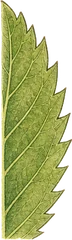
Typical of the family


Characters marked “recorded” are for Bongi itself; the rest are typical of the Pandanaceae family.
Flower & fruit characters
- Flower colour
- Yellowrecorded“The leathery flower spathes are golden-yellow, the lowermost are largest and about 1m in length.” — Wikipedia, CC BY-SA 4.0
- Fruit type
- DruperecordedA fleshy fruit with a single hard stone/pit enclosing the seed.“These give rise to cone-like fruit, 15–25 cm long, that are bright orange to red when mature and consist of numerous 5-6 angled drupes;” — Wikipedia, CC BY-SA 4.0
Typical of the family
- Inflorescence
- Umbel
- Fruit
- Drupe
Characters marked “recorded” are for Bongi itself; the rest are typical of the Pandanaceae family — flowering plants only.
Local Names
- Nepali
- तारिका Tarika, केउरा Keura, वनतरी Vanataree
- Malayalam
- Kaida-tsjeria, Cheriyakaita, Kaidatsjerria
- Marathi
- Bongi
About Bongi
Himalayan Screw Pine (Pandanus furcatus) is a shrub in the Pandanaceae family. In India it has been recorded in Arunachal Pradesh, Maharashtra, West Bengal and 5 other states. It grows in along river banks. Flowering and fruiting run from October to April.
Uses
In practice it is grown for parts that are eaten.
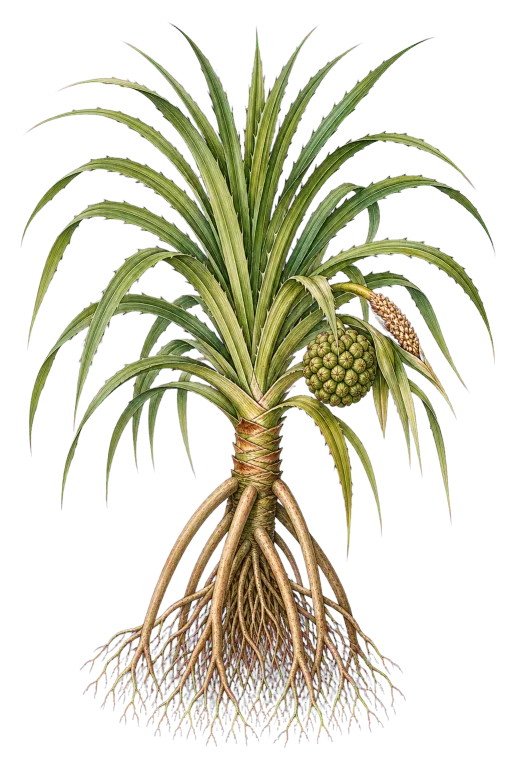
Pandanaceae
Screw-Pine Family
Bongi belongs to the Pandanaceae family.
The illustration represents the family — not necessarily this exact species.
Explore the Pandanaceae familySnap it. Know it.
Point your camera at Bongi or any plant and SASYA identifies it instantly — on-device, offline, and private.
Common plant problems
If you are starting from symptoms instead of a diagnosis, use the plant disease symptom checker to narrow the cause before treating.
All plant problem & care guides