
Bidyaale Bidisale / Dolls Eyes
Harpullia arborea
Also known as Mogum-Mogum
- Habit
- Tree
- Found in India
- Tamil Nadu, Karnataka, Assam & more
- Flowering
- December-August
How to identify Bidyaale Bidisale
Identify Bidyaale Bidisale by combining habit, leaf characters, flower or fruit details, location, and its family pattern. Do not rely on one feature alone.
- Look for a tree habit.
- Check the distinctive field mark: Orange capsules revealing shiny black seeds (doll's eyes).
- Confirm leaf type: Pinnately compound.
- Confirm leaf shape: Ovate.
- Confirm flower arrangement: Raceme.
- Confirm fruit type: Capsule.
- In season, compare flowering and fruiting time: December-August.
Plant Details
- Scientific name
- Harpullia arborea
- Genus
- Harpullia
- Family
- Sapindaceae
- Habit
- Tree
- Habitat
- Along streams in semi-evergreen and Evergreen forests
- Native to
- Indo-Malaysia
- Distribution
- India, Andaman & Nicobar Islands (India), Myanmar, Sri Lanka, Sumatra, Java, Borneo, Australia
- Found in India
- Tamil Nadu, Karnataka, Assam, Kerala, Maharashtra
- Flowering & fruiting
- December-August
- Conservation status
- Not Evaluated (NE)
Leaf characters
- Leaf type
- Pinnately compoundrecordedLeaflets are arranged in rows along a central stalk, like a feather.“Its leaves are paripinnate, 40–220 mm (1.6–8.7 in) long with 6 to 10 elliptic to egg-shaped leaflets with the narrower end towards the base, mostly 100–190 mm (3.9–7.5 in) long and” — Wikipedia, CC BY-SA 4.0
- Leaf shape
- OvaterecordedEgg-shaped, broader near the base.“Its leaves are paripinnate, 40–220 mm (1.6–8.7 in) long with 6 to 10 elliptic to egg-shaped leaflets with the narrower end towards the base, mostly 100–190 mm (3.9–7.5 in) long and” — Wikipedia, CC BY-SA 4.0
Typical of the family
- Arrangement
- Alternate


Characters marked “recorded” are for Bidyaale Bidisale itself; the rest are typical of the Sapindaceae family.
Flower & fruit characters
- Flower arrangement
- RacemerecordedIndividual stalked flowers arranged along a central stem, opening from bottom to top.“Separate male and female flowers are borne on the same plant, usually in racemes in , sometimes on old wood, and are 40–220 mm (1.6–8.7 in) long.” — Wikipedia, CC BY-SA 4.0
- Fruit type
- CapsulerecordedA dry fruit from a fused ovary that splits open at maturity to release seeds.“The fruit is a broadly heart-shaped, orange-yellow to red capsule 15–23 mm (0.59–0.91 in) long, containing shiny black seeds.” — Wikipedia, CC BY-SA 4.0
- Fruit surface
- SmoothrecordedSmooth, unornamented surface.
Typical of the family
- Flower symmetry
- Actinomorphic (radially symmetrical)
- Inflorescence
- Panicle
- Fruit
- Capsule
Characters marked “recorded” are for Bidyaale Bidisale itself; the rest are typical of the Sapindaceae family — flowering plants only.
Local Names
- Tamil
- நெய்க் கொட்டை
- Kannada
- ಬಿಡ್ಯಾಲೆ Bidyaale ಬಿಡಿಸಾಳೆ Bidisale
- Malayalam
- ചിറ്റിലമടക്ക് cirrilamatakk, ചിറ്റിലമടക്ക്
- Marathi
- हारपुळी harpuli
About Bidyaale Bidisale
Dolls eyes (Harpullia arborea) is a tree in the Sapindaceae family. In India it has been recorded in Tamil Nadu, Karnataka, Assam and 2 other states. It grows in along streams in semi-evergreen and Evergreen forests. Flowering and fruiting run from December to August.
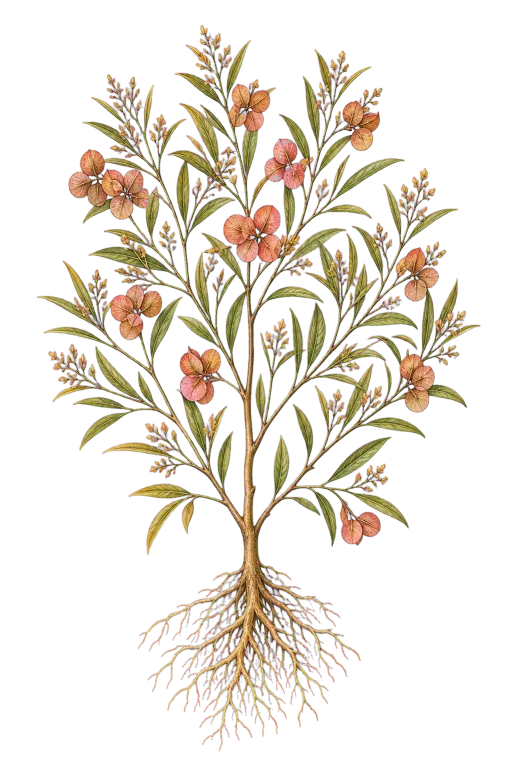
Sapindaceae
Soapberry/Lychee family
Bidyaale Bidisale belongs to the Sapindaceae family.
The illustration represents the family — not necessarily this exact species.
Explore the Sapindaceae familySnap it. Know it.
Point your camera at Bidyaale Bidisale or any plant and SASYA identifies it instantly — on-device, offline, and private.
Common plant problems
If you are starting from symptoms instead of a diagnosis, use the plant disease symptom checker to narrow the cause before treating.
All plant problem & care guides