
Bachnag / Malabar Glory Lily
Gloriosa superba
Also known as Tiger Claw Lily, Glorious Lily, Climbing Lily
- Habit
- Climber
- Found in India
- Karnataka, Maharashtra, Tamil Nadu & more
- Flowering
- July-November
How to identify Bachnag
Identify Bachnag by combining habit, leaf characters, flower or fruit details, location, and its family pattern. Do not rely on one feature alone.
- Look for a climber habit.
- Check the distinctive field mark: Flame-shaped flowers with backward-curling petals, leaf tips modified into tendrils (glory lily).
- Confirm leaf arrangement: Opposite.
- Confirm leaf shape: Tendril-tipped.
- Confirm flower colour: Red/yellow flame-colored.
- Confirm fruit type: Capsule.
- In season, compare flowering and fruiting time: July-November.
Plant Details
- Scientific name
- Gloriosa superba
- Genus
- Gloriosa
- Family
- Liliaceae
- Habit
- Climber
- Habitat
- Semi-evergreen, moist deciduous and dry deciduous forests, also in the plains
- Habitat type
- Forest
- Native to
- Paleotropics
- Distribution
- Tropical Africa, Madagascar, India, China, Malaysia
- Found in India
- Karnataka, Maharashtra, Tamil Nadu, Kerala, Andhra Pradesh, Telangana, Gujarat, Madhya Pradesh, Goa, Rajasthan, Uttarakhand, Chhattisgarh, Odisha, West Bengal, Assam, Puducherry, Andaman & Nicobar Islands, Bihar, Uttar Pradesh, Himachal Pradesh, Arunachal Pradesh, Haryana, Jammu & Kashmir, Jharkhand, Sikkim
- Flowering & fruiting
- July-November
- Conservation status
- Least Concern (LC)
Leaf characters
- Leaf arrangement
- OppositerecordedTwo leaves arise from the stem at the same point, facing each other.“The leaves are mainly alternately arranged, but they may be opposite, as well.” — Wikipedia, CC BY-SA 4.0
- Leaf shape
- Tendril-tippedrecorded
Typical of the family



Characters marked “recorded” are for Bachnag itself; the rest are typical of the Liliaceae family.
Flower & fruit characters
- Flower colour
- Red/yellow flame-coloredrecorded
- Fruit type
- CapsulerecordedA dry fruit from a fused ovary that splits open at maturity to release seeds.“The fruit is a fleshy capsule up to 6 to 12 cm (2.4 to 4.7 in) long containing red seeds.” — Wikipedia, CC BY-SA 4.0
Typical of the family
- Flower symmetry
- Actinomorphic (radially symmetrical)
- Inflorescence
- Raceme
- Fruit
- Capsule
Characters marked “recorded” are for Bachnag itself; the rest are typical of the Liliaceae family — flowering plants only.
Local Names
- Hindi
- बचनाग bachnag, kadyanag, करी हरी kari hari
- Nepali
- नेपाली केवारा Nepali kewara
- Bengali
- Bishalanguli, Ulatchandal, উলট চন্ডাল
- Tamil
- செங்காந்தள் Chenkantal, கலப்பை கிழங்கு Kallappai kilangu, கோடல்
- Telugu
- అగ్నీసిఖా Agnisikha, అగ్నిశిఖ, అడవినాభి
- Kannada
- ಅಗ್ನಿಶಿಖೆ Agnisikhe, ಶಿವಶಕ್ತಿ Shivashakti, Karadikanninagadde, ಅಗ್ನಿಶಿಖೆ
- Malayalam
- Kithonni, Mendoni, കാളിഹാരി
- Marathi
- कळ लावी Kal-lavi, indai, khadyanag, अग्निशिखा
- Gujarati
- અગ્નિશિખા, વછનાગ
- Odia
- କଲିହାରି
- Punjabi
- ਕਲਿਹਾਰੀ
- Assamese
- কলিহাৰী
- Sinhala
- නියඟලා
Bachnag in India
This climbing lily, known as बचनाग bachnag (Hindi), செங்காந்தள் Chenkantal (Tamil), అగ్నీసిఖా Agnisikha (Telugu), ಅಗ್ನಿಶಿಖೆ Agnisikhe (Kannada), Kithonni (Malayalam), कळ लावी Kal-lavi (Marathi), is prized for its dramatic flame-like flowers and is the state flower of Tamil Nadu. Gloriosa superba is found across Karnataka, Maharashtra, Tamil Nadu, Kerala, Andhra Pradesh, Telangana, often scrambling through hedges and forest edges.
Uses
It's grown ornamentally for its striking recurved flowers, and its alkaloids have long been of interest to researchers — but every part of the plant, especially the tuberous roots, is highly toxic if eaten, and the tubers have been mistaken for edible yams with fatal results. Do not handle or ingest any part without expert guidance.
How to Identify Bachnag
A slender climber that grips supports using curling tendrils at the tips of its leaves. Flowers are large and dramatic, with wavy, backward-curving petals that open yellow at the base and deepen to fiery red at the tips, giving the plant its 'glory' name.
Frequently Asked Questions
- What is Malabar Glory Lily called in different Indian languages?
- बचनाग bachnag (Hindi); செங்காந்தள் Chenkantal (Tamil); అగ్నీసిఖా Agnisikha (Telugu); ಅಗ್ನಿಶಿಖೆ Agnisikhe (Kannada); Kithonni (Malayalam); कळ लावी Kal-lavi (Marathi); Bishalanguli (Bengali); અગ્નિશિખા (Gujarati); କଲିହାରି (Odia); ਕਲਿਹਾਰੀ (Punjabi).
- Is Glory Lily poisonous?
- Yes — the entire plant, and especially its tuberous roots, is highly toxic if ingested; the tubers have been fatally mistaken for edible yams, so it should never be eaten or handled carelessly.
- Why is it Tamil Nadu's state flower?
- Its dramatic, flame-shaped flowers and native presence across the state's forests led to its selection as the official state flower.
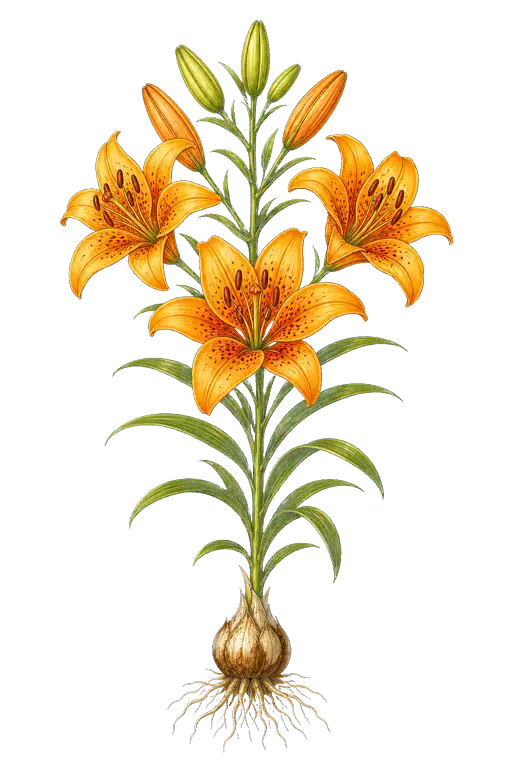
Liliaceae
Lily Family
Bachnag belongs to the Liliaceae family.
The illustration represents the family — not necessarily this exact species.
Explore the Liliaceae familySnap it. Know it.
Point your camera at Bachnag or any plant and SASYA identifies it instantly — on-device, offline, and private.
Common plant problems
If you are starting from symptoms instead of a diagnosis, use the plant disease symptom checker to narrow the cause before treating.
All plant problem & care guidesMore in Liliaceae
View all LiliaceaeSources: GBIF — Gloriosa superba (India distribution & vernacular names) (CC BY 4.0) · Wikipedia — Gloriosa superba (background/comprehension only) (CC BY-SA 4.0)