
Safed Musli
Chlorophytum borivilianum
- Habit
- Herb
- Found in India
- Maharashtra, Chhattisgarh
- Flowering
- June-August
How to identify Safed Musli
Identify Safed Musli by combining habit, leaf characters, flower or fruit details, location, and its family pattern. Do not rely on one feature alone.
- Look for a herb habit.
- Check the distinctive field mark: Tuberous roots harvested as safed musli.
- Confirm leaf shape: Lanceolate.
- Confirm flower colour: White.
- In season, compare flowering and fruiting time: June-August.
- In India, compare location records such as Maharashtra, Chhattisgarh.
- Confirm it sits within the Liliaceae family pattern, then compare close relatives before deciding it is Safed Musli.
Plant Details
Leaf characters
- Leaf shape
- LanceolaterecordedLong and narrow, tapering to a point, like a lance head.“Chlorophytum borivilianum is a herb with lanceolate leaves, from tropical wet forests in the peninsular Indian region.” — Wikipedia, CC BY-SA 4.0
Typical of the family
- Arrangement
- Alternate



Characters marked “recorded” are for Safed Musli itself; the rest are typical of the Liliaceae family.
Flower & fruit characters
- Flower colour
- Whiterecorded
Typical of the family
- Flower symmetry
- Actinomorphic (radially symmetrical)
- Inflorescence
- Raceme
- Fruit
- Capsule
Characters marked “recorded” are for Safed Musli itself; the rest are typical of the Liliaceae family — flowering plants only.
Local Names
- Hindi
- सफ़ेद मुसली Safed musli,सफेद मूसली sapheda musali,सफ़ेद मूसली safeda musali
- Bengali
- সফেদ মুসলি
- Telugu
- తెల్ల నేల తడి, white musli
- Kannada
- ಸಫೇದ್ ಮಸ್ಲಿ
About Safed Musli
Safed musli (Chlorophytum borivilianum) is a herb in the Liliaceae family. In India it has been recorded in Maharashtra and Chhattisgarh. Flowering and fruiting run from June to August.
Uses
Locally it is grown for parts that are eaten and long used in traditional medicine. Those medicinal uses are traditional attributions, not medical advice.
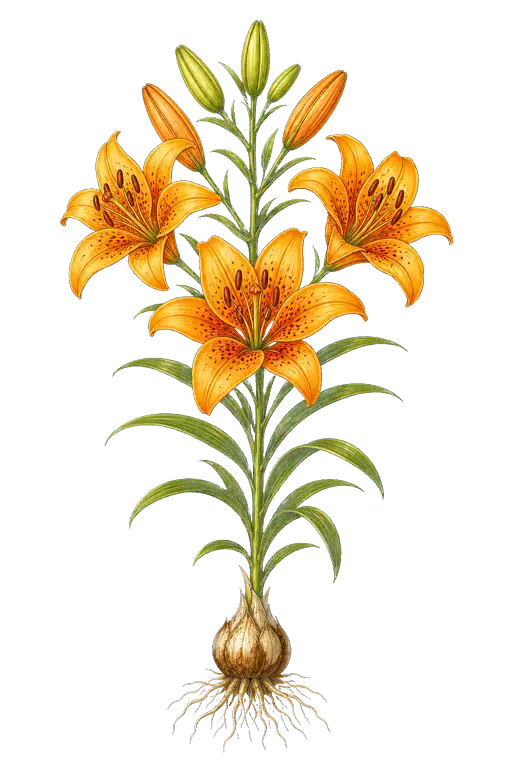
Liliaceae
Lily Family
Safed Musli belongs to the Liliaceae family.
The illustration represents the family — not necessarily this exact species.
Explore the Liliaceae familySnap it. Know it.
Point your camera at Safed Musli or any plant and SASYA identifies it instantly — on-device, offline, and private.
Common plant problems
If you are starting from symptoms instead of a diagnosis, use the plant disease symptom checker to narrow the cause before treating.
All plant problem & care guides