
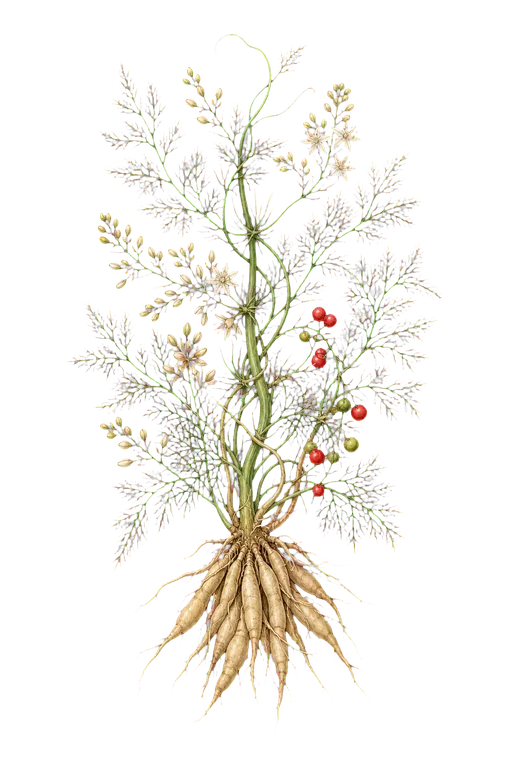
Shatamuli / Asparagus
Asparagus racemosus
Also known as Wild Asparagus
- Habit
- Climbing shrub
- Found in India
- Rajasthan, Telangana, Karnataka & more
- Flowering
- September-June
How to identify Shatamuli
Identify Shatamuli by combining habit, leaf characters, flower or fruit details, location, and its family pattern. Do not rely on one feature alone.
- Look for a climbing shrub habit.
- Check the distinctive field mark: Fine feathery needle-like cladodes, tuberous roots used medicinally.
- Confirm leaf shape: Needle-like.
- Confirm flower colour: White.
- In season, compare flowering and fruiting time: September-June.
- In India, compare location records such as Rajasthan, Telangana, Karnataka, Maharashtra and nearby regions.
- Confirm it sits within the Liliaceae family pattern, then compare close relatives before deciding it is Shatamuli.
Plant Details
- Scientific name
- Asparagus racemosus
- Genus
- Asparagus
- Family
- Liliaceae
- Habit
- Climbing shrub
- Habitat
- All forest types, also in the plains
- Habitat type
- Forest
- Distribution
- Africa through South Asia to China, Malaysia and Northern Australia
- Found in India
- Rajasthan, Telangana, Karnataka, Maharashtra, Gujarat, Kerala, Tamil Nadu, Andhra Pradesh, Madhya Pradesh, Sikkim, Uttarakhand, Bihar, Uttar Pradesh, West Bengal, Arunachal Pradesh, Assam, Delhi, Himachal Pradesh
- Flowering & fruiting
- September-June
- Conservation status
- Not Evaluated (NE)
Leaf characters
- Leaf shape
- Needle-likerecorded
Typical of the family
- Arrangement
- Alternate



Characters marked “recorded” are for Shatamuli itself; the rest are typical of the Liliaceae family.
Flower & fruit characters
- Flower colour
- Whiterecorded
Typical of the family
- Flower symmetry
- Actinomorphic (radially symmetrical)
- Inflorescence
- Raceme
- Fruit
- Capsule
Characters marked “recorded” are for Shatamuli itself; the rest are typical of the Liliaceae family — flowering plants only.
Local Names
- Hindi
- शतमूली Shatamuli, शतावरी Shatavari, shatamuli, shatavari
- Nepali
- कुरिलो Kurilo, सतावरी Sataawaree, झिरझिरे काँडा Jhirajhire Kaandaa
- Bengali
- শতমূলী Satamuli, শতমূলী
- Tamil
- தண்ணீர்விட்டான் Tannir-vittan, சாத்தாவாரி
- Telugu
- అబీరువు Abiruvu, చెల్ల Chella, పిల్లపీచర Pilla-pitsara
- Kannada
- ಹಲವು ಮಕ್ಕಳ ತಾಯಿ ಬೇರು Halavu Makkala Taayi Beru, ಶತಾವರಿ Shatavari, ಶತಾವರಿ (ದಕ್ಷಿಣ ಏಷ್ಯಾ ಪ್ರಭೇದ)
- Malayalam
- ശതാവരി Sathavari, ശതാവരി
- Marathi
- शतमूली Shatamuli, शतावरी Shatavari, शतावरी
- Sinhala
- හාතවාරියා, හීන් හාතවාරිය
Shatamuli in India
Shatavari is a thorny, climbing relative of asparagus prized in Ayurveda — शतमूली Shatamuli (Hindi), தண்ணீர்விட்டான் Tannir-vittan (Tamil), అబీరువు Abiruvu (Telugu), ಹಲವು ಮಕ್ಕಳ ತಾಯಿ ಬೇರು Halavu Makkala Taayi Beru (Kannada), ശതാവരി Sathavari (Malayalam), शतमूली Shatamuli (Marathi). Asparagus racemosus is recorded across Rajasthan, Karnataka, Telangana, Maharashtra, Gujarat, Kerala, scrambling through scrub and hedges.
Uses
Its tuberous roots are a classical Ayurvedic rasayana, especially associated with women's health and as a general tonic — an attributed traditional use described for information, not medical advice. It is now cultivated for the herbal trade.
How to Identify Shatamuli
A spiny, woody climber whose 'leaves' are actually fine needle-like cladodes in tufts, giving a feathery look. It bears small, fragrant white flowers in sprays and red berries, and underground produces a cluster of finger-like succulent tuberous roots.
Frequently Asked Questions
- What is Asparagus called in different Indian languages?
- शतमूली Shatamuli (Hindi); தண்ணீர்விட்டான் Tannir-vittan (Tamil); అబీరువు Abiruvu (Telugu); ಹಲವು ಮಕ್ಕಳ ತಾಯಿ ಬೇರು Halavu Makkala Taayi Beru (Kannada); ശതാവരി Sathavari (Malayalam); शतमूली Shatamuli (Marathi); শতমূলী Satamuli (Bengali).
- What is shatavari used for?
- Shatavari root is a classical Ayurvedic rasayana, traditionally linked with women's health and overall vitality; this is an attributed traditional use, not medical advice.
- Is shatavari related to edible asparagus?
- Yes — it is in the same genus (Asparagus), but it is a thorny climber grown for its medicinal roots rather than for edible spears.
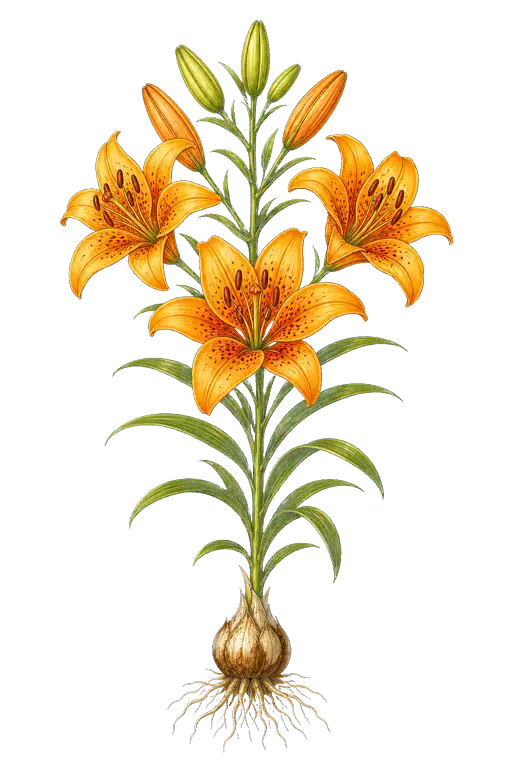
Liliaceae
Lily Family
Shatamuli belongs to the Liliaceae family.
The illustration represents the family — not necessarily this exact species.
Explore the Liliaceae familySnap it. Know it.
Point your camera at Shatamuli or any plant and SASYA identifies it instantly — on-device, offline, and private.
Common plant problems
If you are starting from symptoms instead of a diagnosis, use the plant disease symptom checker to narrow the cause before treating.
All plant problem & care guidesMore in Liliaceae
View all LiliaceaeSources: GBIF — Asparagus racemosus (India distribution & vernacular names) (CC BY 4.0) · iNaturalist — Asparagus racemosus (regional names, India observations) (CC BY 4.0) · Wikipedia — Asparagus racemosus (background/comprehension only) (CC BY-SA 4.0)