
Liliaceae
Lily Family
The lily family in the traditional broad sense — now split into many families, but often used for bulbous monocots with showy 6-tepalled flowers. Includes true lilies (Lilium), tulips (Tulipa), and many ornamental bulb plants. Most grow from bulbs, corms, or rhizomes in temperate regions.
Browse all 31 species ↓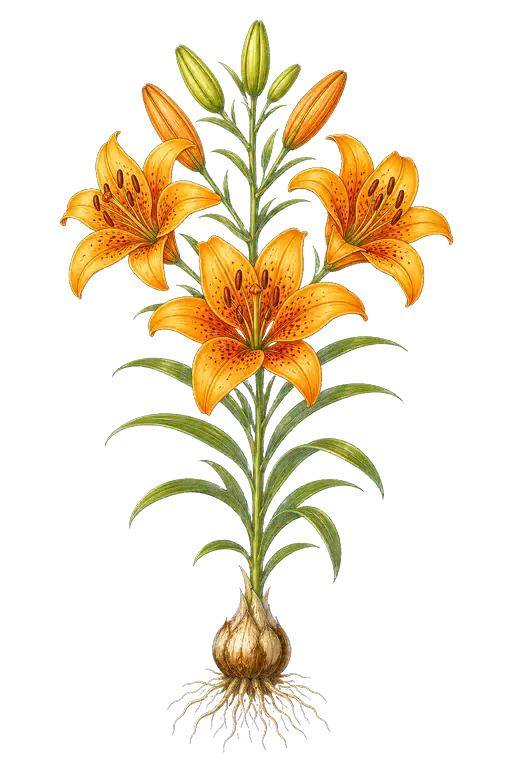
Three sepals and three petals identical in size and colour (reading as six petals), six stamens, and a superior three-chambered ovary.
Many true lilies grow from a starchy bulb — but several unrelated, highly toxic bulb-forming plants share that trait, so a bulb alone is never a safe identifier.
Which Liliaceae species is this?
Answer what you can see and narrow it down to a single Liliaceae species.
How to recognise the Liliaceae family
- 01
6 free tepals (3+3), often large and showy
- 02
Bulb, corm, or rhizome storage organ
- 03
Superior 3-locular ovary; capsule or berry fruit
To check whether a plant belongs to Liliaceae, compare the leaf arrangement, leaf type, flower symmetry, fruit type, and one distinctive marker together. A single feature can mislead; the family pattern is the combination.
Learn the full family-identification methodTypical leaf characters
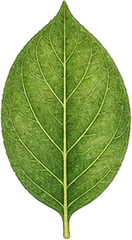


Characters typical of the family — individual species can vary.
Typical flower & fruit
- Flower symmetryActinomorphic (radially symmetrical)
- InflorescenceRaceme
- FruitCapsule
Typical of the family — flowering plants only; species can vary.
Notable members
Families that can look similar
Euphorbiaceae
Compare against Euphorbiaceae when the plant shares similar leaves, flowers, or fruit. Confirm by checking the full family pattern.
Compare EuphorbiaceaeOrchidaceae
Compare against Orchidaceae when the plant shares similar leaves, flowers, or fruit. Confirm by checking the full family pattern.
Compare OrchidaceaeMalvaceae
Compare against Malvaceae when the plant shares similar leaves, flowers, or fruit. Confirm by checking the full family pattern.
Compare MalvaceaeConvolvulaceae
Compare against Convolvulaceae when the plant shares similar leaves, flowers, or fruit. Confirm by checking the full family pattern.
Compare ConvolvulaceaeAll 31 species in LILIACEAE
- Asparagus, Wild AsparagusAsparagus racemosus
- Safed MusliChlorophytum borivilianum
- Scaly-Stem ChlorophytumChlorophytum glaucum
- Hill ChlorophytumChlorophytum heynei
- Indian ChlorophytumChlorophytum indicum
- Malabar ChlorophytumChlorophytum malabaricum
- Lax-Flowered ChlorophytumChlorophytum nimmonii
- Edible ChlorophytumChlorophytum tuberosum
- Cerulean Flax-LilyDianella ensifolia
- Konkan DipcadiDipcadi concanense
- Mountain DipcadiDipcadi montanum
- Ursula's DipcadiDipcadi ursulae
- Chinese Fairy BellsDisporum cantoniense
- Secret Night SquillDrimia indica
- Razi's SquillDrimia razii
- Malabar Glory Lily, Tiger Claw Lily, Glorious Lily, Climbing LilyGloriosa superba
- Orange DaylilyHemerocallis fulva
- Orange Day-LilyHemerocallis lilioasphodelus
- Indian Grass LilyIphigenia indica
- Star Grass LilyIphigenia stellata
- Common African HyacinthLedebouria revoluta
- The Nilgir LillyLilium wallichianum var. neilgherrense
- Himalayan Lily TurfOphiopogon intermedius
- Ribbon Grass, Silver Ribbon Grass, Green Ribbon GrassOphiopogon jaburan
- Dwarf Lily-TurfOphiopogon japonicus
- Blueberry Dark-FlowerPeliosanthes teta
- Garden TulipTulipa gesneriana
- Asparagus gonoclados
- Chlorophytum bharuchae
- Chlorophytum breviscapum
- Chlorophytum glaucoides
Identify any Liliaceae plant in seconds
Point your camera and SASYA names the species on-device — offline and private.
Download SASYA — Free