
Vediplavu / Wild Durian
Cullenia exarillata
- Habit
- Tree
- Found in India
- Tamil Nadu, Karnataka, Kerala
- Flowering
- January-November
How to identify Vediplavu
Identify Vediplavu by combining habit, leaf characters, flower or fruit details, location, and its family pattern. Do not rely on one feature alone.
- Look for a tree habit.
- Confirm leaf arrangement: Alternate.
- Confirm leaf type: Simple.
- Confirm flower colour: White.
- Confirm fruit type: Capsule.
- In season, compare flowering and fruiting time: January-November.
- In India, compare location records such as Tamil Nadu, Karnataka, Kerala.
Plant Details
- Scientific name
- Cullenia exarillata
- Genus
- Cullenia
- Family
- Bombacaceae
- Habit
- Tree
- Habitat
- Evergreen forests
- Habitat type
- Forest
- Native to
- India
- Found in India
- Tamil Nadu, Karnataka, Kerala
- Flowering & fruiting
- January-November
- Conservation status
- Vulnerable (VU)
Leaf characters
- Leaf arrangement
- AlternaterecordedOne leaf per node, arranged in a spiral or zigzag up the stem.“Leaves are simple, alternate, glabrous, shiny green above and covered beneath with silvery or orangish peltate scales.” — Wikipedia, CC BY-SA 4.0
- Leaf type
- SimplerecordedA single, undivided leaf blade.“Leaves are simple, alternate, glabrous, shiny green above and covered beneath with silvery or orangish peltate scales.” — Wikipedia, CC BY-SA 4.0
- Leaf surface
- GlabrousrecordedSmooth, hairless.“Leaves are simple, alternate, glabrous, shiny green above and covered beneath with silvery or orangish peltate scales.” — Wikipedia, CC BY-SA 4.0

Characters marked “recorded” are for Vediplavu itself; the rest are typical of the Bombacaceae family.
Flower & fruit characters
- Flower colour
- Whiterecorded“The tubular, hermaphroditic flowers (also covered by golden brown scales) are about 4–5 cm long and cream or pinkish brown in colour.” — Wikipedia, CC BY-SA 4.0
- Fruit type
- CapsulerecordedA dry fruit from a fused ovary that splits open at maturity to release seeds.“The fruit is a capsule, 5-valved, containing many reddish brown seeds about 4–5 cm long and 2–3 cm wide.” — Wikipedia, CC BY-SA 4.0
Characters marked “recorded” are for Vediplavu itself; the rest are typical of the Bombacaceae family — flowering plants only.
Local Names
- Tamil
- பெரியகாய் மரம், குரங்கு பலா, வெடிப்பலா
- Malayalam
- Vediplavu., Karayni, Vediplavu
About Vediplavu
Wild Durian (Cullenia exarillata) belongs to the Bombacaceae family, where it grows as a tree. In India it has been recorded in Tamil Nadu, Karnataka and Kerala. It grows in evergreen forests. Flowering and fruiting run from January to November.
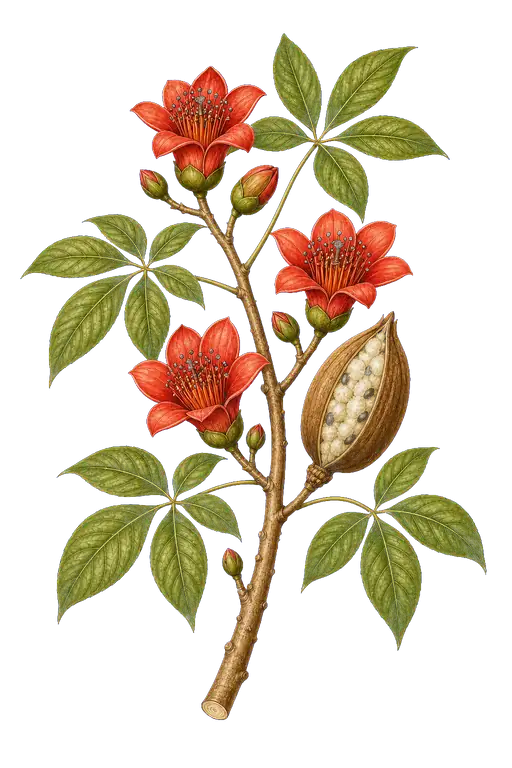
Bombacaceae
Bombax Or Kapok Family
Vediplavu belongs to the Bombacaceae family.
The illustration represents the family — not necessarily this exact species.
Explore the Bombacaceae familySnap it. Know it.
Point your camera at Vediplavu or any plant and SASYA identifies it instantly — on-device, offline, and private.
Common plant problems
If you are starting from symptoms instead of a diagnosis, use the plant disease symptom checker to narrow the cause before treating.
All plant problem & care guides