Bombacaceae family
Bombax Or Kapok Family
9 catalogue species · Order Malvales
The Bombacaceae family (Bombax Or Kapok Family) is a botanical family placed in the order Malvales. In the SASYA catalogue it spans 9 species across 8 genera. Its members are predominantly trees. Well-represented genera include Bombax, Adansonia and Ceiba. Several members are valued in traditional medicine. Familiar examples include African Calabash, Silk Cotton Tree and The White Silk Cotton Tree.
Explore the species roster ↓Field identification keys
Compare several features together. These are typical family patterns; individual species can vary. Observe without tasting or handling unfamiliar plants.
- Stem cross-section
- Round
- Distinctive marker
- Trunk often swollen and water-storing, sometimes bottle-shaped; seeds embedded in silky buoyant floss (kapok).
Familiar members: Kapok · Semal · Vediplavu · Khurasani Imli · Dev-Savar
Species in Bombacaceae
9 of 9 species
Native status is regional. Range tags distinguish Kew WCVP dataset matches from individual reviews. Pet-filter records report no known toxicity to cats and dogs; some sources cover a genus or cultivar. Review the source context. Missing values are excluded, and no rating establishes suitability to eat or freedom from other hazards.
| Botanical name | Common & regional names | Origin & reviewed pet status |
|---|---|---|
| Ceiba pentandra | Kapok Kapok Tree / White Silk Cotton Tree
+4 languages
| Introduced: India ↗︎ Kew datasetKew WCVP dataset; accepted-name match. Dataset matching is separate from an individual regional review. Recorded worldwide native range: Mexico to Trop. America. |
| Bombax ceiba | Semal Silk Cotton Tree / Malabar Semul
+7 languages
| Native: Assam, India ↗︎ Kew datasetKew WCVP dataset; accepted-name match. Dataset matching is separate from an individual regional review. Recorded worldwide native range: Trop. & Subtrop. Asia to N. Australia. |
| Cullenia exarillata | Vediplavu Wild Durian
| Native: India ↗︎ Kew datasetKew WCVP dataset; accepted-name match. Dataset matching is separate from an individual regional review. Recorded worldwide native range: SW. India. |
| Adansonia digitata | Khurasani Imli African Calabash / Baobab Tree / Monkey Bread Tree / African Baobab tree
+2 languages
| Introduced: India ↗︎ Kew datasetKew WCVP dataset; accepted-name match. Dataset matching is separate from an individual regional review. Recorded worldwide native range: Trop. & S. Africa, S. Arabian Pen.. |
| Bombax insigne | Dev-Savar The White Silk Cotton Tree
+1 languages
| Native: Andaman Is., Assam, India ↗︎ Kew datasetKew WCVP dataset; accepted-name match. Dataset matching is separate from an individual regional review. Recorded worldwide native range: India to China (S. Yunnan) and Indo-China. |
| Ochroma pyramidale | Balsa Tree
| Introduced: India ↗︎ Kew datasetKew WCVP dataset; accepted-name match. Dataset matching is separate from an individual regional review. Recorded worldwide native range: S. Mexico to Trop. America. |
| Pseudobombax ellipticum | Shaving Brush Tree
| Not listed native: India ↗︎ Kew datasetKew WCVP dataset; accepted-name match. Dataset matching is separate from an individual regional review. Recorded worldwide native range: Mexico to Nicaragua, Caribbean. Not listed native does not establish introduction or absence from India. |
| Chorisia speciosa | Silk Floss Tree | Introduced: India ↗︎ Kew datasetKew WCVP dataset; listed synonym of Ceiba speciosa. Dataset matching is separate from an individual regional review. Recorded worldwide native range: Brazil to Peru and NE. Argentina. |
| Pachira insignis | Wild Chestnut | Not listed native: India ↗︎ Kew datasetKew WCVP dataset; accepted-name match. Dataset matching is separate from an individual regional review. Recorded worldwide native range: Trinidad to S. Trop. America. Not listed native does not establish introduction or absence from India. |
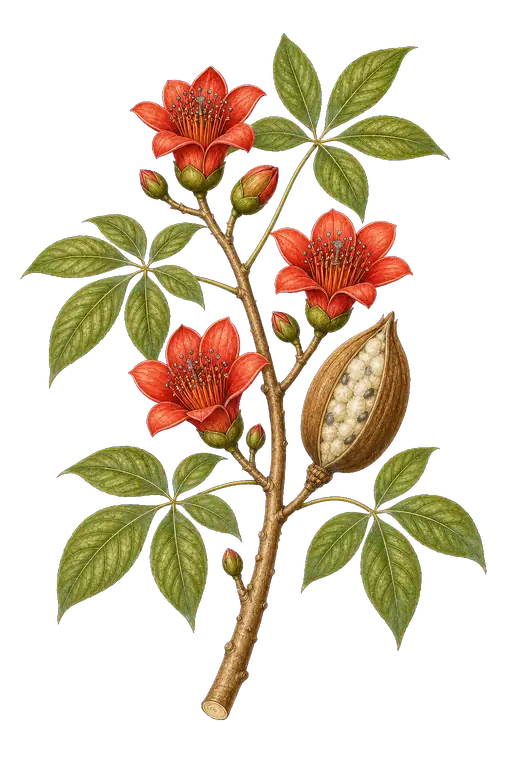
Massive trees with swollen, sometimes bottle-shaped, water-storing trunks and palmately compound leaves; large showy flowers with numerous stamens fused at the base ripen into a capsule packed with seeds embedded in silky floss.
The silky seed-floss (kapok) is naturally buoyant and water-repellent, once widely used to stuff life jackets and pillows before synthetic fibres took over.
Which Bombacaceae species is this?
Answer what you can see and narrow it down to a single Bombacaceae species.
To check whether a plant belongs to Bombacaceae, compare the leaf arrangement, leaf type, flower symmetry, fruit type, and one distinctive marker together. A single feature can mislead; the family pattern is the combination.
Learn the full family-identification methodFamilies that can look similar
Malvaceae
Compare against Malvaceae when the plant shares similar leaves, flowers, or fruit. Confirm by checking the full family pattern.
Compare MalvaceaeSterculiaceae
Compare against Sterculiaceae when the plant shares similar leaves, flowers, or fruit. Confirm by checking the full family pattern.
Compare SterculiaceaeTiliaceae
Compare against Tiliaceae when the plant shares similar leaves, flowers, or fruit. Confirm by checking the full family pattern.
Compare TiliaceaeDipterocarpaceae
Compare against Dipterocarpaceae when the plant shares similar leaves, flowers, or fruit. Confirm by checking the full family pattern.
Compare DipterocarpaceaeMeet Bombacaceae in the field
Point your camera, explore possible matches and compare the field marks. Identification runs on your phone, offline and private.
Download SASYA — Free