

Giloy / Heartleaf Moonseed
Tinospora cordifolia
Also known as Gulbel, Tinospora, Moon Creeper, Bile Killer
- Habit
- Climbing shrub
- Found in India
- Maharashtra, Telangana, Uttar Pradesh & more
- Flowering
- Throughout the year
How to identify Giloy
Identify Giloy by combining habit, leaf characters, flower or fruit details, location, and its family pattern. Do not rely on one feature alone.
- Look for a climbing shrub habit.
- Check the distinctive field mark: Warty green climbing stem, widely used medicinally (guduchi).
- Confirm leaf arrangement: Alternate.
- Confirm leaf type: Simple.
- Confirm flower arrangement: Solitary.
- Confirm fruit type: Drupe.
- Use the leaf pattern: alternate leaf arrangement, simple leaves, entire leaf margins, palmate venation.
Plant Details
- Scientific name
- Tinospora cordifolia
- Genus
- Tinospora
- Family
- Menispermaceae
- Habit
- Climbing shrub
- Habitat
- Upto 1000m in moist deciduous forests and scrub jungles; also in plains
- Native to
- Indian subcontinent
- Distribution
- India, Bangladesh, Sri Lanka, Myanmar
- Found in India
- Maharashtra, Telangana, Uttar Pradesh, Rajasthan, Gujarat, Tamil Nadu, West Bengal, Karnataka, Andhra Pradesh, Kerala, Madhya Pradesh, Odisha, Bihar, Chhattisgarh, Delhi, Chandigarh, Goa, Jharkhand, Uttarakhand
- Flowering & fruiting
- Throughout the year
- Conservation status
- Not Evaluated (NE)
Leaf characters
- Leaf arrangement
- AlternaterecordedOne leaf per node, arranged in a spiral or zigzag up the stem.“Leaves are simple, alternate, and exstipulate with long petioles up to 15 cm (6 in) long which are roundish and pulvinate, both at the base and apex with the basal one longer and t” — Wikipedia, CC BY-SA 4.0
- Leaf type
- SimplerecordedA single, undivided leaf blade.“Leaves are simple, alternate, and exstipulate with long petioles up to 15 cm (6 in) long which are roundish and pulvinate, both at the base and apex with the basal one longer and t” — Wikipedia, CC BY-SA 4.0
- Leaf shape
- OvaterecordedEgg-shaped, broader near the base.“Lamina are broadly ovate or ovate cordate, 10–20 cm (4–8 in) long or 8–15 cm (3–6 in) broad, seven nerved and deeply cordate at base, membranous, pubescent above, whitish tomentose” — Wikipedia, CC BY-SA 4.0
- Leaf surface
- TomentoserecordedDensely covered in matted, woolly hairs.“Lamina are broadly ovate or ovate cordate, 10–20 cm (4–8 in) long or 8–15 cm (3–6 in) broad, seven nerved and deeply cordate at base, membranous, pubescent above, whitish tomentose” — Wikipedia, CC BY-SA 4.0
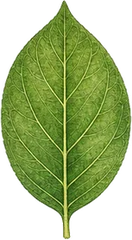
Typical of the family
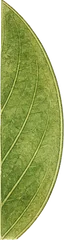
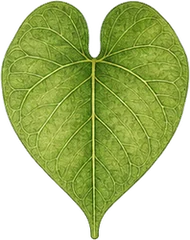
Characters marked “recorded” are for Giloy itself; the rest are typical of the Menispermaceae family.
Flower & fruit characters
- Flower arrangement
- SolitaryrecordedA single flower borne alone, not in a cluster.“Male flowers are clustered, but female flowers are usually solitary.” — Wikipedia, CC BY-SA 4.0
- Fruit type
- DruperecordedA fleshy fruit with a single hard stone/pit enclosing the seed.“They are ovoid smooth drupelets on thick stalks with sub terminal style scars, scarlet or orange colored.” — Wikipedia, CC BY-SA 4.0
Typical of the family
- Flower symmetry
- Zygomorphic (bilaterally symmetrical)
Characters marked “recorded” are for Giloy itself; the rest are typical of the Menispermaceae family — flowering plants only.
Local Names
- Hindi
- गिलोय Giloy, गुलबेल Gulbel, गुड़च Gurach,गिलोय giloy
- Nepali
- गरुच लट्टी Garuch Lattee, गुडुची Guduchee, गुर्जो Gurjo
- Bengali
- গুলঞ্চ Gulancha, গুলঞ্চ
- Tamil
- அசாசி Acaci, ஆகாசக்கருடன் Akaca-K-Karutan, ஆகாசவல்லி Akaca-Valli
- Telugu
- అమృత Amrta, దూయు తీగ Dooyu Thige, గలూచి Galoochi
- Kannada
- ಅಮರ Amara, ಅಮೃತಬಳ್ಳಿ Amritaballi, ಗುಡೂಚಿ Guduchi
- Malayalam
- അമൃതവള്ളി Amruthavalli, ചിറ്റമൃത് Chittamruthu, പെയ്യമൃതം Peyyamrutham
- Marathi
- अमरवेल Amarvel, अमृतवेल Amrutvel, गुडूची Guduchi
Giloy in India
Giloy is one of the most talked-about herbs in Ayurveda, a climber that drapes over trees and fences — गिलोय Giloy (Hindi), அசாசி Acaci (Tamil), అమృత Amrta (Telugu), ಅಮರ Amara (Kannada), അമൃതവള്ളി Amruthavalli (Malayalam), अमरवेल Amarvel (Marathi). Tinospora cordifolia is recorded across Maharashtra, Telangana, Uttar Pradesh, Rajasthan, Gujarat, Tamil Nadu.
Uses
Known in Ayurveda as guduchi or amrita ('the immortal'), its stems are among the most widely used traditional tonics, taken as juice, kadha or powder — an attributed traditional use described for information, not medical advice. It is easy to grow from a stem cutting.
How to Identify Giloy
A large deciduous climber with smooth, heart-shaped leaves and thin papery bark. Mature stems develop characteristic long, thread-like aerial roots hanging down, and the warty greenish stems root easily wherever they touch — a useful field mark.
Frequently Asked Questions
- What is Heartleaf Moonseed called in different Indian languages?
- गिलोय Giloy (Hindi); அசாசி Acaci (Tamil); అమృత Amrta (Telugu); ಅಮರ Amara (Kannada); അമൃതവള്ളി Amruthavalli (Malayalam); अमरवेल Amarvel (Marathi); গুলঞ্চ Gulancha (Bengali).
- What is giloy used for?
- Giloy (guduchi) stem is a classical Ayurvedic tonic taken as juice, decoction or powder; this is a traditional, attributed use and not medical advice.
- How do you identify giloy?
- Look for a climber with heart-shaped leaves, warty greenish stems, and long thread-like aerial roots dangling from higher branches.
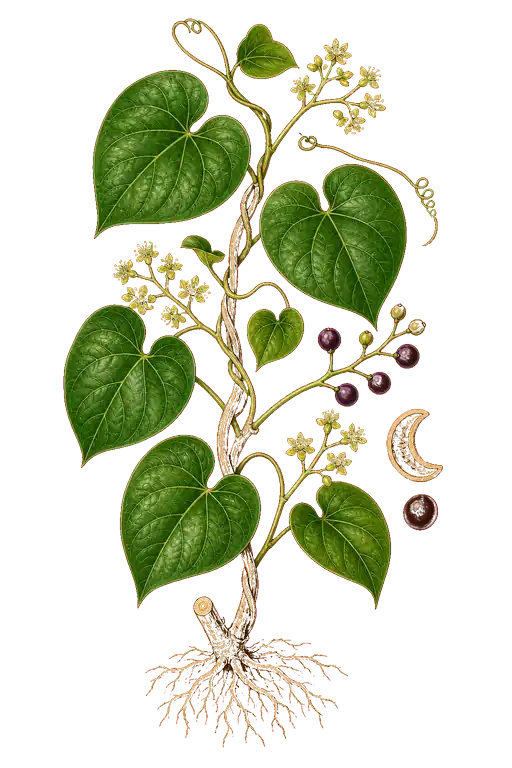
Menispermaceae
Moonseed Family
Giloy belongs to the Menispermaceae family.
The illustration represents the family — not necessarily this exact species.
Explore the Menispermaceae familySnap it. Know it.
Point your camera at Giloy or any plant and SASYA identifies it instantly — on-device, offline, and private.
Common plant problems
If you are starting from symptoms instead of a diagnosis, use the plant disease symptom checker to narrow the cause before treating.
All plant problem & care guidesMore in Menispermaceae
View all MenispermaceaeSources: GBIF — Tinospora cordifolia (India distribution & vernacular names) (CC BY 4.0) · iNaturalist — Tinospora cordifolia (regional names, India observations) (CC BY 4.0) · Wikipedia — Tinospora cordifolia (background/comprehension only) (CC BY-SA 4.0)