
Amrul / Common Sorrel
Oxalis corniculata
Also known as Indian Sorrel, Yellow Wood, Creeping Oxalis, Creeping Wood-Sorrel, Inda
- Habit
- Herb
- Found in India
- Karnataka, Maharashtra, Telangana & more
- Flowering
- Throughout the year
How to identify Amrul
Identify Amrul by combining habit, leaf characters, flower or fruit details, location, and its family pattern. Do not rely on one feature alone.
- Look for a herb habit.
- Check the distinctive field mark: Common weedy clover-like sorrel with yellow flowers.
- Confirm leaf type: Trifoliate.
- Confirm leaf shape: Orbicular.
- Confirm flower colour: Yellow.
- Confirm fruit type: Capsule.
- In season, compare flowering and fruiting time: Throughout the year.
Plant Details
- Scientific name
- Oxalis corniculata
- Genus
- Oxalis
- Family
- Oxalidaceae
- Habit
- Herb
- Habitat
- Degraded forests, also in the plains
- Habitat type
- Forest
- Distribution
- Cosmopolitan
- Found in India
- Karnataka, Maharashtra, Telangana, Uttar Pradesh, Kerala, Uttarakhand, West Bengal, Rajasthan, Tamil Nadu, Himachal Pradesh, Delhi, Assam, Jammu & Kashmir, Arunachal Pradesh, Haryana, Gujarat, Madhya Pradesh, Meghalaya, Jharkhand, Sikkim, Mizoram, Bihar, Goa, Odisha, Andhra Pradesh, Chandigarh, Punjab, Chhattisgarh
- Flowering & fruiting
- Throughout the year
- Conservation status
- Not Evaluated (NE)
Leaf characters
- Leaf type
- TrifoliaterecordedA compound leaf made of exactly three leaflets.“Its trifoliate leaves are subdivided into three rounded leaflets, resembling a clover.” — Wikipedia, CC BY-SA 4.0
- Leaf shape
- OrbicularrecordedRounded, roughly circular.“Its trifoliate leaves are subdivided into three rounded leaflets, resembling a clover.” — Wikipedia, CC BY-SA 4.0
Typical of the family
- Arrangement
- Alternate

Characters marked “recorded” are for Amrul itself; the rest are typical of the Oxalidaceae family.
Flower & fruit characters
- Flower colour
- Yellowrecorded“The small, yellow flowers have either round-edged or sharp-ended petals.” — Wikipedia, CC BY-SA 4.0
- Fruit type
- CapsulerecordedA dry fruit from a fused ovary that splits open at maturity to release seeds.“The fruit is a narrow, cylindrical capsule, 1–2 cm (0.4–0.8 in) long, and noteworthy for its explosive discharge of the contained seeds, 1 mm (0.04 in) long.” — Wikipedia, CC BY-SA 4.0
Typical of the family
- Fruit
- Berry
Characters marked “recorded” are for Amrul itself; the rest are typical of the Oxalidaceae family — flowering plants only.
Local Names
- Hindi
- Amrul अम्रुल,चांगेरी changeri
- Nepali
- चरी अमिलो Charee Amilo, चरीअमिलो
- Bengali
- অমৰুলশাক Amrulshak, হলুদ আমরুল
- Kannada
- ಪುಳ್ಳಂಪುರುಚೆ Pullampuruche, ಪುಳ್ಳಂಪುರಚಿ Pullampurachi, ಪುಳ್ಳಂಪುರಿಚೆ Pullampuriche ಹುಳಿಹುಳಿಸೆ Hulihulise
- Malayalam
- Poliyarala
- Marathi
- आंबुशी Ambushi, चांगेरी Changeri, आंबुशी
Amrul in India
This low, creeping weed, known as Amrul अम्रुल (Hindi), ಪುಳ್ಳಂಪುರುಚೆ Pullampuruche (Kannada), Poliyarala (Malayalam), आंबुशी Ambushi (Marathi), অমৰুলশাক Amrulshak (Bengali), is one of the most common garden and lawn weeds in India. Oxalis corniculata is found across Karnataka, Maharashtra, Telangana, Kerala, Uttar Pradesh, Uttarakhand, thriving in cultivated ground, pavements and lawns.
Uses
Its tangy, sour leaves are traditionally chewed or nibbled fresh in small amounts, and it has a history of folk culinary and traditional use in some regions — an attributed traditional use, and best eaten only in small quantities given its natural oxalic acid content.
How to Identify Amrul
A low, creeping herb with clover-like leaves divided into three heart-shaped leaflets that fold shut at night or under stress. Small yellow five-petalled flowers are followed by narrow, upright seed capsules that spring open explosively when ripe, flinging seeds outward.
Frequently Asked Questions
- What is Common Sorrel called in different Indian languages?
- Amrul अम्रुल (Hindi); ಪುಳ್ಳಂಪುರುಚೆ Pullampuruche (Kannada); Poliyarala (Malayalam); आंबुशी Ambushi (Marathi); অমৰুলশাক Amrulshak (Bengali).
- Why do the leaves taste sour?
- Like other Oxalis species, its leaves contain oxalic acid, which gives them a distinctive tart, lemony flavour — pleasant in small amounts but best not eaten in large quantities.
- Is it the same as clover?
- No — despite the similar three-lobed leaf shape, Oxalis corniculata is unrelated to true clover (Trifolium); the resemblance is only superficial.
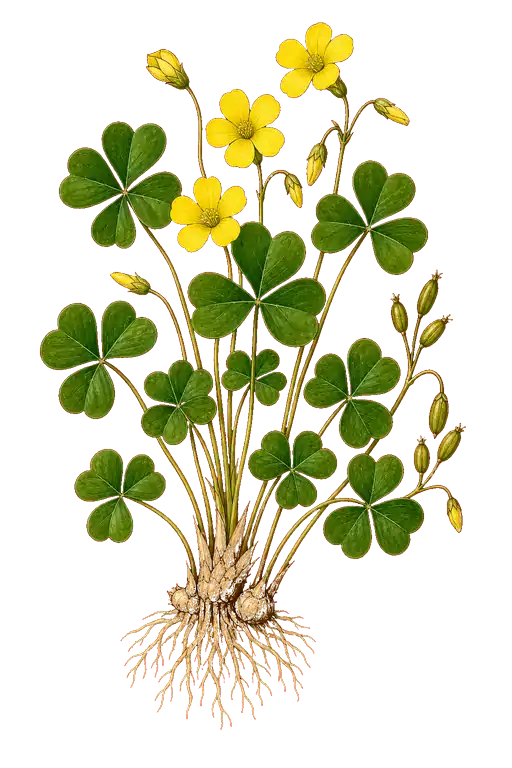
Oxalidaceae
Wood sorrel family
Amrul belongs to the Oxalidaceae family.
The illustration represents the family — not necessarily this exact species.
Explore the Oxalidaceae familySnap it. Know it.
Point your camera at Amrul or any plant and SASYA identifies it instantly — on-device, offline, and private.
Common plant problems
If you are starting from symptoms instead of a diagnosis, use the plant disease symptom checker to narrow the cause before treating.
All plant problem & care guidesMore in Oxalidaceae
View all OxalidaceaeSources: GBIF — Oxalis corniculata (India distribution & vernacular names) (CC BY 4.0) · Wikipedia — Oxalis corniculata (background/comprehension only) (CC BY-SA 4.0)