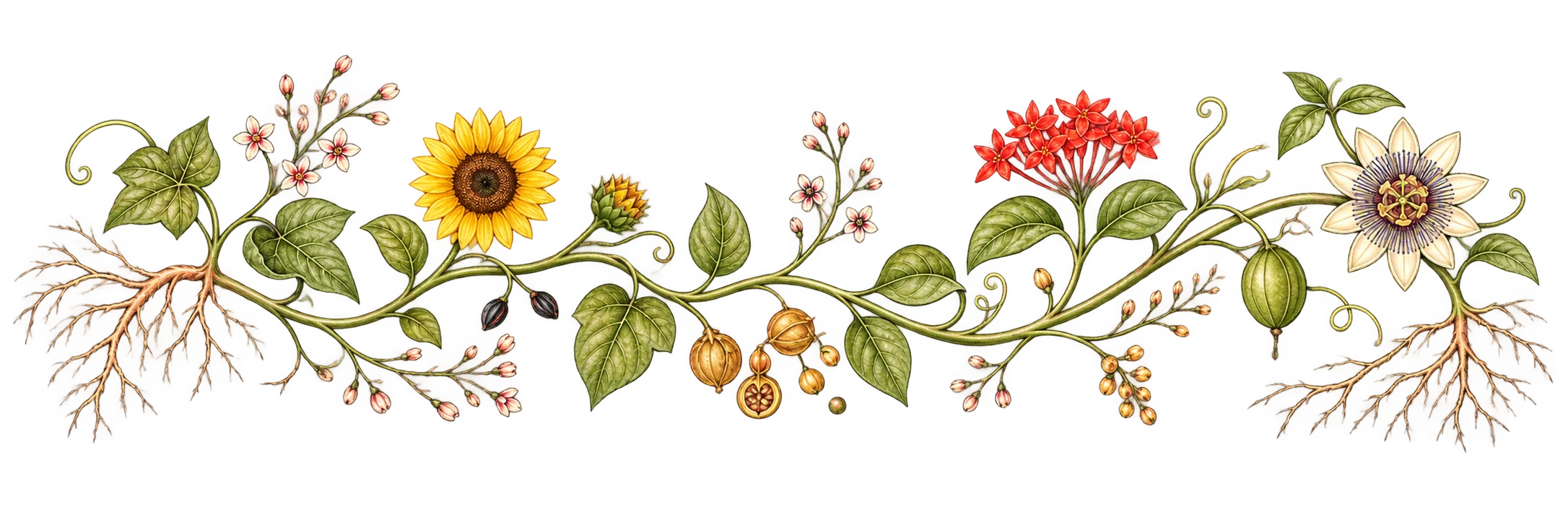
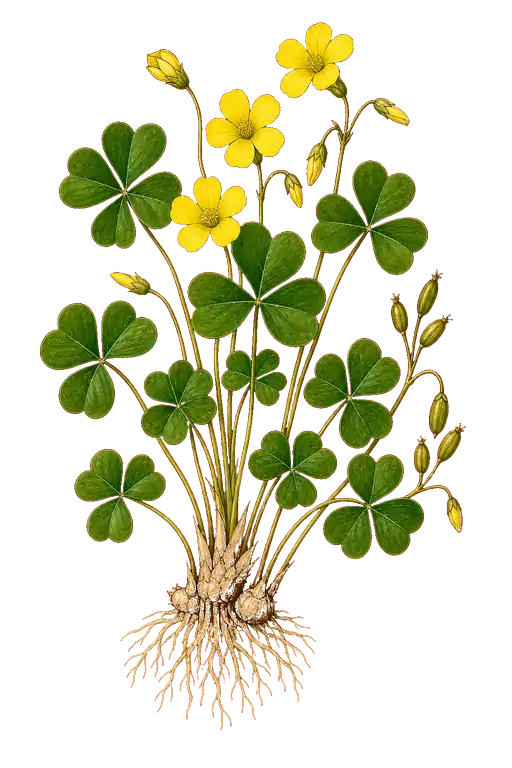
Oxalidaceae family
Wood sorrel family
10 catalogue species · Order Oxalidales
Plants with trifoliate leaves that fold at night (nyctinasty). Sour taste from oxalic acid. Includes wood sorrel and carambola (star fruit).
Explore the species roster ↓Field identification keys
Compare several features together. These are typical family patterns; individual species can vary. Observe without tasting or handling unfamiliar plants.
- Stem cross-section
- Round
- Leaf arrangement
- Alternate
- Fruit
- Berry
- Distinctive marker
- Leaflets fold down and close at night (nyctinasty) or when touched; tissue tastes distinctly sour from oxalic acid.
Familiar members: Lajalu · Amrul · Bilimbi · Karmal · Dodda Moorele Gida
Species in Oxalidaceae
10 of 10 species
Native status is regional. Range tags distinguish Kew WCVP dataset matches from individual reviews. Pet-filter records report no known toxicity to cats and dogs; some sources cover a genus or cultivar. Review the source context. Missing values are excluded, and no rating establishes suitability to eat or freedom from other hazards.
| Botanical name | Common & regional names | Origin & reviewed pet status |
|---|---|---|
| Biophytum sensitivum | Lajalu Little Tree Plant / Sensitive plant
+4 languages
| Native: Andaman Is., Assam, India ↗︎ Kew datasetKew WCVP dataset; accepted-name match. Dataset matching is separate from an individual regional review. Recorded worldwide native range: Trop. & Subtrop. Asia. |
| Oxalis corniculata | Amrul Common Sorrel / Indian Sorrel / Yellow wood / Creeping oxalis / creeping wood-sorrel / Inda
+3 languages
| Native: Assam, India, West Himalaya ↗︎ Kew datasetKew WCVP dataset; accepted-name match. Dataset matching is separate from an individual regional review. Recorded worldwide native range: Indian Subcontinent to Japan and Philippines. |
| Averrhoa bilimbi | Bilimbi Tree Sorrel / Kamias
+4 languages
| Introduced: India ↗︎ Kew datasetKew WCVP dataset; accepted-name match. Dataset matching is separate from an individual regional review. Recorded worldwide native range: C. & E. Malesia. |
| Averrhoa carambola | Karmal Carombola apple / Star fruit tree
+3 languages
| Introduced: India ↗︎ Kew datasetKew WCVP dataset; accepted-name match. Dataset matching is separate from an individual regional review. Recorded worldwide native range: C. & E. Jawa to Maluku. |
| Oxalis latifolia | Dodda Moorele Gida Broad-leaved Sorel
| Introduced: India ↗︎ Kew datasetKew WCVP dataset; accepted-name match. Dataset matching is separate from an individual regional review. Recorded worldwide native range: Trop. & Subtrop. America. |
| Biophytum reinwardtii | Horamuchhaka Slender Tree Plant
| Native: Andaman Is., Assam, India, West Himalaya ↗︎ Kew datasetKew WCVP dataset; accepted-name match. Dataset matching is separate from an individual regional review. Recorded worldwide native range: W. India, Himalaya to S. China and New Guinea. |
| Biophytum candolleanum | Lajalu Tropical Little Tree Plant
+5 languages
| Native: Andaman Is., Assam, India ↗︎ Kew datasetKew WCVP dataset; listed synonym of Biophytum sensitivum. Dataset matching is separate from an individual regional review. Recorded worldwide native range: Trop. & Subtrop. Asia. |
| Biophytum nervifolium | Lajalu
+3 languages
| Native: India ↗︎ Kew datasetKew WCVP dataset; accepted-name match. Dataset matching is separate from an individual regional review. Recorded worldwide native range: W. & S. India, Sri Lanka. |
| Oxalis triangularis | Love Plant Purple shamrock | Not listed native: India ↗︎ Kew datasetKew WCVP dataset; accepted-name match. Dataset matching is separate from an individual regional review. Recorded worldwide native range: Peru to Brazil and N. Argentina. Not listed native does not establish introduction or absence from India. |
| Oxalis debilis | Large-Flowered Pink Sorrel
| Introduced: India ↗︎ Kew datasetKew WCVP dataset; accepted-name match. Dataset matching is separate from an individual regional review. Recorded worldwide native range: C. America to Guyana and Paraguay. |
Trifoliate (or multi-leafleted) leaves that visibly fold down and close at night or when touched; five-petalled flowers with sour, oxalic-acid-rich tissue ripen into a capsule that, in star fruit, forms a distinctive five-ridged, star-shaped cross-section.
Sharply sour oxalic acid runs throughout the leaves and fruit — pleasant in small amounts in wood sorrel and star fruit, but toxic to kidneys in large quantities.
Which Oxalidaceae species is this?
Answer what you can see and narrow it down to a single Oxalidaceae species.
How to recognise the Oxalidaceae family
- 01
Leaf arrangement: alternate
- 02
Leaf type: trifoliate
- 03
Growth forms: herb/shrub/tree
- 04
Inflorescence: cymose umbel
- 05
Fruit: capsule/berry
To check whether a plant belongs to Oxalidaceae, compare the leaf arrangement, leaf type, flower symmetry, fruit type, and one distinctive marker together. A single feature can mislead; the family pattern is the combination.
Learn the full family-identification methodTypical leaf characters
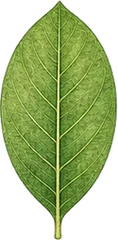
Characters typical of the family — individual species can vary.
Typical flower & fruit
- Flower symmetryVariable
- InflorescenceVariable
- FruitBerry
Typical of the family — flowering plants only; species can vary.
Families that can look similar
Solanaceae
Compare against Solanaceae when the plant shares similar leaves, flowers, or fruit. Confirm by checking the full family pattern.
Compare SolanaceaeAnnonaceae
Compare against Annonaceae when the plant shares similar leaves, flowers, or fruit. Confirm by checking the full family pattern.
Compare AnnonaceaeRutaceae
Compare against Rutaceae when the plant shares similar leaves, flowers, or fruit. Confirm by checking the full family pattern.
Compare RutaceaeFlacourtiaceae
Compare against Flacourtiaceae when the plant shares similar leaves, flowers, or fruit. Confirm by checking the full family pattern.
Compare FlacourtiaceaeMeet Oxalidaceae in the field
Point your camera, explore possible matches and compare the field marks. Identification runs on your phone, offline and private.
Download SASYA — Free