
Anjan / Iron-Wood Tree
Memecylon umbellatum
- Habit
- Tree
- Found in India
- Maharashtra, Tamil Nadu, Karnataka & more
- Flowering
- February-September
How to identify Anjan
Identify Anjan by combining habit, leaf characters, flower or fruit details, location, and its family pattern. Do not rely on one feature alone.
- Look for a tree habit.
- Check the distinctive field mark: Flowers in umbrella-like clusters, ironwood tree.
- Confirm leaf arrangement: Opposite.
- Confirm leaf type: Simple.
- Confirm flower colour: Blue.
- Confirm flower arrangement: Umbel.
- In season, compare flowering and fruiting time: February-September.
Plant Details
- Scientific name
- Memecylon umbellatum
- Genus
- Memecylon
- Family
- Melastomataceae
- Habit
- Tree
- Habitat
- Along rocks in ravines and slopes of semi-Evergreen forests, also in sholas
- Native to
- India
- Distribution
- India, Sri Lanka, Myanmar, Thailand, Malesia
- Found in India
- Maharashtra, Tamil Nadu, Karnataka, Andhra Pradesh, Goa, Kerala, Odisha, West Bengal, Chhattisgarh, Puducherry, Telangana
- Flowering & fruiting
- February-September
- Conservation status
- Not Evaluated (NE)
Leaf characters
- Leaf arrangement
- OppositerecordedTwo leaves arise from the stem at the same point, facing each other.“Leaves are simple, opposite type.” — Wikipedia, CC BY-SA 4.0
- Leaf type
- SimplerecordedA single, undivided leaf blade.“Leaves are simple, opposite type.” — Wikipedia, CC BY-SA 4.0

Characters marked “recorded” are for Anjan itself; the rest are typical of the Melastomataceae family.
Flower & fruit characters
- Flower colour
- Bluerecorded
- Flower arrangement
- UmbelrecordedFlower stalks all radiate from a single point, like umbrella ribs.“Flowers are blue coloured and produced in cymose umbels.” — Wikipedia, CC BY-SA 4.0
- Fruit type
- BerryrecordedA fleshy fruit with seeds embedded directly in the pulp, no central stone.“The fruit is round berry bluish-black in colour.” — Wikipedia, CC BY-SA 4.0
Typical of the family
- Inflorescence
- Cyme
- Fruit
- Berry
Characters marked “recorded” are for Anjan itself; the rest are typical of the Melastomataceae family — flowering plants only.
Local Names
- Hindi
- Anjan अंजन, Kaya
- Telugu
- Mandi, Lakhonde
- Kannada
- ಅರಚರೆ Arachare, ಅರಚಟೆ Arachate, ಅಲಮರು
- Malayalam
- Kanjavu, Kayampoomaram, Anjanamaram
- Marathi
- अंजनी Anjani
About Anjan
Iron-wood tree (Memecylon umbellatum) is a tree in the Melastomataceae family. In India it has been recorded in Maharashtra, Tamil Nadu, Karnataka and 8 other states. It grows in along rocks in ravines and slopes of semi-Evergreen forests, also in sholas. Flowering and fruiting run from February to September.
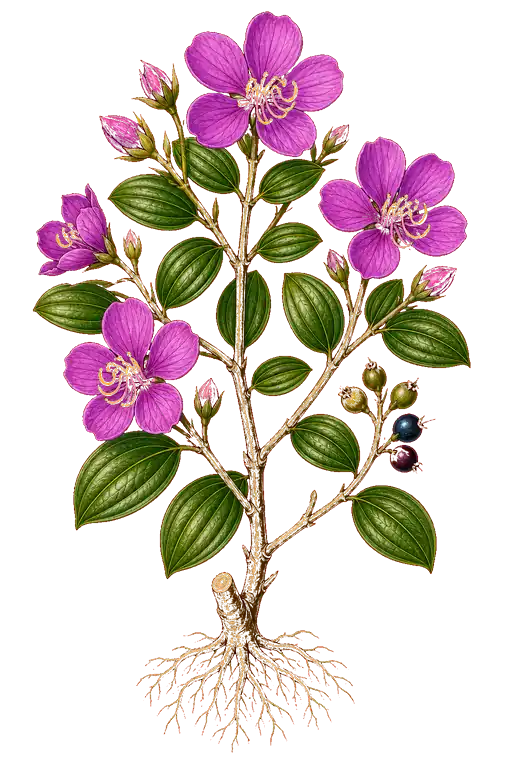
Melastomataceae
Melastome family
Anjan belongs to the Melastomataceae family.
The illustration represents the family — not necessarily this exact species.
Explore the Melastomataceae familySnap it. Know it.
Point your camera at Anjan or any plant and SASYA identifies it instantly — on-device, offline, and private.
Common plant problems
If you are starting from symptoms instead of a diagnosis, use the plant disease symptom checker to narrow the cause before treating.
All plant problem & care guides