
Rupasi / Silky Oak
Grevillea robusta
Also known as Silver Oak
- Habit
- Tree
- Found in India
- Karnataka, Tamil Nadu, Maharashtra & more
- Flowering
- June-April
How to identify Rupasi
Identify Rupasi by combining habit, leaf characters, flower or fruit details, location, and its family pattern. Do not rely on one feature alone.
- Look for a tree habit.
- Check the distinctive field mark: Fern-like silvery leaves, widely planted shade/timber tree (silky oak).
- Confirm leaf shape: Elliptic.
- Confirm leaf margin: Lobed.
- In season, compare flowering and fruiting time: June-April.
- In India, compare location records such as Karnataka, Tamil Nadu, Maharashtra, Uttarakhand and nearby regions.
- Confirm it sits within the Proteaceae family pattern, then compare close relatives before deciding it is Rupasi.
Plant Details
- Scientific name
- Grevillea robusta
- Genus
- Grevillea
- Family
- Proteaceae
- Habit
- Tree
- Habitat
- Grown as shade tree
- Habitat type
- Cultivated
- Native to
- Eastern Australia
- Distribution
- Tropics and sub-tropics
- Found in India
- Karnataka, Tamil Nadu, Maharashtra, Uttarakhand, Himachal Pradesh, Kerala, Delhi, Mizoram, Rajasthan, Telangana, West Bengal, Chandigarh, Uttar Pradesh, Andhra Pradesh, Arunachal Pradesh, Gujarat, Haryana, Manipur, Odisha, Punjab
- Flowering & fruiting
- June-April
- Conservation status
- Not Evaluated (NE)
Leaf characters
- Leaf shape
- EllipticrecordedWidest at the middle, tapering evenly at both ends.“Its leaves are 10–34 cm (3.9–13.4 in) long and 90–150 mm (3.5–5.9 in) wide and deeply dissected with 11 to 24 primary lobes, sometimes with up to five further divisions, the end lo” — Wikipedia, CC BY-SA 4.0
- Leaf margin
- LobedrecordedThe edge is divided into rounded or pointed sections that don't reach the midrib.“Its leaves are 10–34 cm (3.9–13.4 in) long and 90–150 mm (3.5–5.9 in) wide and deeply dissected with 11 to 24 primary lobes, sometimes with up to five further divisions, the end lo” — Wikipedia, CC BY-SA 4.0

Typical of the family
- Arrangement
- Alternate
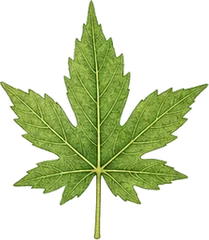
Characters marked “recorded” are for Rupasi itself; the rest are typical of the Proteaceae family.
Flower & fruit characters
- Flower symmetry
- Zygomorphic (bilaterally symmetrical)
- Inflorescence
- Solitary
- Fruit
- Grain
Typical of the Proteaceae family — flowering plants only; individual species can differ.
Local Names
- Nepali
- काँगियो (वनस्पति)
- Bengali
- ৰূপসী Rupasi
- Tamil
- மலைச் சவுக்கு, சில்வர் ஓக், வெள்ளோக்கு
- Kannada
- ಸಿಲ್ವರ್ ಮರ
- Malayalam
- സിൽവർ ഓക്ക്, Grevillea robusta
About Rupasi
Silky oak (Grevillea robusta) belongs to the Proteaceae family, where it grows as a tree. In India it has been recorded in Karnataka, Tamil Nadu, Maharashtra and 17 other states. It is grown as shade tree. Flowering and fruiting run from June to April.
Uses
Locally it is cut for timber and furniture and planted as an ornamental.
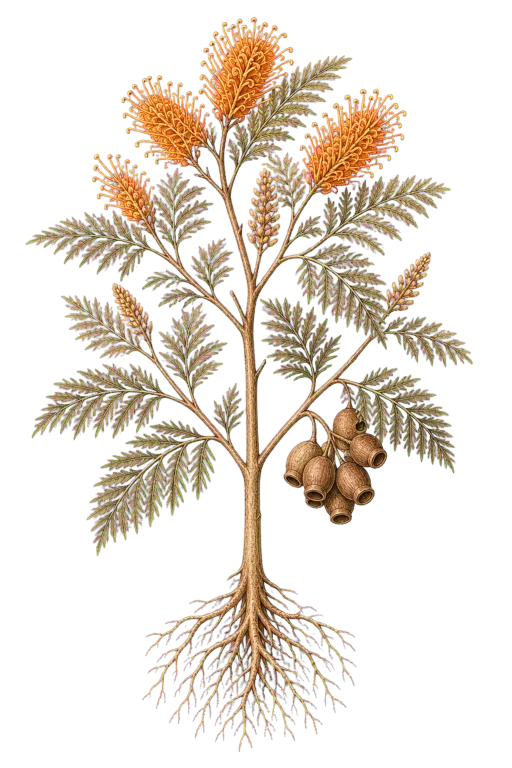
Proteaceae
Protea/Grevillea family
Rupasi belongs to the Proteaceae family.
The illustration represents the family — not necessarily this exact species.
Explore the Proteaceae familySnap it. Know it.
Point your camera at Rupasi or any plant and SASYA identifies it instantly — on-device, offline, and private.
Common plant problems
If you are starting from symptoms instead of a diagnosis, use the plant disease symptom checker to narrow the cause before treating.
All plant problem & care guides