
Darwin Silky Oak
Grevillea pteridifolia
- Habit
- Tree
- Native to
- Australia
- Flowering
- February-April
How to identify Darwin Silky Oak
Identify Darwin Silky Oak by combining habit, leaf characters, flower or fruit details, location, and its family pattern. Do not rely on one feature alone.
- Look for a tree habit.
- Check the distinctive field mark: Fern-like divided leaves, orange bottlebrush flowers.
- Confirm leaf shape: Ovate.
- Confirm leaf margin: Lobed.
- In season, compare flowering and fruiting time: February-April.
- Confirm it sits within the Proteaceae family pattern, then compare close relatives before deciding it is Darwin Silky Oak.
Plant Details
- Scientific name
- Grevillea pteridifolia
- Genus
- Grevillea
- Family
- Proteaceae
- Habit
- Tree
- Habitat
- Escape from plantations to wild
- Habitat type
- Cultivated
- Native to
- Australia
- Distribution
- Introduced in other tropics
- Flowering & fruiting
- February-April
Leaf characters
- Leaf shape
- OvaterecordedEgg-shaped, broader near the base.“Its leaves are 100–450 mm (3.9–17.7 in) long and usually pinnatisect with 13 to 29 linear or very narrowly egg-shaped lobes 150–250 mm (5.9–9.8 in) long and 1–4 mm (0.039–0.157 in)” — Wikipedia, CC BY-SA 4.0
- Leaf margin
- LobedrecordedThe edge is divided into rounded or pointed sections that don't reach the midrib.“Its leaves are 100–450 mm (3.9–17.7 in) long and usually pinnatisect with 13 to 29 linear or very narrowly egg-shaped lobes 150–250 mm (5.9–9.8 in) long and 1–4 mm (0.039–0.157 in)” — Wikipedia, CC BY-SA 4.0

Typical of the family
- Arrangement
- Alternate

Characters marked “recorded” are for Darwin Silky Oak itself; the rest are typical of the Proteaceae family.
Flower & fruit characters
- Flower symmetry
- Zygomorphic (bilaterally symmetrical)
- Inflorescence
- Solitary
- Fruit
- Grain
Typical of the Proteaceae family — flowering plants only; individual species can differ.
About Darwin Silky Oak
Darwin Silky Oak (Grevillea pteridifolia) belongs to the Proteaceae family, where it grows as a tree. It is native to Australia. It grows in escape from plantations to wild. Flowering and fruiting run from February to April.
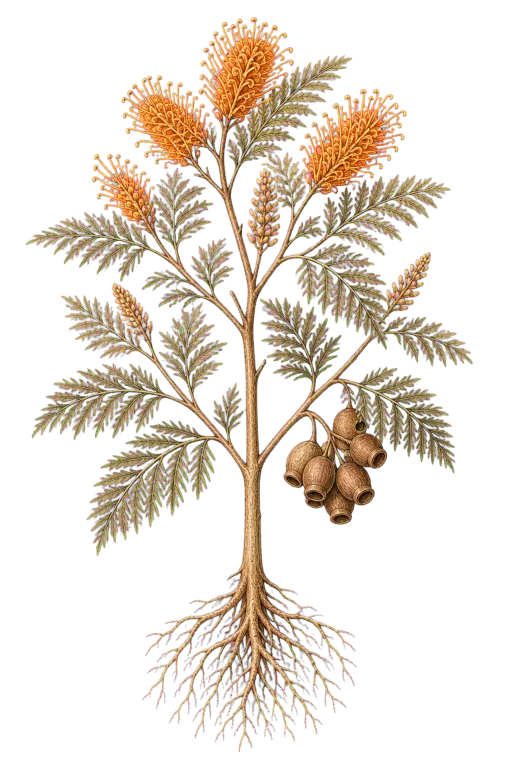
Proteaceae
Protea/Grevillea family
Darwin Silky Oak belongs to the Proteaceae family.
The illustration represents the family — not necessarily this exact species.
Explore the Proteaceae familySnap it. Know it.
Point your camera at Darwin Silky Oak or any plant and SASYA identifies it instantly — on-device, offline, and private.
Common plant problems
If you are starting from symptoms instead of a diagnosis, use the plant disease symptom checker to narrow the cause before treating.
All plant problem & care guides