Jala Khumbhi / Water Hyacinth
Eichhornia crassipes
- Habit
- Herb
- Found in India
- West Bengal, Uttar Pradesh, Tamil Nadu & more
- Flowering
- Throughout the year
How to identify Jala Khumbhi
Identify Jala Khumbhi by combining habit, leaf characters, flower or fruit details, location, and its family pattern. Do not rely on one feature alone.
- Look for a herb habit.
- Check the distinctive field mark: Free-floating with inflated bulbous leaf stalks and lavender flowers (water hyacinth).
- Confirm leaf shape: Ovate.
- Confirm flower colour: Pink.
- Confirm flower arrangement: Spike.
- In season, compare flowering and fruiting time: Throughout the year.
- In India, compare location records such as West Bengal, Uttar Pradesh, Tamil Nadu, Assam and nearby regions.
Plant Details
- Scientific name
- Eichhornia crassipes
- Genus
- Eichhornia
- Family
- Pontederiaceae
- Habit
- Herb
- Habitat
- Ponds and wet lowlands
- Habitat type
- Wetland
- Native to
- South America
- Distribution
- Naturalized in Asiatic Tropics
- Found in India
- West Bengal, Uttar Pradesh, Tamil Nadu, Assam, Himachal Pradesh, Jammu & Kashmir, Kerala, Madhya Pradesh, Meghalaya, Odisha, Punjab, Rajasthan, Sikkim, Uttarakhand
- Flowering & fruiting
- Throughout the year
- Conservation status
- Not Evaluated (NE)
Leaf characters
- Leaf shape
- OvaterecordedEgg-shaped, broader near the base.“With broad, thick, glossy, ovate leaves, water hyacinth may rise above the surface of the water as much as 1 m (3 ft) in height.” — Wikipedia, CC BY-SA 4.0
Characters marked “recorded” are for Jala Khumbhi itself; the rest are typical of the Pontederiaceae family.
Flower & fruit characters
- Flower colour
- Pinkrecorded“An erect stalk supports a single spike of 8–15 conspicuously attractive flowers, mostly lavender to pink in colour with six petals.” — Wikipedia, CC BY-SA 4.0
- Flower arrangement
- SpikerecordedFlowers arranged directly on a central stem without individual stalks.“An erect stalk supports a single spike of 8–15 conspicuously attractive flowers, mostly lavender to pink in colour with six petals.” — Wikipedia, CC BY-SA 4.0
Characters marked “recorded” are for Jala Khumbhi itself; the rest are typical of the Pontederiaceae family — flowering plants only.
Local Names
- Hindi
- जल खुंभी jala khumbhi
- Bengali
- কচুরিপানা
- Kannada
- ಐಕಾರ್ನಿಯ
- Malayalam
- കുളവാഴ, Water hyacinth
About Jala Khumbhi
Water Hyacinth (Eichhornia crassipes) is a herb in the Pontederiaceae family. In India it has been recorded in West Bengal, Uttar Pradesh, Tamil Nadu and 11 other states. It grows in ponds and wet lowlands. It flowers and fruits through much of the year.
Uses
In practice it is grown for parts that are eaten, cut for timber and furniture and stripped for fibre used in rope and matting. Parts of this plant are reported as poisonous — treat it as unsafe to eat and wash your hands after handling.
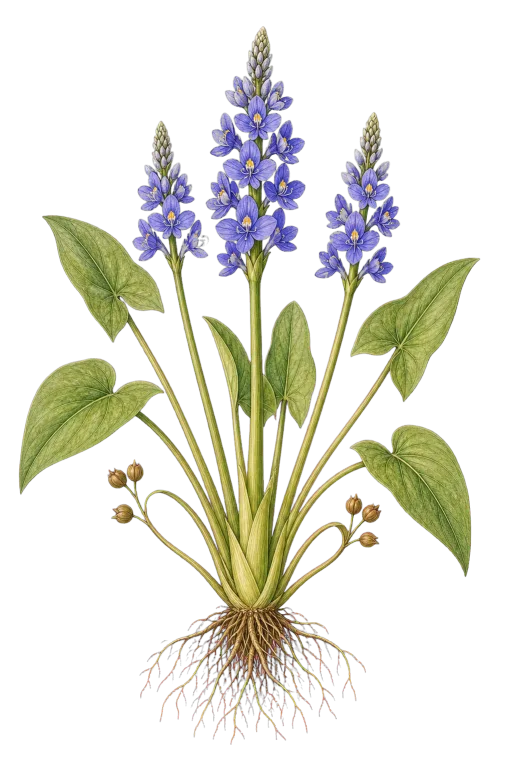
Pontederiaceae
Pickerel-Weed Family
Jala Khumbhi belongs to the Pontederiaceae family.
The illustration represents the family — not necessarily this exact species.
Explore the Pontederiaceae familySnap it. Know it.
Point your camera at Jala Khumbhi or any plant and SASYA identifies it instantly — on-device, offline, and private.
Common plant problems
If you are starting from symptoms instead of a diagnosis, use the plant disease symptom checker to narrow the cause before treating.
All plant problem & care guides