
Kundru / Ivy Gourd
Coccinia grandis
Also known as Scarlet Gourd, Tindora
- Habit
- Climber
- Found in India
- Maharashtra, Tamil Nadu, Kerala & more
- Flowering
- Throughout the year
How to identify Kundru
Identify Kundru by combining habit, leaf characters, flower or fruit details, location, and its family pattern. Do not rely on one feature alone.
- Look for a climber habit.
- Confirm leaf margin: Lobed.
- Confirm leaf surface: Glabrous.
- Confirm flower colour: White.
- In season, compare flowering and fruiting time: Throughout the year.
- In India, compare location records such as Maharashtra, Tamil Nadu, Kerala, Andhra Pradesh and nearby regions.
- Confirm it sits within the Cucurbitaceae family pattern, then compare close relatives before deciding it is Kundru.
Plant Details
- Scientific name
- Coccinia grandis
- Genus
- Coccinia
- Family
- Cucurbitaceae
- Habit
- Climber
- Habitat
- Dry deciduous forests, wasteland, also cultivated
- Habitat type
- Forest, Cultivated, Wasteland
- Distribution
- Tropical & sub-tropics of the World
- Found in India
- Maharashtra, Tamil Nadu, Kerala, Andhra Pradesh, Uttar Pradesh, West Bengal, Telangana, Gujarat, Karnataka, Uttarakhand, Rajasthan, Odisha, Assam, Delhi, Bihar, Madhya Pradesh, Haryana, Goa, Chandigarh, Punjab, Chhattisgarh, Tripura, Jharkhand, Puducherry, Daman & Diu, Himachal Pradesh, Jammu & Kashmir, Manipur
- Flowering & fruiting
- Throughout the year
- Conservation status
- Not Evaluated (NE)
Leaf characters
- Leaf margin
- LobedrecordedThe edge is divided into rounded or pointed sections that don't reach the midrib.“The leaves have 5 lobes and are 6.5–8.5 cm long and 7–8 cm wide.” — Wikipedia, CC BY-SA 4.0
- Leaf surface
- GlabrousrecordedSmooth, hairless.“This plant is a perennial climber with single tendrils and glabrous leaves.” — Wikipedia, CC BY-SA 4.0

Typical of the family
- Arrangement
- Alternate


Characters marked “recorded” are for Kundru itself; the rest are typical of the Cucurbitaceae family.
Flower & fruit characters
- Flower colour
- Whiterecorded
Typical of the family
- Flower symmetry
- Actinomorphic (radially symmetrical)
- Inflorescence
- Solitary
- Fruit
- Berry
Characters marked “recorded” are for Kundru itself; the rest are typical of the Cucurbitaceae family — flowering plants only.
Local Names
- Hindi
- कुन्द्रू Kundru, kundree, tindora, tindori
- Nepali
- गोल काँक्री Gol Kaakree, गोल काँक्री
- Bengali
- তেলাকুচা Telakucha, তেলাকুচা, কুচিলা
- Tamil
- கோவை Kovai, கொவ்வை, கோவை
- Telugu
- Donda kaya, దొండ కాయ
- Kannada
- ತೊಂಡೆ Tonde, ತೊಂಡೆಕಾಯಿ Tonde Kayi ತೊಂಡಿಕಾಯಿ Tondikay, ತೊಂಡೆ
- Malayalam
- Kova, കോവൽ
- Marathi
- तोंडली Tondli, तोंडले
- Gujarati
- ટીંડોરા
- Sinhala
- කෝවක්කා
Kundru in India
This climbing vine, known as कुन्द्रू Kundru (Hindi), கோவை Kovai (Tamil), Donda kaya (Telugu), ತೊಂಡೆ Tonde (Kannada), Kova (Malayalam), तोंडली Tondli (Marathi), is grown for its small cucumber-like fruit. Coccinia grandis is cultivated across Maharashtra, Tamil Nadu, Kerala, Andhra Pradesh, West Bengal, Uttar Pradesh, and also grows wild along hedges and fences.
Uses
Its young green fruit is cooked as a common everyday vegetable across India (kundru/tindora sabzi), and the ripe red fruit, though edible, is rarely eaten and mostly left for birds.
How to Identify Kundru
A slender climbing vine with tendrils and heart-shaped leaves. Star-shaped white flowers are followed by small, oval fruit striped pale and dark green when young, ripening to bright red as it matures.
Frequently Asked Questions
- What is Ivy Gourd called in different Indian languages?
- कुन्द्रू Kundru (Hindi); கோவை Kovai (Tamil); Donda kaya (Telugu); ತೊಂಡೆ Tonde (Kannada); Kova (Malayalam); तोंडली Tondli (Marathi); তেলাকুচা Telakucha (Bengali); ટીંડોરા (Gujarati).
- Is kundru the same as tindora?
- Yes — kundru and tindora are both common Indian names for the same vegetable, Coccinia grandis, used interchangeably in different regions.
- Can the ripe red fruit be eaten?
- Yes, technically, though it's much softer and blander than the young green fruit, so it's almost always harvested and cooked while still green.
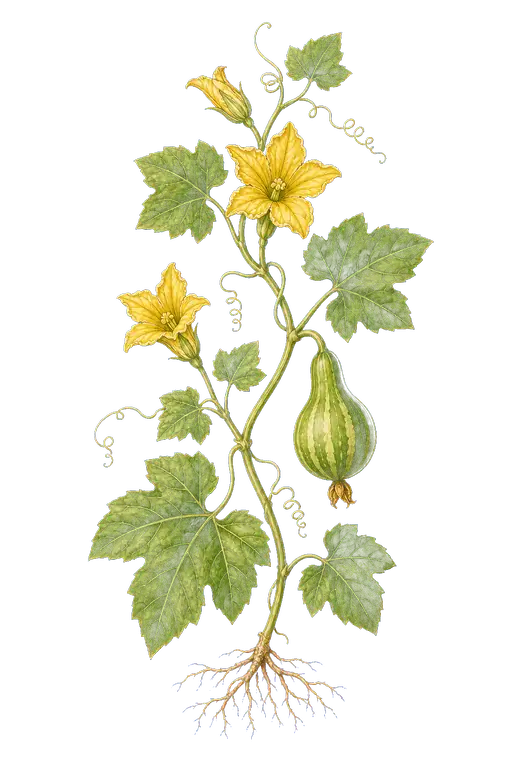
Cucurbitaceae
Cucumber/Gourd family
Kundru belongs to the Cucurbitaceae family.
The illustration represents the family — not necessarily this exact species.
Explore the Cucurbitaceae familySnap it. Know it.
Point your camera at Kundru or any plant and SASYA identifies it instantly — on-device, offline, and private.
Common plant problems
If you are starting from symptoms instead of a diagnosis, use the plant disease symptom checker to narrow the cause before treating.
All plant problem & care guidesMore in Cucurbitaceae
View all CucurbitaceaeSources: GBIF — Coccinia grandis (India distribution & vernacular names) (CC BY 4.0) · Wikipedia — Coccinia grandis (background/comprehension only) (CC BY-SA 4.0)