
Badi Indrayan / Colocynth
Citrullus colocynthis
Also known as Indian Wild Gourd, Citron, Bitter Apple, Vine Of Sodom
- Habit
- Climber
- Found in India
- Rajasthan, Tamil Nadu, Andhra Pradesh & more
- Flowering
- May-October
How to identify Badi Indrayan
Identify Badi Indrayan by combining habit, leaf characters, flower or fruit details, location, and its family pattern. Do not rely on one feature alone.
- Look for a climber habit.
- Confirm flower colour: Yellow.
- In season, compare flowering and fruiting time: May-October.
- In India, compare location records such as Rajasthan, Tamil Nadu, Andhra Pradesh, Punjab and nearby regions.
- Confirm it sits within the Cucurbitaceae family pattern, then compare close relatives before deciding it is Badi Indrayan.
Plant Details
- Scientific name
- Citrullus colocynthis
- Genus
- Citrullus
- Family
- Cucurbitaceae
- Habit
- Climber
- Habitat
- Dry deciduous forests
- Habitat type
- Forest
- Distribution
- Tropics & Sub-tropics of the North Africa, Asia; Semi-arid regions of Atlantic Islands, Afganistan, Pakistan
- Found in India
- Rajasthan, Tamil Nadu, Andhra Pradesh, Punjab, Gujarat, Madhya Pradesh, Uttarakhand
- Flowering & fruiting
- May-October
- Conservation status
- Not Evaluated (NE)
Leaf characters
- Arrangement
- Alternate



Typical of the Cucurbitaceae family — a field-mark hint, not measured for this exact species.
Flower & fruit characters
- Flower colour
- Yellowrecorded
Typical of the family
- Flower symmetry
- Actinomorphic (radially symmetrical)
- Inflorescence
- Solitary
- Fruit
- Berry
Characters marked “recorded” are for Badi Indrayan itself; the rest are typical of the Cucurbitaceae family — flowering plants only.
Local Names
- Hindi
- बड़ी इन्द्रायन Badi Indrayan, Ghorumba, इन्द्रायन Indarayan, tumba
- Bengali
- ইন্দ্রাযন Indrayan, Panjot, Indrabaruni, রাখাল শসা
- Tamil
- kumatti, pey-komatti, பேய்க்குமட்டி
- Telugu
- Chitti-papara, వెర్రి పుచ్చ, ఏటి పుచ్చ
- Kannada
- Hamekkae, Hara-mekki-kayi, ಹಿಂಡಲ Hindala
- Malayalam
- കത്തുവെല്ലരീ Kattuvellari, പേക്കുമ്മട്ടി, Bitter Cucumber plant
- Marathi
- काडु इन्द्रावनी Kadu-indravani
- Assamese
- কোৱাভাতুৰি
Badi Indrayan in India
This trailing desert vine, known as बड़ी इन्द्रायन Badi Indrayan (Hindi), kumatti (Tamil), Chitti-papara (Telugu), Hamekkae (Kannada), കത്തുവെല്ലരീ Kattuvellari (Malayalam), काडु इन्द्रावनी Kadu-indravani (Marathi), is adapted to some of India's driest regions. Citrullus colocynthis is found across Rajasthan, Tamil Nadu, Andhra Pradesh, Punjab, Gujarat, Collected from field during the rainy season. Near 16 km before Jaitsu (going from Suratgargh towards Pallu), in Ganganagar district,Rajasthan state, India. Site:014., typically in sandy or rocky desert and semi-desert ground.
Uses
Its intensely bitter fruit pulp has a long history of traditional use as a strong purgative in some folk and Ayurvedic traditions — an attributed traditional use, not a medical claim; the fruit should never be self-administered, as it can be toxic in excess.
How to Identify Badi Indrayan
A trailing, tendril-bearing vine with deeply lobed, rough leaves, similar in form to its relative the watermelon. Yellow flowers are followed by round fruit, smooth-skinned and striped or mottled green when young, drying to a hard, pale, bitter gourd as it matures.
Frequently Asked Questions
- What is Colocynth called in different Indian languages?
- बड़ी इन्द्रायन Badi Indrayan (Hindi); kumatti (Tamil); Chitti-papara (Telugu); Hamekkae (Kannada); കത്തുവെല്ലരീ Kattuvellari (Malayalam); काडु इन्द्रावनी Kadu-indravani (Marathi); ইন্দ্রাযন Indrayan (Bengali).
- Is bitter apple related to watermelon?
- Yes — it belongs to the same genus (Citrullus) as watermelon, though its fruit is intensely bitter and used very differently, never eaten as a sweet fruit.
- Is it safe to eat?
- No — the fruit pulp is intensely bitter and can be toxic in excess, so it should never be eaten casually or self-administered as a remedy.
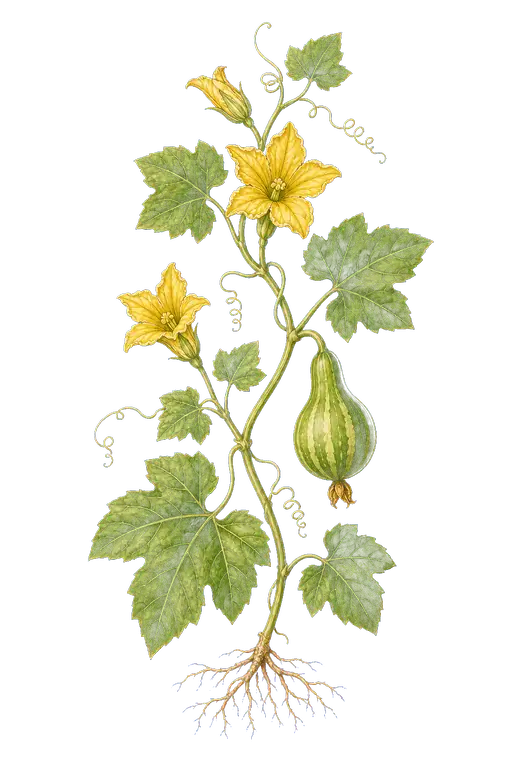
Cucurbitaceae
Cucumber/Gourd family
Badi Indrayan belongs to the Cucurbitaceae family.
The illustration represents the family — not necessarily this exact species.
Explore the Cucurbitaceae familySnap it. Know it.
Point your camera at Badi Indrayan or any plant and SASYA identifies it instantly — on-device, offline, and private.
Common plant problems
If you are starting from symptoms instead of a diagnosis, use the plant disease symptom checker to narrow the cause before treating.
All plant problem & care guidesMore in Cucurbitaceae
View all CucurbitaceaeSources: GBIF — Citrullus colocynthis (India distribution & vernacular names) (CC BY 4.0) · Wikipedia — Citrullus colocynthis (background/comprehension only) (CC BY-SA 4.0)