
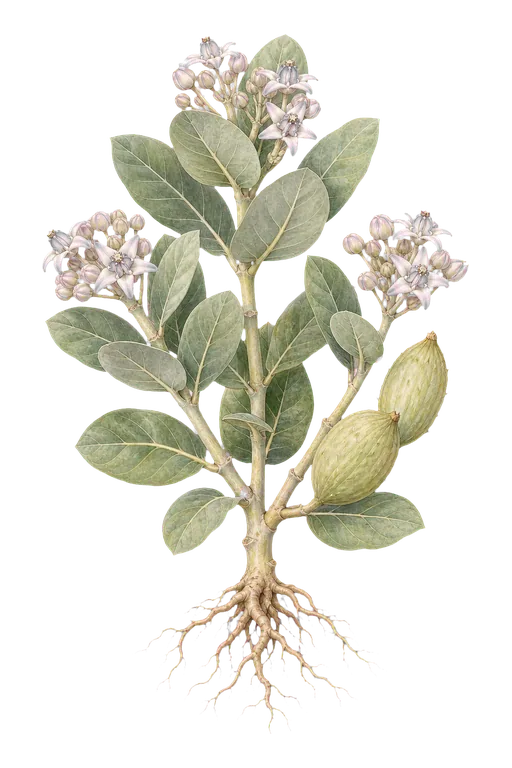
Aak / Giant Milkweed
Calotropis procera
- Habit
- Shrub
- Found in India
- Rajasthan, Maharashtra, Gujarat & more
- Flowering
- Throughout the year
How to identify Aak
Identify Aak by combining habit, leaf characters, flower or fruit details, location, and its family pattern. Do not rely on one feature alone.
- Look for a shrub habit.
- Check the distinctive field mark: Large grey-green leaves, milky latex, white-purple crown flowers.
- Confirm leaf shape: Broad oval.
- Confirm flower colour: White.
- Use the leaf pattern: opposite leaf arrangement, simple leaves, entire leaf margins, pinnate venation.
- In season, compare flowering and fruiting time: Throughout the year.
- In India, compare location records such as Rajasthan, Maharashtra, Gujarat, Uttar Pradesh and nearby regions.
Plant Details
- Scientific name
- Calotropis procera
- Genus
- Calotropis
- Family
- Asclepiadaceae
- Habit
- Shrub
- Distribution
- India, Afghanistan, Arabian peninsula to Tropical Africa
- Found in India
- Rajasthan, Maharashtra, Gujarat, Uttar Pradesh, Uttarakhand, Madhya Pradesh, Andhra Pradesh, Delhi, Bihar, Haryana, Telangana, Punjab, Karnataka, Chhattisgarh, West Bengal, Himachal Pradesh, Chandigarh, Jammu & Kashmir, Tamil Nadu, Arunachal Pradesh, Assam
- Flowering & fruiting
- Throughout the year
- Conservation status
- Not Evaluated (NE)
Leaf characters
- Leaf shape
- Broad ovalrecorded
Typical of the family
- Arrangement
- Opposite
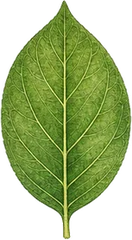


Characters marked “recorded” are for Aak itself; the rest are typical of the Asclepiadaceae family.
Flower & fruit characters
- Flower colour
- Whiterecorded
Typical of the family
- Flower symmetry
- Actinomorphic (radially symmetrical)
- Inflorescence
- Cyme
- Fruit
- Follicle
Characters marked “recorded” are for Aak itself; the rest are typical of the Asclepiadaceae family — flowering plants only.
Local Names
- Hindi
- आक Aak, मुदर Mudar, aak, akada
- Nepali
- सेतो आँक Seto Aank, बाह्रमासे आँक Bahramaase Aank, आँक Aank
- Bengali
- ছোট আকন্দ
- Tamil
- vellai erukkan, vellai erukku, வெள்ளெருக்கு
- Telugu
- తెల్ల జిల్లేడు, తెల్లజిల్లేడు, శ్వేతార్క
- Kannada
- bili aekka, bili aekkada gida, ಅರ್ಕ
- Malayalam
- erikku, erukku, ചിറ്റെരിക്ക്
- Marathi
- mandara, rui, रुई
- Sanskrit
- akund
- Gujarati
- આંકડો
Aak in India
Aak is the tough milkweed of India's hottest, driest waste ground — आक Aak (Hindi), vellai erukkan (Tamil), తెల్ల జిల్లేడు (Telugu), bili aekka (Kannada), erikku (Malayalam), mandara (Marathi). Calotropis procera is recorded across Rajasthan, Maharashtra, Gujarat, Uttar Pradesh, Uttarakhand, Madhya Pradesh, thriving where little else will grow.
Uses
Its flowers are offered to Shiva and Hanuman and strung into temple garlands, and it has many attributed folk-medicine uses. But its milky latex is a strong irritant and the plant is toxic, so any such use is traditional, never advice; the floss from its pods is used to stuff pillows.
How to Identify Aak
A stout shrub with thick, pale grey-green oval leaves coated in a waxy bloom. The waxy star-shaped flowers are white with purple-tipped lobes; it is very like its sibling C. gigantea but the flower lobes curve inward. Every cut part bleeds copious white latex.
Frequently Asked Questions
- What is Giant Milkweed called in different Indian languages?
- आक Aak (Hindi); vellai erukkan (Tamil); తెల్ల జిల్లేడు (Telugu); bili aekka (Kannada); erikku (Malayalam); mandara (Marathi); ছোট আকন্দ (Bengali); આંકડો (Gujarati); akund (Sanskrit).
- Is aak (madar) poisonous?
- Yes — its milky latex is a strong irritant and the plant is toxic if eaten, so it must be handled carefully despite its ritual and folk-medicine associations.
- How is it different from Calotropis gigantea?
- Both are 'aak/madar'; in C. procera the flower lobes curve inward and the plant is often shrubbier, while C. gigantea's flower lobes spread flatter.
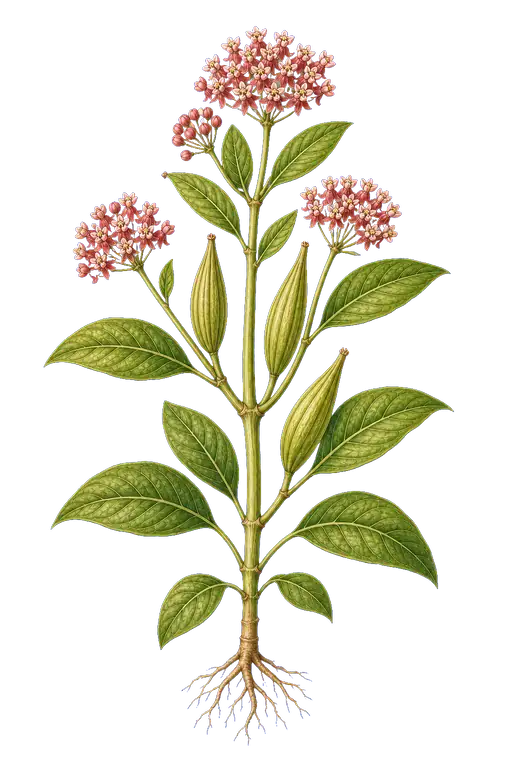
Asclepiadaceae
Milkweed Family
Aak belongs to the Asclepiadaceae family.
The illustration represents the family — not necessarily this exact species.
Explore the Asclepiadaceae familySnap it. Know it.
Point your camera at Aak or any plant and SASYA identifies it instantly — on-device, offline, and private.
Common plant problems
If you are starting from symptoms instead of a diagnosis, use the plant disease symptom checker to narrow the cause before treating.
All plant problem & care guidesMore in Asclepiadaceae
View all AsclepiadaceaeSources: GBIF — Calotropis procera (India distribution & vernacular names) (CC BY 4.0) · iNaturalist — Calotropis procera (regional names, India observations) (CC BY 4.0) · Wikipedia — Calotropis procera (background/comprehension only) (CC BY-SA 4.0)