
Kakatundi / Garden Silk-Weed
Asclepias curassavica
Also known as Blood Flower, Bastard Ipecac, Curassavian Swallow-Wort
- Habit
- Herb
- Found in India
- Karnataka, Tamil Nadu, Maharashtra & more
- Flowering
- Throughout the year
How to identify Kakatundi
Identify Kakatundi by combining habit, leaf characters, flower or fruit details, location, and its family pattern. Do not rely on one feature alone.
- Look for a herb habit.
- Check the distinctive field mark: Orange-and-yellow flowers, milky latex sap (blood flower).
- Confirm leaf shape: Lanceolate.
- Confirm flower colour: Orange/red.
- Confirm flower arrangement: Cyme.
- In season, compare flowering and fruiting time: Throughout the year.
- In India, compare location records such as Karnataka, Tamil Nadu, Maharashtra, Kerala and nearby regions.
Plant Details
- Scientific name
- Asclepias curassavica
- Genus
- Asclepias
- Family
- Asclepiadaceae
- Habit
- Herb
- Habitat
- Cultivated and wild
- Habitat type
- Cultivated
- Native to
- Tropical America
- Distribution
- Naturalized in tropics
- Found in India
- Karnataka, Tamil Nadu, Maharashtra, Kerala, Uttarakhand, Telangana, Mizoram, Andhra Pradesh, Goa, Gujarat, Madhya Pradesh, Haryana, Arunachal Pradesh, Assam, Chhattisgarh, Himachal Pradesh, Rajasthan, Delhi, Jammu & Kashmir, Meghalaya, Nagaland, Uttar Pradesh, West Bengal
- Flowering & fruiting
- Throughout the year
- Conservation status
- Not Evaluated (NE)
Leaf characters
- Leaf shape
- LanceolaterecordedLong and narrow, tapering to a point, like a lance head.“The leaves are arranged oppositely on the stems and are lanceolate or oblong-lanceolate shaped ending in acuminate or acute tips.” — Wikipedia, CC BY-SA 4.0
Typical of the family
- Arrangement
- Opposite



Characters marked “recorded” are for Kakatundi itself; the rest are typical of the Asclepiadaceae family.
Flower & fruit characters
- Flower colour
- Orange/redrecorded
- Flower arrangement
- CymerecordedA branched cluster where the central/terminal flower opens first.“The flowers are in cymes with 10-20 flowers each.” — Wikipedia, CC BY-SA 4.0
- Fruit type
- FolliclerecordedA dry pod that splits open along a single seam.“The 5–10 cm (2.0–3.9 in) long, fusiform shaped fruits are called follicles.” — Wikipedia, CC BY-SA 4.0
Typical of the family
- Flower symmetry
- Actinomorphic (radially symmetrical)
- Inflorescence
- Cyme
- Fruit
- Follicle
Characters marked “recorded” are for Kakatundi itself; the rest are typical of the Asclepiadaceae family — flowering plants only.
Local Names
- Hindi
- काकाटुन्डी Kakatundi
- Bengali
- মরিচা ফুল, ইপিকাক, লাল মুন্ডি
- Telugu
- జిల్లేడు మందార
- Kannada
- ಕಾಕತುಂಡಿ Kakatundi
- Malayalam
- ചെമ്മുള്ളി
- Marathi
- पिवला चित्रक Pivla chitrak, Halad kunku
Kakatundi in India
This milkweed, known as काकाटुन्डी Kakatundi (Hindi), జిల్లేడు మందార (Telugu), ಕಾಕತುಂಡಿ Kakatundi (Kannada), ചെമ്മുള്ളി (Malayalam), पिवला चित्रक Pivla chitrak (Marathi), মরিচা ফুল (Bengali), is grown ornamentally and valued as a host plant for butterflies. Asclepias curassavica is grown across Karnataka, Tamil Nadu, Maharashtra, Kerala, Uttarakhand, Telangana, both cultivated and naturalised in gardens and waste ground.
Uses
It's grown as an ornamental for its striking red-orange flowers, and widely valued in butterfly gardening as a food source for monarch and other milkweed-dependent butterfly caterpillars.
How to Identify Kakatundi
A shrubby perennial herb with narrow, lance-shaped leaves and milky sap when cut. Clusters of small flowers have a distinctive two-tone colouring — red-orange petals below a contrasting yellow-orange crown — followed by narrow, spindle-shaped seed pods that split to release silky-tufted seeds.
Frequently Asked Questions
- What is Garden Silk-Weed called in different Indian languages?
- काकाटुन्डी Kakatundi (Hindi); జిల్లేడు మందార (Telugu); ಕಾಕತುಂಡಿ Kakatundi (Kannada); ചെമ്മുള്ളി (Malayalam); पिवला चित्रक Pivla chitrak (Marathi); মরিচা ফুল (Bengali).
- Is it safe to touch?
- The milky sap can irritate skin and eyes on contact and is toxic if ingested, so it's best handled with care, though it's commonly grown in gardens without issue when treated sensibly.
- Why is it popular with butterfly gardeners?
- Its leaves are a food source for monarch and related milkweed butterfly caterpillars, making it a popular deliberate addition to pollinator and butterfly gardens.
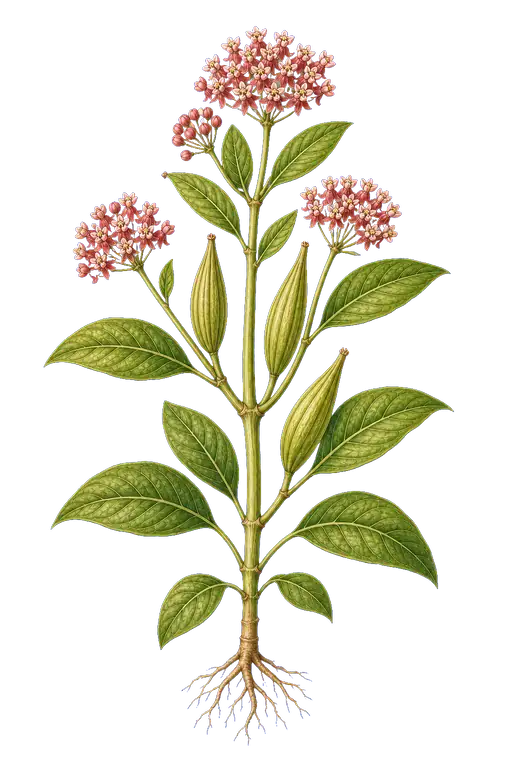
Asclepiadaceae
Milkweed Family
Kakatundi belongs to the Asclepiadaceae family.
The illustration represents the family — not necessarily this exact species.
Explore the Asclepiadaceae familySnap it. Know it.
Point your camera at Kakatundi or any plant and SASYA identifies it instantly — on-device, offline, and private.
Common plant problems
If you are starting from symptoms instead of a diagnosis, use the plant disease symptom checker to narrow the cause before treating.
All plant problem & care guidesMore in Asclepiadaceae
View all AsclepiadaceaeSources: GBIF — Asclepias curassavica (India distribution & vernacular names) (CC BY 4.0) · Wikipedia — Asclepias curassavica (background/comprehension only) (CC BY-SA 4.0)