
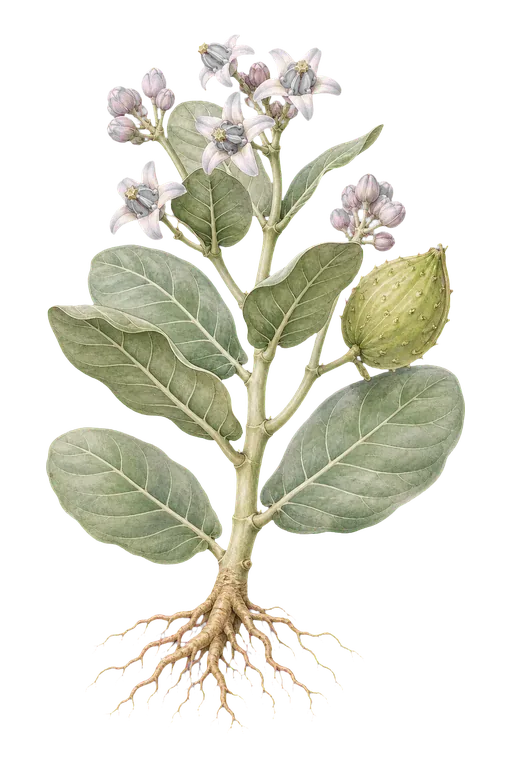
Madar / Giant Milk-Weed
Calotropis gigantea
Also known as Giant Swallow Wort Madar Plant, Bowstring Hemp, Crown Flower, Giant Calotrope
- Habit
- Tree
- Found in India
- Tamil Nadu, Andhra Pradesh, Maharashtra & more
- Flowering
- Throughout the year
How to identify Madar
Identify Madar by combining habit, leaf characters, flower or fruit details, location, and its family pattern. Do not rely on one feature alone.
- Look for a tree habit.
- Check the distinctive field mark: Large grey-green leaves, milky latex, crown-shaped purple flowers.
- Confirm leaf shape: Broad oval.
- Confirm flower colour: White.
- Confirm flower arrangement: Umbel.
- Use the leaf pattern: opposite leaf arrangement, simple leaves, entire leaf margins, pinnate venation.
- In season, compare flowering and fruiting time: Throughout the year.
Plant Details
- Scientific name
- Calotropis gigantea
- Genus
- Calotropis
- Family
- Asclepiadaceae
- Habit
- Tree
- Distribution
- India, Sri Lanka, Tropical Himalayas, Malaysia, S. China, Pakistan, Maldives
- Found in India
- Tamil Nadu, Andhra Pradesh, Maharashtra, Karnataka, Telangana, Kerala, Uttarakhand, West Bengal, Odisha, Goa, Gujarat, Uttar Pradesh, Chhattisgarh, Assam, Madhya Pradesh, Bihar, Rajasthan, Jharkhand, Puducherry, Haryana, Tripura, Delhi, Arunachal Pradesh, Lakshadweep, Chandigarh, Punjab, Dadra & Nagar Haveli, Himachal Pradesh
- Flowering & fruiting
- Throughout the year
- Conservation status
- Not Evaluated (NE)
Leaf characters
- Leaf shape
- Broad ovalrecorded
Typical of the family
- Arrangement
- Opposite



Characters marked “recorded” are for Madar itself; the rest are typical of the Asclepiadaceae family.
Flower & fruit characters
- Flower colour
- Whiterecorded“Flower-buds ovoid, angled, Calyx lobes 5, divided to the base, white, ovate;” — Wikipedia, CC BY-SA 4.0
- Flower arrangement
- UmbelrecordedFlower stalks all radiate from a single point, like umbrella ribs.“Inflorescence : Umbellate cymes.” — Wikipedia, CC BY-SA 4.0
- Fruit type
- FolliclerecordedA dry pod that splits open along a single seam.“Fruit : A pair of follicles with many, hairy seeds.” — Wikipedia, CC BY-SA 4.0
Typical of the family
- Flower symmetry
- Actinomorphic (radially symmetrical)
- Inflorescence
- Cyme
- Fruit
- Follicle
Characters marked “recorded” are for Madar itself; the rest are typical of the Asclepiadaceae family — flowering plants only.
Local Names
- Hindi
- Safed aak सफ़ैद आक, madar,अर्क ark,मदार madar
- Nepali
- आंक Aank, अर्क Ark, मदार Madaar
- Tamil
- எருக்கு Erukku, ஏருக்கு
- Telugu
- జిల్లేడి పువ్వు Jilledi Puvvu, జిల్లేడు
- Kannada
- Yekke gida, Ekke gida ಎಕ್ಕೆ ಗಿಡ Ekka ಎಕ್ಕ, ಎಕ
- Malayalam
- എരുക്ക്
- Marathi
- मंदार
- Gujarati
- આંકડો
- Punjabi
- ਅਕ
- Urdu
- اک
- Sinhala
- වරා
Madar in India
Aak or madar is a hardy shrub of dry wasteland and roadsides across India — Safed aak सफ़ैद आक (Hindi), எருக்கு Erukku (Tamil), జిల్లేడి పువ్వు Jilledi Puvvu (Telugu), Yekke gida (Kannada), എരുക്ക് (Malayalam), मंदार (Marathi). Calotropis gigantea is recorded across Tamil Nadu, Andhra Pradesh, Maharashtra, Karnataka, Telangana, Kerala, thriving on the most neglected, sun-baked ground.
Uses
Its flowers are offered to Shiva and Hanuman and are strung into garlands at certain temples. The plant has many attributed uses in folk medicine, but its milky sap is an irritant and the plant is toxic, so any such use is traditional and not advice.
How to Identify Madar
A stout shrub with thick, pale grey-green oval leaves coated in a fine waxy bloom. The waxy, star-shaped flowers are dusty white to lilac with a distinctive central crown. Every broken part bleeds copious white latex, and the inflated pods split to release silky-tufted seeds.
Frequently Asked Questions
- What is Giant Milk-Weed called in different Indian languages?
- Safed aak सफ़ैद आक (Hindi); எருக்கு Erukku (Tamil); జిల్లేడి పువ్వు Jilledi Puvvu (Telugu); Yekke gida (Kannada); എരുക്ക് (Malayalam); मंदार (Marathi); આંકડો (Gujarati); ਅਕ (Punjabi).
- Is aak (madar) poisonous?
- Yes — the milky latex is irritant and the plant is toxic if eaten, so it should be handled with care despite its ritual and traditional-medicine associations.
- Why is aak offered to Lord Shiva?
- Aak flowers and leaves are traditional offerings to Shiva and Hanuman in many parts of India, and the plant is commonly found growing near temples on open ground.
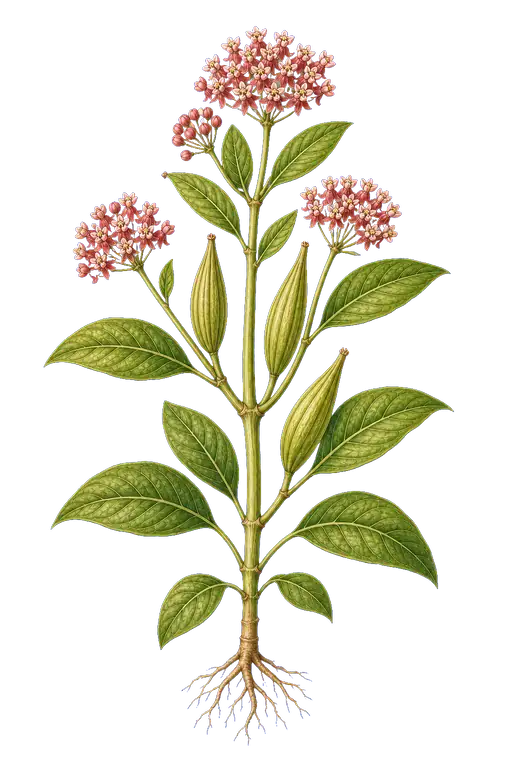
Asclepiadaceae
Milkweed Family
Madar belongs to the Asclepiadaceae family.
The illustration represents the family — not necessarily this exact species.
Explore the Asclepiadaceae familySnap it. Know it.
Point your camera at Madar or any plant and SASYA identifies it instantly — on-device, offline, and private.
Common plant problems
If you are starting from symptoms instead of a diagnosis, use the plant disease symptom checker to narrow the cause before treating.
All plant problem & care guidesMore in Asclepiadaceae
View all AsclepiadaceaeSources: GBIF — Calotropis gigantea (India distribution & vernacular names) (CC BY 4.0) · iNaturalist — Calotropis gigantea (regional names, India observations) (CC BY 4.0) · Wikipedia — Calotropis gigantea (background/comprehension only) (CC BY-SA 4.0)