
Kankra / Orange Mangrove
Bruguiera gymnorrhiza
- Habit
- Tree
- Found in India
- Kerala, West Bengal, Goa & more
- Flowering
- March-October
How to identify Kankra
Identify Kankra by combining habit, leaf characters, flower or fruit details, location, and its family pattern. Do not rely on one feature alone.
- Look for a tree habit.
- Check the distinctive field mark: Orange flowers, knee roots, mangrove tree.
- Confirm leaf shape: Elliptic.
- Confirm flower arrangement: Solitary.
- In season, compare flowering and fruiting time: March-October.
- In India, compare location records such as Kerala, West Bengal, Goa, Maharashtra and nearby regions.
- Confirm it sits within the Rhizophoraceae family pattern, then compare close relatives before deciding it is Kankra.
Plant Details
- Scientific name
- Bruguiera gymnorrhiza
- Genus
- Bruguiera
- Family
- Rhizophoraceae
- Habit
- Tree
- Habitat
- Tidal forests
- Distribution
- India, SE. Asia, Africa, Madagascar, Papua New Guinea, Australia
- Found in India
- Kerala, West Bengal, Goa, Maharashtra, Andaman & Nicobar Islands, Andhra Pradesh, Odisha, Tamil Nadu
- Flowering & fruiting
- March-October
- Conservation status
- Not Evaluated (NE)
Leaf characters
- Leaf shape
- EllipticrecordedWidest at the middle, tapering evenly at both ends.“The green elliptic leaves are 5–15 cm long.” — Wikipedia, CC BY-SA 4.0
Characters marked “recorded” are for Kankra itself; the rest are typical of the Rhizophoraceae family.
Flower & fruit characters
- Flower arrangement
- SolitaryrecordedA single flower borne alone, not in a cluster.“Flowers are solitary, with white or cream petals, that soon turn brown up to 1.5 cm long, pinkish-green to reddish brown calyx.” — Wikipedia, CC BY-SA 4.0
Characters marked “recorded” are for Kankra itself; the rest are typical of the Rhizophoraceae family — flowering plants only.
Local Names
- Bengali
- kankra
About Kankra
Orange mangrove (Bruguiera gymnorrhiza) belongs to the Rhizophoraceae family, where it grows as a tree. In India it has been recorded in Kerala, West Bengal, Goa and 5 other states. It grows in tidal forests. Flowering and fruiting run from March to October.
Uses
Locally it is grown for parts that are eaten, long used in traditional medicine and cut for timber and furniture. Those medicinal uses are traditional attributions, not medical advice. Parts of this plant are reported as poisonous — treat it as unsafe to eat and wash your hands after handling.
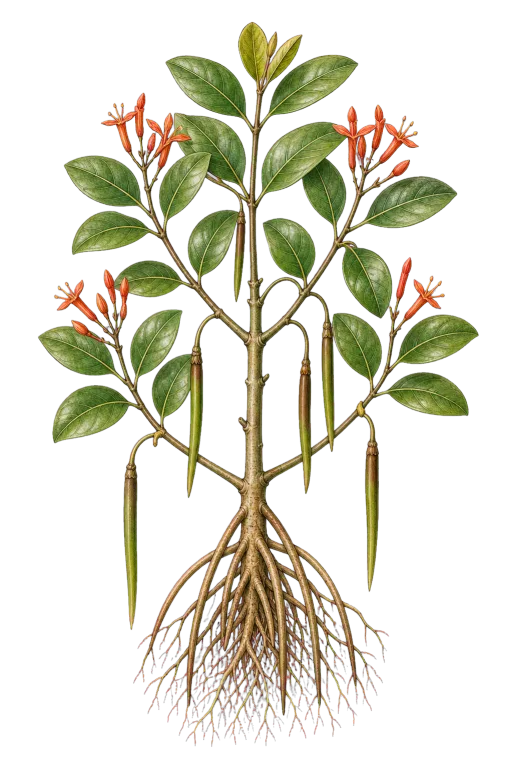
Rhizophoraceae
Mangrove Family
Kankra belongs to the Rhizophoraceae family.
The illustration represents the family — not necessarily this exact species.
Explore the Rhizophoraceae familySnap it. Know it.
Point your camera at Kankra or any plant and SASYA identifies it instantly — on-device, offline, and private.
Common plant problems
If you are starting from symptoms instead of a diagnosis, use the plant disease symptom checker to narrow the cause before treating.
All plant problem & care guides