
Ijjul / Seaside Indian Oak
Barringtonia racemosa
Also known as Fish-Killer Tree, Freshwater Mangrove, Putat Kampung
- Habit
- Tree
- Found in India
- Kerala, Andaman & Nicobar Islands, West Bengal & more
- Flowering
- April-October
How to identify Ijjul
Identify Ijjul by combining habit, leaf characters, flower or fruit details, location, and its family pattern. Do not rely on one feature alone.
- Look for a tree habit.
- Check the distinctive field mark: Long hanging flower racemes, grows near water.
- Confirm flower colour: White.
- In season, compare flowering and fruiting time: April-October.
- In India, compare location records such as Kerala, Andaman & Nicobar Islands, West Bengal, Tamil Nadu.
- Confirm it sits within the Lecythidaceae family pattern, then compare close relatives before deciding it is Ijjul.
Plant Details
- Scientific name
- Barringtonia racemosa
- Genus
- Barringtonia
- Family
- Lecythidaceae
- Habit
- Tree
- Habitat
- Along banks of backwaters and mangrove forests
- Distribution
- Indo-Malesia to Polynesia
- Found in India
- Kerala, Andaman & Nicobar Islands, West Bengal, Tamil Nadu
- Flowering & fruiting
- April-October
- Conservation status
- Not Evaluated (NE)
Flower & fruit characters
- Flower colour
- Whiterecorded
Characters marked “recorded” are for Ijjul itself; the rest are typical of the Lecythidaceae family — flowering plants only.
Local Names
- Hindi
- Ijjul, Norvisnee
- Bengali
- সমুদ্রফল samudraphal, kunda, সমুন্দরফল
- Tamil
- arattam, isudaru, isuvaradaru
- Telugu
- కనప, కనపచెట్టు, సముద్రపండు
- Kannada
- ಗಣಿಗಲತೋರ Ganigalatora, kanaginatora, kempuganigilu
- Malayalam
- katampu, samstaravati, samstravadi
- Marathi
- nivar, sadphali
Ijjul in India
This tree, known as Ijjul (Hindi), arattam (Tamil), కనప (Telugu), ಗಣಿಗಲತೋರ Ganigalatora (Kannada), katampu (Malayalam), nivar (Marathi), is typically found close to water. Barringtonia racemosa is found across , typically along riverbanks, swamps and coastal freshwater wetlands.
Uses
Its wood has been used locally for construction, and various parts of the plant have a history of traditional folk use in some coastal communities — an attributed traditional use, not a medical claim.
How to Identify Ijjul
A tree with large, glossy, broad leaves clustered near the branch tips. Its most distinctive feature is a long, trailing, drooping flower spike, sometimes over a metre long, with pink-white flowers that open at night, followed by angular, fibrous-husked fruit.
Frequently Asked Questions
- What is Seaside Indian oak called in different Indian languages?
- Ijjul (Hindi); arattam (Tamil); కనప (Telugu); ಗಣಿಗಲತೋರ Ganigalatora (Kannada); katampu (Malayalam); nivar (Marathi); সমুদ্রফল samudraphal (Bengali).
- Why is it called a 'freshwater mangrove'?
- Like true coastal mangroves, it's adapted to grow in waterlogged, often flooded ground, but typically in freshwater or brackish wetlands rather than full seawater.
- Why are the flower spikes so long?
- Its drooping, elongated flower spikes maximise the number of night-opening flowers offered to pollinators like moths and bats along a single stalk.
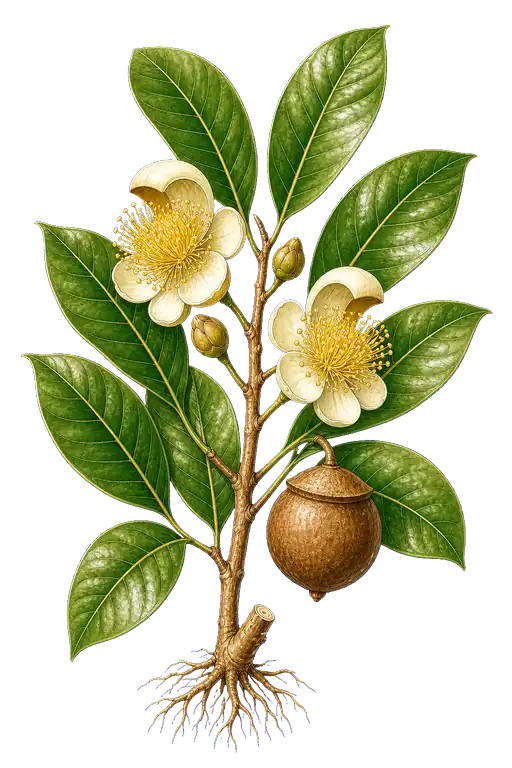
Lecythidaceae
Lecythis Or Brasil Nut Family
Ijjul belongs to the Lecythidaceae family.
The illustration represents the family — not necessarily this exact species.
Explore the Lecythidaceae familySnap it. Know it.
Point your camera at Ijjul or any plant and SASYA identifies it instantly — on-device, offline, and private.
Common plant problems
If you are starting from symptoms instead of a diagnosis, use the plant disease symptom checker to narrow the cause before treating.
All plant problem & care guidesMore in Lecythidaceae
View all LecythidaceaeSources: GBIF — Barringtonia racemosa (India distribution & vernacular names) (CC BY 4.0) · Wikipedia — Barringtonia racemosa (background/comprehension only) (CC BY-SA 4.0)