Lecythidaceae family
Lecythis Or Brasil Nut Family
6 catalogue species · Order Ericales
The Lecythidaceae family (Lecythis Or Brasil Nut Family) is a botanical family placed in the order Ericales. In the SASYA catalogue it spans 6 species across 4 genera. Its members are predominantly trees. Well-represented genera include Barringtonia, Careya and Couroupita. Several members are valued in traditional medicine. Familiar examples include Indian Oak Tree, Fish Poison Tree and Seaside Indian oak.
Explore the species roster ↓Field identification keys
Compare several features together. These are typical family patterns; individual species can vary. Observe without tasting or handling unfamiliar plants.
- Stem cross-section
- Round
- Distinctive marker
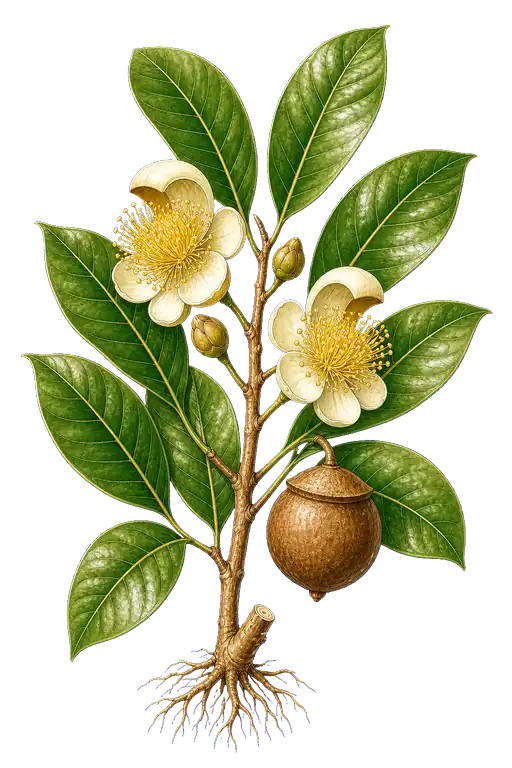
- Stamens fuse into a hood or ring arching over the flower's centre; woody fruit often opens through a lid-like operculum.
Familiar members: Nagalinga · Samundra Phal · Kumbhi · Ijjul · Stink Wood
Species in Lecythidaceae
6 of 6 species
Native status is regional. Range tags distinguish Kew WCVP dataset matches from individual reviews. Pet-filter records report no known toxicity to cats and dogs; some sources cover a genus or cultivar. Review the source context. Missing values are excluded, and no rating establishes suitability to eat or freedom from other hazards.
| Botanical name | Common & regional names | Origin & reviewed pet status |
|---|---|---|
| Couroupita guianensis | Nagalinga Cannon-ball Tree
+4 languages
| Introduced: India ↗︎ Kew datasetKew WCVP dataset; accepted-name match. Dataset matching is separate from an individual regional review. Recorded worldwide native range: Panama to S. Trop. America. |
| Barringtonia acutangula | Samundra Phal Indian Oak Tree / Small Indain oak
+4 languages
| Native: Assam, India ↗︎ Kew datasetKew WCVP dataset; accepted-name match. Dataset matching is separate from an individual regional review. Recorded worldwide native range: Afghanistan to N. Australia. |
| Careya arborea | Kumbhi Ceylon Oak Tree / Wild Guava / Kumbi Tree / Patana oak / Slow match tree / Wild guava
+4 languages
| Native: Andaman Is., Assam, India ↗︎ Kew datasetKew WCVP dataset; accepted-name match. Dataset matching is separate from an individual regional review. Recorded worldwide native range: Afghanistan to NW. Pen. Malaysia. |
| Barringtonia racemosa | Ijjul Seaside Indian oak / Fish-killer tree / Freshwater mangrove / Putat Kampung
+4 languages
| Native: Andaman Is., India, Nicobar Is. ↗︎ Kew datasetKew WCVP dataset; accepted-name match. Dataset matching is separate from an individual regional review. Recorded worldwide native range: Kenya to KwaZulu-Natal and W. Pacific. |
| Gustavia augusta | Stink Wood | Not listed native: India ↗︎ Kew datasetKew WCVP dataset; accepted-name match. Dataset matching is separate from an individual regional review. Recorded worldwide native range: S. Trop. America. Not listed native does not establish introduction or absence from India. |
| Barringtonia asiatica | Barringtonia Speciosa Fish Poison Tree
| Native: Andaman Is., India, Nicobar Is. ↗︎ Kew datasetKew WCVP dataset; accepted-name match. Dataset matching is separate from an individual regional review. Recorded worldwide native range: NE. Tanzania (incl. Pemba, Zanzibar), Indian Ocean to Pacific. |
Large, often leathery alternate leaves on trees with a showy ring or hood of stamens curving over the flower's centre like a hinged lid; the woody fruit, as in the true Brazil nut, opens through a cap-like lid (operculum) to release its seeds.
The stamens fuse at their base into a hood that arches over the flower — a structure so distinctive it alone can place a tree in this family from a single fallen flower.
Which Lecythidaceae species is this?
Answer what you can see and narrow it down to a single Lecythidaceae species.
To check whether a plant belongs to Lecythidaceae, compare the leaf arrangement, leaf type, flower symmetry, fruit type, and one distinctive marker together. A single feature can mislead; the family pattern is the combination.
Learn the full family-identification methodFamilies that can look similar
Balsaminaceae
Compare against Balsaminaceae when the plant shares similar leaves, flowers, or fruit. Confirm by checking the full family pattern.
Compare BalsaminaceaeEbenaceae
Compare against Ebenaceae when the plant shares similar leaves, flowers, or fruit. Confirm by checking the full family pattern.
Compare EbenaceaeSapotaceae
Compare against Sapotaceae when the plant shares similar leaves, flowers, or fruit. Confirm by checking the full family pattern.
Compare SapotaceaeMyrsinaceae
Compare against Myrsinaceae when the plant shares similar leaves, flowers, or fruit. Confirm by checking the full family pattern.
Compare MyrsinaceaeMeet Lecythidaceae in the field
Point your camera, explore possible matches and compare the field marks. Identification runs on your phone, offline and private.
Download SASYA — Free